

The rosy apple aphid (Dysaphis plantaginea) is one of the most feared pests of apple trees, together with codling moth. If not promptly controlled, this aphid can cause serious damage to apple trees. In this technical sheet, we will analyze how to control this insect using organic pest management. At the end of the article, you will find a list of insecticides and natural remedies to combat the rosy apple aphid.
Identification and damage of the rosy apple aphid
This aphid lives in colonies on the underside of leaves and on young shoots. These young tissues, rich in water and nutrients and not yet lignified, represent the optimal substrate for the growth of this insect. With its piercing-sucking mouthparts, it easily penetrates these tissues to feed.
It causes considerable damage and also attacks flowers and fruitlets during fruit set (fruit development immediately after flowering). The rosy apple aphid is one of the most harmful apple pests, together with codling moth.
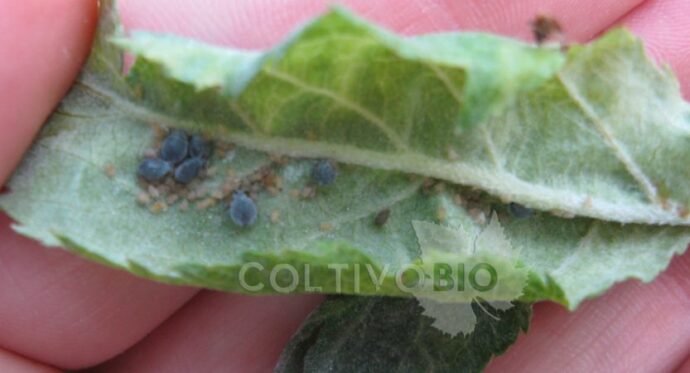
Adult aphids reach approximately 2–3 mm in length, are greyish to purplish in color, and are covered with a waxy layer that gives them a powdery appearance. Juvenile stages are smaller than adults and lighter in color, often pinkish (see Figure 1).
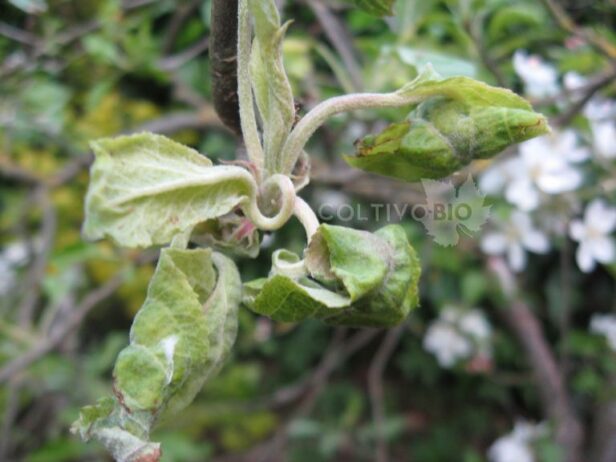
Damage is caused by feeding activity on leaves. The piercing action results in yellowing and severe leaf curling (see Figure 2), while shoots show stunted growth and deformation. On flowers, it can cause abortion. On fruitlets, it may lead to fruit drop and, in any case, causes deformation and reduced growth, resulting in unmarketable or downgraded fruit.
Indirect damage follows due to the production of honeydew, which causes suffocation of plant tissues and promotes the development of sooty mold (saprophytic fungi that grow on honeydew).
Biological cycle
The rosy apple aphid completes its life cycle on two different host plants (dioecious cycle). The primary host is apple, while the secondary host consists of plants of the genus Plantago.
The egg is the overwintering stage. It is black in color and laid near buds or in bark crevices. Around March–April, the eggs hatch, giving rise to parthenogenetic founding females (reproducing without fertilization). These produce a variable number (3–5) of generations.
Nymphs (post-embryonic stages differing from adults) are born directly from the founding females. The attack on shoots continues throughout June and, in some cases, into July.
During summer, winged migrants develop and move to the secondary host, where they produce several parthenogenetic generations. Between late summer and early autumn, sexuparae are produced on the secondary host. These return to apple trees and give rise to sexual forms (males and females). After mating, females lay overwintering eggs on the branches.
Be careful not to confuse the rosy apple aphid with the green apple aphid, which also attacks apple trees but is much less harmful and easier to control.
Organic control of the rosy apple aphid and natural remedies
Due to the numerous generations and rapid reproduction rate of these aphids, prompt intervention is necessary. Treatments should be applied at relatively low damage thresholds because even small populations can cause significant damage.
Control measures include products based on azadirachtin, often combined with horticultural oil insecticide. The latter should also be applied in winter to target and kill overwintering eggs.
The use of pyrethrum is not recommended because the aphids are protected inside curled leaves, where they are sheltered. Using pyrethrum risks killing only beneficial insects while being ineffective against the target pest.
Natural enemies are numerous:
- Lady beetles (Coccinellidae)
- Lacewings (Chrysopidae)
- Hoverflies (Syrphidae)
- Gall midges (Cecidomyiidae)
- Parasitic wasps
- Predatory mites of the genus Allothrombium
Many of these beneficial insects are mass-reared and commercially available for field release.
Certain agronomic practices can help reduce pest populations while preserving natural enemies. Practices aimed at maintaining agroecosystem complexity are beneficial—for example, ground cover management and the presence of hedgerows that provide shelter for natural antagonists are excellent natural remedies.
Avoid excessive nitrogen fertilization and over-irrigation, as excessive vegetative growth favors aphid development.