

Soil solarization is a nonchemical soil disinfestation technique that uses solar energy to raise soil temperature and reduce harmful organisms.
It can help suppress plant-parasitic nematodes, soilborne fungi, some insect pests, weed seeds, and young weeds. It is particularly useful in fields affected by root-knot nematodes, recurring root diseases, or soil fatigue.
Solarization does not completely sterilize the soil. Its effect is strongest in the upper layers and decreases with depth.
How soil solarization works
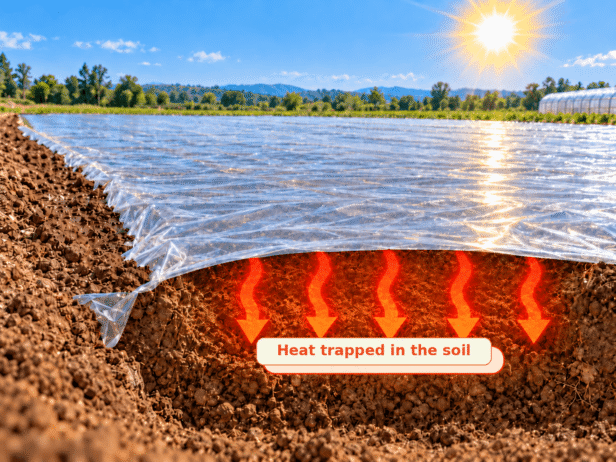
The soil is thoroughly irrigated and covered with clear plastic during the hottest and sunniest part of the year.
Solar radiation passes through the transparent film and heats the soil underneath. The plastic reduces heat loss and allows temperatures to rise enough to damage many soilborne pests and pathogens.
In warm climates, the plastic is usually left in place for about 6 to 8 weeks. UC IPM reports that soil temperatures near the surface can reach about 140°F (60°C) under favorable conditions.
Soil moisture is essential
Solarization works best when the soil is moist.
Before covering the field, irrigate deeply enough to wet the soil profile you want to treat. Moist soil transfers heat more efficiently and can make many soilborne organisms more sensitive to high temperatures.
Solarizing dry soil can greatly reduce the effectiveness of the treatment.
How to solarize soil
The basic procedure is simple:
- Remove or finely chop existing vegetation.
- Cultivate and level the soil.
- Incorporate organic amendments or plant material if desired.
- Irrigate thoroughly.
- Cover the entire soil surface with clear polyethylene film.
- Stretch the plastic tightly and bury or secure the edges.
- Leave it in place during the hottest and sunniest period.
The closer the plastic is to the soil surface, the more efficiently heat is transferred.
For larger areas, UV-stabilized clear polyethylene is often preferred. Whenever practical, choose a durable film that can be recovered and reused.
Soil solarization in the United States
Soil solarization has been studied and used for decades in the United States, especially in regions with hot summers and strong solar radiation.
California is one of the main areas where the technique has been researched, particularly in the Central Valley and desert valleys. Florida also uses solarization as part of integrated programs for soilborne pests and root-knot nematodes.
The technique can be used in open fields, gardens, nurseries, greenhouses, and high tunnels.
In cooler or cloudy regions, treatment may need to last longer and results may be less consistent.
Solarization against nematodes
Solarization can reduce plant-parasitic nematodes, including root-knot nematodes such as Meloidogyne spp.
High temperatures affect eggs, juveniles, and other stages present in the upper soil layers.
The main limitation is depth. Some nematodes can survive deeper in the soil and later recolonize the root zone.
For severe infestations, solarization works best as part of an integrated strategy that includes crop rotation, resistant crops, organic amendments, and biofumigation.
Combining solarization with Brassica crops
Solarization can be strengthened by combining it with biofumigation.
Mustard, radish, broccoli, and other Brassicaceae can be grown as cover crops, finely chopped, and rapidly incorporated into the soil.
These plants contain glucosinolates that can produce biologically active compounds, including isothiocyanates, after the plant tissues are disrupted.
For best results, finely chop the biomass, incorporate it quickly, irrigate the soil, and cover it immediately with plastic.
Organic matter and biosolarization
Organic amendments can also be incorporated before solarization.
Compost, crop residues, green manure, and agricultural by-products can stimulate intense microbial activity while the soil is heated.
This combination is commonly called biosolarization.
This approach combines high soil temperature with microbial activity and decomposition products that can contribute to pest suppression.
Neem, garlic, and other amendments
Plant-derived amendments can also be incorporated before solarization.
Neem seed meal or neem-based pellets have been studied for their effects on plant-parasitic nematodes. Commercial products containing garlic extracts or other botanicals may also be available.
Effectiveness depends on the formulation, rate, soil conditions, and target pest. Always follow the product label and local regulations.
Calcium cyanamide
In conventional production systems, calcium cyanamide may also be considered where its use is permitted.
It is primarily a nitrogen and calcium fertilizer, but during its transformation in moist soil it temporarily produces cyanamide, which can affect some soil organisms and weeds.
Its effect can therefore complement solar heating.
Because calcium cyanamide can be phytotoxic shortly after application, rates and the interval before planting must be carefully managed.
After solarization: rebuild beneficial microorganisms
Once solarization is complete, remove the plastic and allow the soil to cool before applying beneficial microorganisms.
Trichoderma species are particularly useful because they can colonize the soil and rhizosphere, compete with soilborne pathogens, and contribute to root protection.
Beneficial bacteria such as Bacillus subtilis and Bacillus amyloliquefaciens can also establish in the rhizosphere and compete with certain pathogens.
After solarization, the temporary reduction in the existing microbial population may create favorable conditions for introduced beneficial microorganisms to establish.
Do not apply these products while the soil is still hot. Wait until temperatures have returned to a suitable range for the selected biological product.
Solarization, biofumigation, and biosolarization
These three techniques are related but different.
Soil solarization uses moist soil, clear plastic, and solar heat.
Biofumigation uses plant material, especially Brassicaceae, to generate biologically active compounds.
Biosolarization combines solar heating with organic amendments and increased microbial activity.
Combining these approaches can be especially useful in heavily infested soils.