

If not properly controlled, root-knot nematodes can multiply rapidly in a short time, causing serious damage to agricultural crops, especially in greenhouses. In this technical guide, we will look at biological methods to control and prevent them.
What root-knot nematodes are
Damage is caused by several species of nematodes that are invisible to the naked eye. The most important ones in horticulture belong to the genus Meloidogyne spp., and the most representative species is Meloidogyne incognita. It can attack host plants such as fruit trees, grapevine, all vegetable crops especially Solanaceae (tomato, potato) and many wild plants.
When observed under a microscope, males have a worm-like shape, while females are flask-shaped. Nematodes penetrate root tissues and release salivary secretions inside them, which they then ingest through a stylet. This feeding mechanism is called extra-oral feeding.
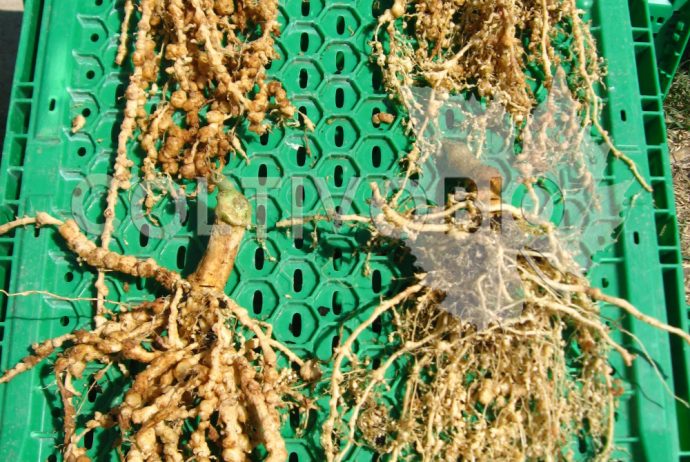
It is this feeding process that causes visible root damage. It leads to cellular hyperplasia and hypertrophy, resulting in rounded swellings on the roots, commonly called galls (see Figure 1). These can range in size from a few millimeters to several centimeters (see Figure 2). Affected plants show reduced growth, yellowing, and increased susceptibility to water stress. In severe cases, plants collapse and die. Potato, tomato, and eggplant are highly sensitive to this parasite. Pepper generally shows greater resistance, although this strongly depends on the cultivar.
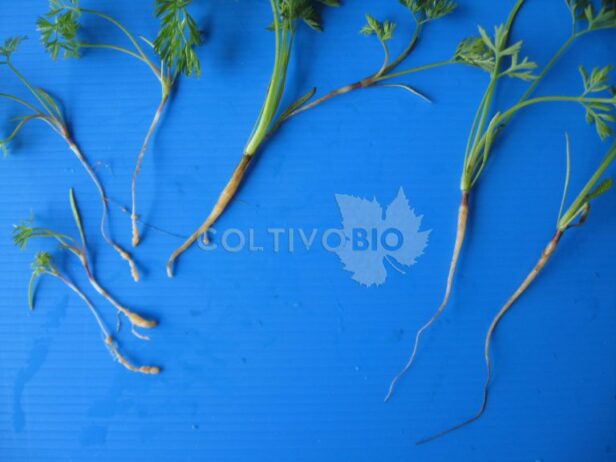
To detect the presence of the disease in the field, root systems of wild indicator plants such as Solanum nigrum, a very sensitive species can be examined for gall formation.
Life cycle
Root-knot nematodes survive in the soil as adults, eggs, or inside infected root systems. They prefer sandy, deep, irrigated soils and can thrive across a wide pH range, from acidic to alkaline. Their development is favored by temperatures between 22 and 32 °C. During winter, their activity slows but does not stop, and in heated greenhouses they can remain active year-round.
The final stage of their cycle is the release of eggs from the galls. Under ideal conditions, the life cycle is completed in 20–25 days, allowing multiple generations per year.
Control and natural remedies against root-knot nematodes
Biological control is mainly preventive and involves crop rotation, alternating susceptible crops (Solanaceae and Cucurbitaceae) with more tolerant ones such as Brassicaceae and legumes.
(Note: do not confuse nitrogen-fixing bacterial nodules on legume roots with nematode galls; bacterial nodules are smaller and attached externally, not formed by deformation of the main root.)
Among natural remedies, biofumigation is an effective option. This involves incorporating green manures of selected Brassicaceae species that produce high levels of insecticidal metabolites. Garlic extracts also have nematicidal activity and are commercially available in granular and liquid formulations; these products are biological plant protection products.
Nematodes are also preyed upon by several microorganisms, including the fungus Paecilomyces lilacinus and the bacterium Bacillus firmus, for which commercial formulations are available.
Some studies on soybean and alfalfa have shown that very acidic soil pH (pH 4.4 or lower) reduces nematode activity. Such low pH levels are suitable for only a limited number of crops. On the other hand, incorporating organic matter enriches the soil with humic acids, which are known to have nematode-suppressive activity. Organic amendments with acidic reactions, such as poultry manure, can slow nematode development and reduce damage.
Fertilizers derived from azadirachtin (commonly but incorrectly called neem oil) processing residues also show nematode-suppressive effects. Although sold as fertilizers, these products still contain compounds with nematicidal activity.
Finally, soil solarization remains a highly effective method for controlling nematodes, weeds, and other soilborne diseases. The best results are achieved when solarization is carried out between July and August. Where permitted (not in organic agriculture), calcium cyanamide can be incorporated before solarization to enhance nematicidal activity.