
Bacillus firmus is a natural nematicide that can be used in organic agriculture. In this technical fact sheet, we will look at the characteristics, mode of action, and use of this bacterium.
The bacterium Bacillus firmus is used as a biological nematicide active against numerous nematode species and is registered on many crops. Among the strains with nematicidal activity, Bacillus firmus strain I-1582 is currently registered in Italy. This bacterium is a Gram-positive aerobe commonly found in soils.
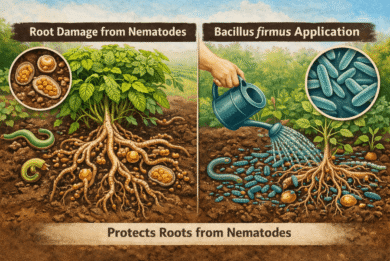
Its mode of action is both direct and indirect. In the direct action, Bacillus firmus attacks nematode eggs, which are destroyed through the secretion of hydrolytic enzymes. Indirectly, Bacillus firmus grows and colonizes the root surface of cultivated plants, first creating a physical barrier that prevents nematode establishment, resulting in fewer root galls. Secondly, some studies suggest that it can stimulate plant growth through the secretion of growth-promoting compounds such as indoleacetic acid.
Bacillus firmus is active against the main species of root-knot nematodes, including:
Meloidogyne hapla, Meloidogyne incognita, Meloidogyne javanica, Heterodera carotae, Pratylenchus spp.
The product can be applied in a single treatment before transplanting, about 7 to 10 days before sowing or transplanting, or split into two applications, with half the dose applied before transplanting and the remaining half applied 5 to 10 days after sowing or transplanting, incorporating the product with light soil cultivation.
Attention: in all cases, it is important to keep the soil moist after application through irrigation. This is necessary to keep Bacillus firmus viable and allow it to reach nematode eggs. The product is approved for use in organic agriculture.