

Chitosan is a natural biopolymer obtained through the deacetylation of chitin, a polysaccharide widely found in nature, especially in the exoskeletons of crustaceans and in the cell walls of fungi and yeasts. In recent years, chitosan has attracted growing interest in agriculture, winemaking, food technology, and medicine because of its biodegradability, biocompatibility, and generally low toxicity. This article contains affiliate links. We may earn a commission from qualifying purchases.
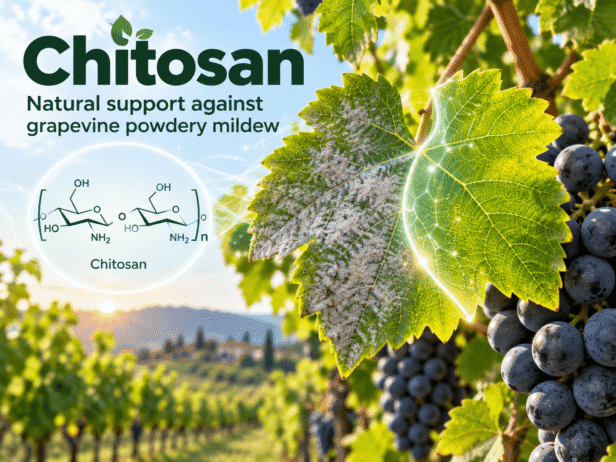
How chitosan works in plant protection
Chitosan differs from many other biological crop protection products because it is a cationic polysaccharide capable of interacting both with plant pathogens and with the host plant itself. This dual mode of action makes chitosan particularly interesting for the management of fungal diseases, especially powdery mildew, and potentially also downy mildew.
Direct action against plant pathogens
Chitosan can exert direct antifungal activity through several mechanisms. The positive charge of chitosan molecules interacts with negatively charged components of fungal cell membranes, altering membrane permeability and potentially causing leakage of intracellular material.
Chitosan can also reduce spore germination of Erysiphe necator, the fungus responsible for grapevine powdery mildew, as well as several other powdery mildew fungi. Activity has also been reported against propagules of some oomycetes.
When applied to leaves, shoots, and grape clusters, chitosan may also form a thin protective film on the plant surface, creating an additional physical barrier that can make pathogen establishment and colonization more difficult.
In organic and low-input disease management programs, chitosan can therefore represent another option alongside potassium bicarbonate and sulfur, two widely used tools for powdery mildew control. Chitosan and chitosan-derived products are also increasingly used in conventional and integrated pest management programs.
Indirect action: inducing plant resistance
In addition to its direct activity, chitosan is an important elicitor of plant defense responses. It can stimulate signaling pathways involved in the plant response to biotic stress, including pathways associated with salicylic acid, jasmonic acid, and ethylene.
In grapevines, chitosan can stimulate the production of phytoalexins, including resveratrol and other stilbenes, compounds involved in the plant’s natural defense against fungal pathogens.
Chitosan may also promote cell-wall reinforcement through the deposition of callose and lignin and increase the activity of defense-related enzymes such as peroxidases, polyphenol oxidases, glucanases, and chitinases.
The activation of these local defense mechanisms can also contribute to a broader systemic plant response, helping untreated tissues respond more effectively when subsequently exposed to a pathogen.
Where chitosan comes from
Chitosan can be produced from several different biological sources, making it suitable for applications ranging from agriculture and food production to winemaking and industrial processing.
Crustacean-derived chitosan is produced mainly from the exoskeletons of shrimp, crabs, and other crustaceans. It was one of the first forms of chitosan to become commercially available and is supported by a substantial body of research concerning its antimicrobial and plant-protection properties.
Fungal-derived chitosan, on the other hand, can be obtained from fungal cell walls, including fungi such as Aspergillus niger. Fungal chitosan has attracted increasing interest because it provides an alternative source that does not depend on crustacean raw materials.
Under European plant protection legislation, certain forms and uses of chitosan have been classified as a basic substance.
Chitosan regulations in the United States
The regulatory situation in the United States differs from the European system. The U.S. Environmental Protection Agency (EPA) has recognized chitosan as a pesticide active ingredient for several uses, including fungicidal activity, antimicrobial uses, and plant growth regulation.
In 2022, the EPA added chitosan (Poly-D-Glucosamine) to the list of active ingredients eligible for the FIFRA 25(b) Minimum Risk Pesticide exemption. The rule became effective in January 2023.
This means that certain pesticide products containing chitosan may qualify for exemption from normal federal EPA pesticide registration requirements, provided that the complete formulation, labeling, active ingredients, inert ingredients, and intended uses meet all requirements of the Minimum Risk Pesticide exemption.
However, the presence of chitosan alone does not automatically make every formulation a FIFRA 25(b) exempt product. Growers and applicators should always verify the current product label and applicable federal and state requirements before use.
Is chitosan allowed in USDA organic farming?
The situation is more complex for certified organic production in the United States.
Under the USDA National Organic Program (NOP), natural substances are generally allowed in crop production unless specifically prohibited, while synthetic substances generally require specific authorization on the National List.
Chitosan has historically been recognized for certain uses as an inert ingredient or adjuvant under the USDA organic regulations. However, its broader use as an active pesticide for plant disease control has been the subject of several National Organic Standards Board (NOSB) petitions and reviews.
As of 2026, chitosan remains under NOSB review for additional crop-production uses. Therefore, a pesticide containing chitosan should not automatically be assumed to be approved for USDA-certified organic production simply because chitosan is considered a minimum-risk pesticide ingredient by EPA.
For certified organic farms in the United States, always verify the specific formulation with the product manufacturer, OMRI or another recognized material-review organization where applicable, and the farm’s organic certifier before application.
How to use chitosan in agriculture
Chitosan should always be applied according to the rate and application instructions stated on the specific product label.
In many preventive crop protection programs, applications are repeated at intervals of approximately 7 to 10 days. Two or three consecutive applications may be required before the full plant-defense response develops, although application frequency depends on the formulation, crop, disease pressure, and label directions.
Chitosan should primarily be considered a preventive tool rather than a curative fungicide. It is most effective when applied before severe disease symptoms become established.
Chitosan and chitosan-derived products are increasingly used in professional horticulture and conventional crop production as well as in biological and integrated disease-management programs.
Greenhouse cucurbit production is an important example. In crops such as zucchini, cucumber, squash, and other cucurbits, chitosan-based resistance inducers can be incorporated into programs for managing powdery mildew.
This can be particularly useful on crops harvested frequently, where growers may be interested in disease-management tools that can be integrated with biological control, sulfur, potassium bicarbonate, and other registered fungicides while managing pesticide residues and harvest intervals.
COS-OGA
Chitosan oligosaccharides are also used to produce an active ingredient known as COS-OGA.
COS-OGA consists of chitosan-derived oligosaccharide chains (COS) associated with oligogalacturonides (OGA) derived from the breakdown of pectins.
Unlike a conventional fungicide that acts primarily by directly killing the pathogen, COS-OGA functions mainly as a plant defense elicitor. The plant recognizes the oligosaccharide signals and activates its own defense mechanisms before or during pathogen infection.
Research on grapevines and cucurbits has demonstrated significant reductions in powdery mildew severity following preventive COS-OGA applications.
In Europe, COS-OGA is used as a registered plant-protection active ingredient and is incorporated into integrated and organic disease-management programs where authorized.
COS-OGA in the United States
In the United States, COS-OGA has also attracted regulatory interest. The EPA received applications in 2023 for products containing COS-OGA as a new active ingredient for fungicidal and plant-growth-regulator uses.
Commercial formulations
The following are examples of chitosan- and COS-OGA-based products available on the European and Italian market. Product availability, registration, and authorized uses may differ in the United States.
- chitosan 2%: https://amzn.to/4rK7cSj
- Chitosan with Salicylic Acid: https://amzn.to/4z7aCRs
For use in the United States, always follow the current product label and verify EPA and state registration requirements. For USDA-certified organic production, confirm that the specific product and intended use are accepted by your organic certifier before application.