

Potassium bicarbonate is one of the most widely used products in agriculture, especially in organic and integrated crop protection, for the control of several fungal diseases. It is a mineral-derived substance valued for its effectiveness, rapid action, and low environmental impact, making it suitable for both professional growers and home gardeners. This article contains affiliate links. We may earn a commission from qualifying purchases.
What is potassium bicarbonate?
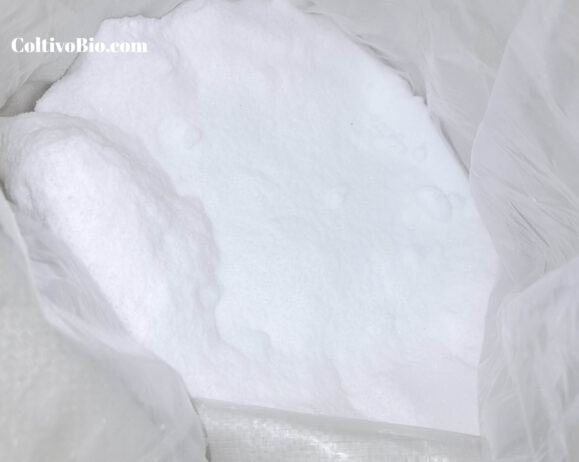
Potassium bicarbonate is a water-soluble alkaline salt. In agriculture, it is mainly used as a contact fungicide, meaning that it acts directly on fungal structures present on the surface of the plant.
Unlike systemic products, it does not enter plant tissues. Instead, it works through a physical and chemical mode of action, creating unfavorable conditions for pathogen development.
How it works against fungal diseases
Potassium bicarbonate works through several complementary mechanisms. First, it alters the pH of the leaf surface, creating conditions that are unfavorable for fungal spore germination. It also causes direct dehydration and collapse of fungal cell structures, rapidly leading to their death.
For this reason, it is effective mainly against pathogens that develop on the surface of leaves and fruit.
Potassium bicarbonate is successfully used against powdery mildews and is partially effective against several other fungal diseases, including:
- Powdery mildew on grapevines, vegetable crops, and ornamental plants (good activity)
- Apple and pear scab (moderate activity)
- Alternaria on vegetable crops (moderate activity)
- Surface molds on various crops (good activity)
- Gray mold caused by Botrytis (good activity)
Its activity is mainly preventive and contact-based, which means it provides the best results when used preventively and is generally only slightly effective or ineffective once infections are already advanced.
How to use potassium bicarbonate in agriculture
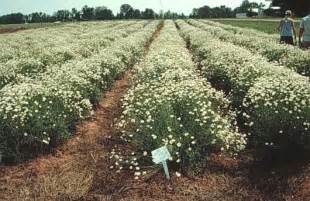
Potassium bicarbonate should be applied as a foliar treatment, ensuring uniform coverage of the vegetation. Because it is a contact product, application quality is essential for achieving good results.
It can be used:
- preventively, before symptoms appear
- at the first signs of disease, to help stop its spread
It is often used in rotation with other crop protection products to reduce the risk of resistance and improve the overall effectiveness of the disease management program.
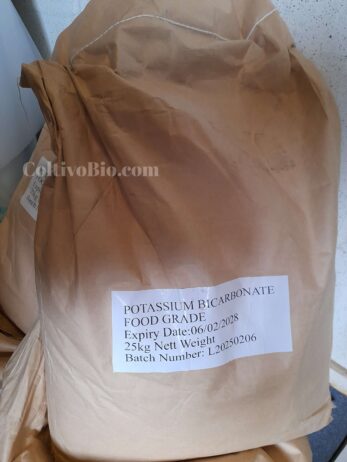
In agriculture, there are two types of potassium bicarbonate commercially available: potassium bicarbonate registered as a plant protection product and potassium bicarbonate registered as a basic substance.
Under current regulations, potassium bicarbonate marketed as a basic substance must be food grade, meaning that it consists of 100% active substance, and it can be used freely on crops.
Potassium bicarbonate registered as a plant protection product, despite containing the same active ingredient, is generally more effective because it is formulated with specific co-formulants that improve distribution, adhesion, and persistence on plant surfaces, resulting in greater overall treatment effectiveness (see products at the bottom of the article).
Application rates for potassium bicarbonate are those indicated on the product label, and generally range from 0.4 to 0.67 oz per gallon 2.7–4.5 lb/acre (3 to 5 grams per liter, 3–5 kg/ha).
Advantages of potassium bicarbonate
The main advantages of potassium bicarbonate include:
- rapid action against the pathogen
- no hazardous residues
- low environmental impact
- compatibility with organic farming when registered formulations are used
- no risk of fungal resistance
- low cost
One of the most important uses of potassium bicarbonate is on strawberries. Because strawberries are harvested repeatedly throughout the season, growers need products with a short pre-harvest interval that do not leave visible marks on the fruit. In this situation, potassium bicarbonate is often preferred over sulfur, which can leave visible residues on the fruit.
Disadvantages of potassium bicarbonate
Because of its alkaline pH, the use of potassium bicarbonate has some practical limitations. Its effect on the leaf surface is relatively short-lived, because within a few days the plant tends to restore the normal physiological pH of its leaf surfaces. As a result, more frequent applications may be required, leading to higher crop protection management costs.
Another limitation is that tank mixing potassium bicarbonate with other products is generally not recommended because of its alkaline reaction. Most fungicides and insecticides require a slightly acidic solution, such as natural pyrethrum. This limits the possibility of optimizing treatments by combining multiple active ingredients in the same spray tank and may require growers to make separate, more expensive applications.
For these reasons, potassium bicarbonate competes with sulfur, which is more widely used in agriculture against powdery mildew because of its longer residual activity, the possibility of tank mixing it with other active ingredients, and its useful secondary activity against plant-feeding mites (such as two-spotted spider mites).
As an alternative to potassium bicarbonate, sodium bicarbonate can also be used.
However, sodium bicarbonate is less commonly used in agriculture because it can cause phytotoxicity when applied at incorrect rates and adds sodium, an element that can be unfavorable to both soil and plants over the long term.
Products available online:
- MilStop SP (Organic Foliar Fungicide): https://amzn.to/3VN0hvH
- Pure Potassium Bicarbonate (food grade): https://amzn.to/4yoxBYl