

In this article we will look at how to manage infestations of Tetranychus urticae, commonly known as the red spider mite also known as the two-spotted spider mite. We will examine its biological cycle, useful insecticides as control measures, and natural antagonists.
Identification and damage
Tetranychus urticae is the scientific name of the red spider mite, also known as the two-spotted spider mite. As an adult, this mite measures about 0.5 mm in length and shows a certain degree of sexual dimorphism, with males generally smaller than females.
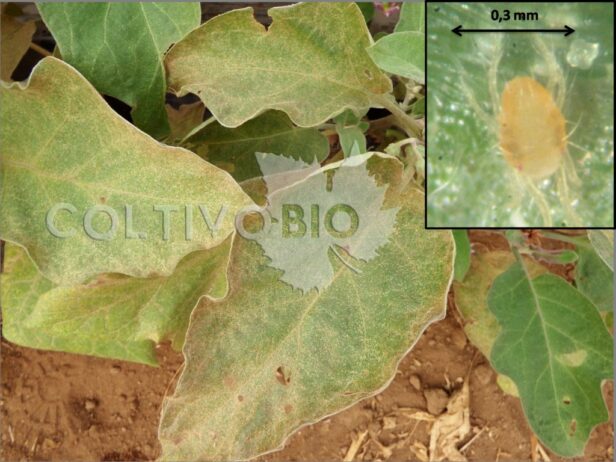
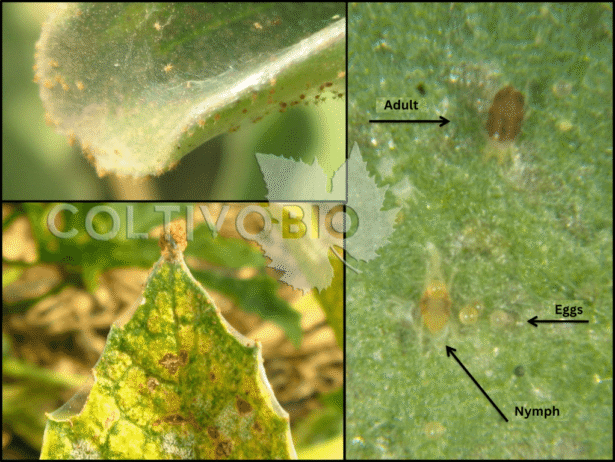
The eggs of this mite are white, translucent, sometimes tending toward orange, and spherical in shape. They are laid singly on the leaf surface. The eggs are not visible to the naked eye but can be identified using a good magnifying lens. In the early developmental stages, the mite ranges in color from whitish to yellowish, later turning various shades of red as an adult. Both juvenile stages and adults show two dark spots on the sides of the body, from which the term “two-spotted” derives.
Damage caused by the red spider mite primarily affects leaves and, if not controlled, can lead to plant death. In affected areas, mobile stages of the mite and their excrement (small black dots) can be observed. In cases of severe infestation, the damaged parts become covered with a fine webbing. Damage is clearly visible as leaf discoloration, resulting in reduced gloss on the upper leaf surface. The affected area later develops into necrosis, passing through a phase in which the damaged tissue takes on a bronze coloration. Eventually, the leaf falls or loses much of its photosynthetic capacity.
An important characteristic influencing control strategies is the strong polyphagy of this mite: it feeds on many plant species, including tomato, eggplant, zucchini, bean crops, and ornamental plants.
Biological cycle of the red spider mite
Temperature is the key factor in the development of this mite. The red spider mite completes 8–10 generations per year, mainly concentrated during the summer months. In heated greenhouses, the cycle is continuous, leading to numerous generations that can result in complete crop destruction.
Fertilized adult females are the overwintering stage. They take shelter in spontaneous vegetation, at the base of plants, or under dried plant debris. In spring, females lay eggs on host plants. Larvae hatch from the eggs and reach adulthood by passing through two nymphal stages: the protonymph and the deutonymph. The optimal temperature for red spider mite development is around 30–32 °C, although infestations can begin at lower temperatures.
Biological control and remedies against red spider mite
Intensive chemical control over the years has led to the near disappearance of this mite’s natural enemies. A direct consequence has been massive outbreaks of red spider mite infestations and the selection of increasingly resistant forms to acaricides and insecticides in general.
Although active ingredients permitted in organic farming are less effective than conventional chemicals, when used within a proper strategy that includes prevention techniques and timely treatments, they can be highly effective.
Among the usable active ingredients are vegetable oils and paraffin oil , which create an asphyxiating film on the surface of the mite’s exoskeleton and eggs, causing death by suffocation. Alternatively, insecticide soap can be used. Sulfur acts as a repellent and helps make the plant less attractive. Beauveria bassiana is a parasitic fungus sold as a bio-insecticide; it mainly affects eggs and juvenile stages of the mite. Several commercial products based on this active ingredient are available.
The use of natural enemies such as the predatory mites Phytoseiulus persimilis and Amblyseius cucumeris provides positive results, especially in protected environments (greenhouses), and can effectively eliminate early infestations. These are among the most classic natural remedies against the red spider mite, and in Italy there are several companies distributing these predators or producing beneficial insects.
An effective control strategy against red spider mite involves the combined use and interaction of these methods. Releases of natural antagonists such as Phytoseiulus and Amblyseius must be carried out at a suitable interval from other treatments to avoid killing them.
Insecticides
- Horticultural oil insecticide
- Soy vegetable oil insecticide
- Sulfur
- Insecticidal soap