
Planting by the Moon and following lunar phases for farming and gardening are among the oldest traditions in rural culture. Even today, many planting calendars recommend sowing seeds, transplanting, pruning, or harvesting at specific times during the lunar cycle, especially according to the waxing and waning Moon.
But do Moon phases really affect plant growth? To answer this question, we need to separate traditions passed down through generations from what we actually know about plant physiology and seed germination.
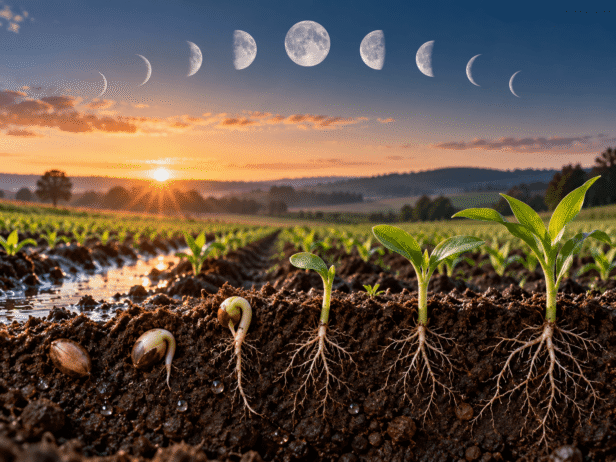
There is no strong scientific evidence that planting by the Moon or choosing specific Moon phases improves seed germination, plant growth, or crop yield. The Moon certainly has physical effects on Earth, including tides and changes in nighttime illumination, but this does not mean that its phases have a meaningful agronomic effect on crops. Seed germination depends mainly on soil moisture, temperature, oxygen, and, for some species, light. In practical farming and gardening, factors such as soil temperature, rainfall, frost risk, field conditions, and the specific needs of the crop are far more important when deciding when to plant. Lunar planting calendars remain an interesting agricultural tradition, but they should not replace decisions based on plant physiology, weather, and soil conditions.
What does a seed really need to germinate?
Seed germination does not begin because a certain date appears on a planting calendar. It begins when specific environmental conditions are met.
The first essential factor is water. A seed absorbs water through a process called imbibition. Hydration of the seed tissues reactivates metabolism and the enzymatic processes required for germination.
The second major factor is temperature. Every plant species has a temperature range within which its seeds can germinate, as well as an optimum temperature at which germination occurs most rapidly.
Seeds also need oxygen for cellular respiration. This is why completely waterlogged soil can reduce or prevent germination even when plenty of water is available.
For some species, light can also act as an important germination signal. Some seeds germinate better when exposed to light, while others may be inhibited by it.
Water, temperature, oxygen, and, when required, light are therefore environmental factors with well-established physiological effects on seed germination.
What about the Moon?
According to some traditional farming and gardening practices, seeds should be planted during specific Moon phases because certain parts of the lunar cycle are believed to promote germination or later plant growth.
The problem is that, from a plant physiology standpoint, there is no solid evidence that Moon phases influence seed germination to a degree comparable with factors such as water and temperature.
A very simple example helps explain why.
Imagine planting seeds during what a lunar gardening calendar describes as the best Moon phase for germination. However, the soil is completely dry.
What happens?
The seeds do not germinate.
The entire lunar phase could pass without anything happening. Without water, imbibition cannot occur and the seed’s metabolism cannot restart.
Now imagine that several days later, during a Moon phase considered less favorable for planting, rainfall arrives. If soil temperature and oxygen levels are also suitable, the seeds can begin to germinate.
In other words, a seed responds to the environmental conditions required by its physiology, not to the planting calendar being followed by the grower.
“In practical terms, we can summarize the idea very simply: commercial growers generally do not schedule planting based on Moon phases. We have direct experience with farms planting acres and acres of crops and obtaining excellent results regardless of the lunar phase at the time. If professional growers managing large acreages do not base their planting decisions on the Moon, there is even less reason for a small grower or home gardener to feel restricted by a lunar planting calendar.”
The Moon still has physical effects on Earth
Saying that there is not enough evidence to schedule planting according to Moon phases does not mean that the Moon has no physical effects on Earth.
The Moon’s gravitational pull is real, and its most obvious effect can be seen in ocean tides. The amount of nighttime illumination also changes considerably throughout the lunar cycle and can influence the behavior of many organisms.
The key point is different: the existence of a physical effect of the Moon does not automatically prove that Moon phases have an agronomically significant effect on seed germination, plant growth, or crop yield.
To demonstrate that planting during a particular Moon phase improves germination, controlled experiments would need to show that, with all other conditions kept equal, seeds planted during that phase germinate better, germinate faster, or eventually produce more productive plants.
Why has planting by the Moon remained popular?
For centuries, farmers built their knowledge through observation and direct experience. Before weather stations, soil sensors, forecasting models, and modern knowledge of plant physiology became available, astronomical cycles provided visible and predictable references for marking time.
This does not mean that traditional farming knowledge has no value. Many practices passed down through generations were later supported by scientific explanations. However, each practice should be evaluated individually rather than assumed to work simply because it has been used for a long time.
Another major difficulty is separating the possible effect of the Moon from the effects of environmental conditions.
If seeds planted during a waxing Moon germinate perfectly, it can be tempting to attribute the result to the lunar phase. But during the same period, soil temperature may have been ideal, soil moisture may have been adequate, and weather conditions may have been favorable.
Without a controlled comparison, we cannot determine which factor actually produced the result.
When should you really plant seeds?
From an agronomic perspective, the best time to plant should be determined primarily by the requirements of the crop and current environmental conditions.
Important factors include soil temperature, soil moisture, frost risk, expected rainfall, field conditions, soil workability, and the specific requirements of the crop being planted.
For a seed, adequately moist soil at the correct temperature provides far more useful information than the current phase of the Moon.
Lunar planting calendars remain an interesting part of farming and gardening culture, but traditional beliefs and plant physiology should not be confused. When deciding when to sow seeds, water, temperature, oxygen, soil conditions, and the biological requirements of the crop are the factors that determine whether germination can occur.