

Botrytis, or gray mold, is one of the most common diseases affecting grapevines near harvest. In this technical guide, we will examine how to identify the disease and the correct management strategies in organic viticulture.
This article contains affiliate links. We may earn a commission from qualifying purchases
Description and symptoms of botrytis
Along with powdery mildew and downy mildew, botrytis is one of the most dangerous fungal diseases of grapevine. In addition to causing quantitative yield losses, it can significantly alter wine quality. The scientific name of this fungus is Botrytis cinerea, while its sexual stage is known as Botryotinia fuckeliana. The pathogen can also survive as a saprophyte on decomposing organic matter. Besides grapevine, many fruit and vegetable crops can be affected, including strawberry, apple, pear, peach, cherry, bean, and broad bean.
How botrytis manifests on grapevine
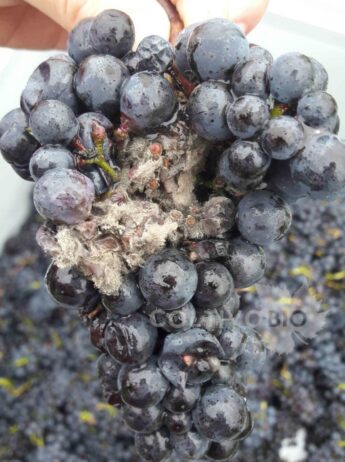
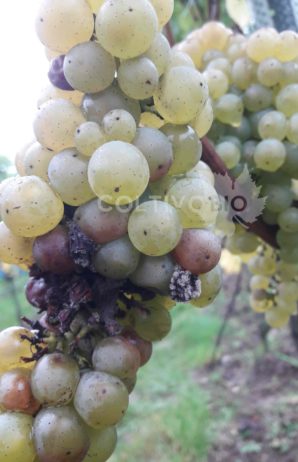
Also known as gray mold, botrytis appears on infected grape clusters as a characteristic gray fungal growth (see Figure 1). Affected tissues lose their firmness, and infected berries are irreversibly damaged.
Table grapes affected by botrytis become unmarketable, while wine grapes undergo biochemical changes that negatively affect wine flavor and quality.
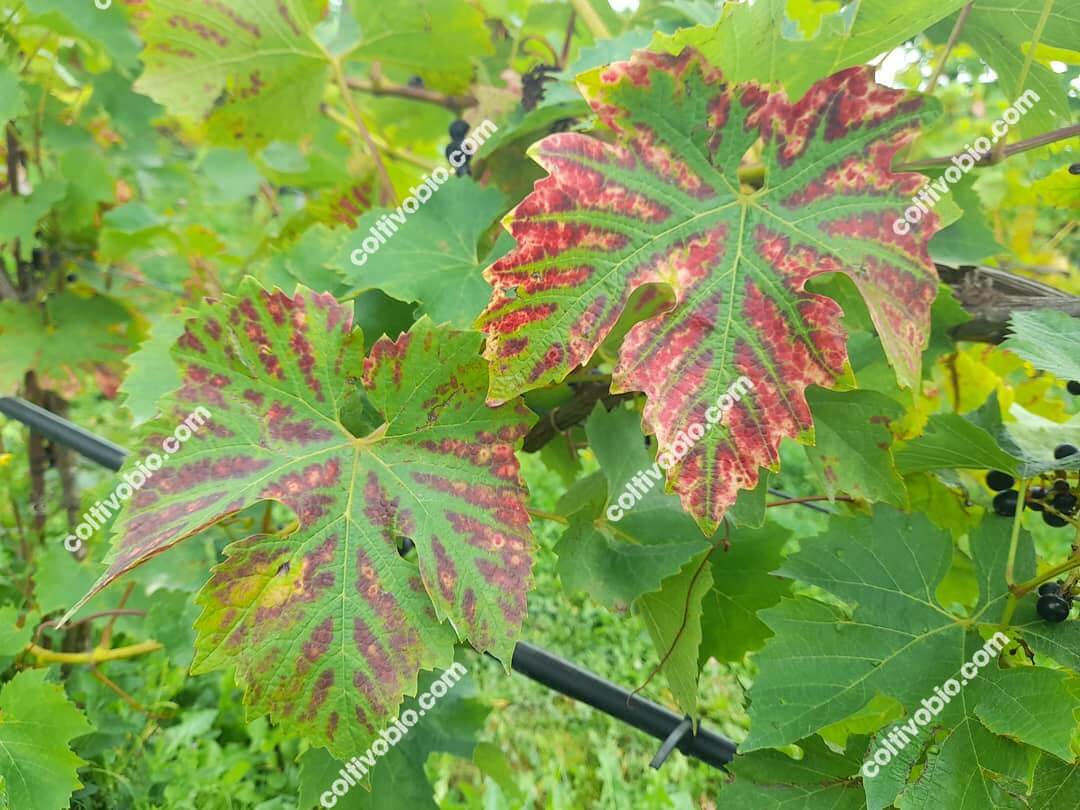
Although clusters are the primary target, leaves and shoots may also be infected, although such infections are much less common. On leaves, symptoms appear as chlorotic areas that later become necrotic and, under favorable environmental conditions, develop a gray moldy growth. On shoots, infection is generally limited to green tissues and results in mild dieback with little tendency to spread. Likewise, infections of tendrils and petioles are rare and usually cause minimal damage.
The fungus can penetrate the plant through two distinct pathways. The first occurs when tissues are still green and actively photosynthesizing, such as leaves, shoots, and immature berries. These tissues possess numerous stomata through which the pathogen can easily enter and colonize the host. Botrytis may also penetrate through the floral stigma, attracted by the secretions produced during flowering. When infection occurs through flowers or young clusters, it generally remains latent due to the low pH of immature berries.
The second pathway is the most dangerous and economically important. It occurs during veraison, when berries no longer possess functional stomata. At this stage, the fungus can invade the host only through wounds caused by biotic factors (such as grape berry moths, thrips, or powdery mildew) or abiotic factors (such as hail or wind damage). During veraison, the decrease in organic acids and the increase in sugar content make the berries highly susceptible to destructive infections.
Biological cycle of botrytis
Botrytis cinerea survives in the environment in several forms, including conidia, sclerotia, and overwintering mycelium beneath the bark. It can also survive as a saprophyte on plant debris.
In early autumn, sclerotia begin forming on infected tissues. These appear as small black structures, only a few millimeters long, oblong in shape and hard to the touch, usually produced on canes.
In spring, under suitable temperature and humidity conditions, the sclerotia, overwintering mycelium, and infected crop residues produce gray fungal growth consisting of conidiophores and conidia. The conidia are dispersed primarily by wind and are favored by rain splashes.
Once deposited on plant tissues, infection can occur through stomata or wounds. The optimal conditions for conidial germination are approximately 15°C and 15 hours of leaf wetness. These conditions are commonly referred to as the “Rule of Two Fifteens.”
If berries at veraison have been damaged by biotic factors (powdery mildew, grape berry moths) or abiotic factors (hail, etc.), fewer hours of wetness are required for infection to occur.
This climatic scenario also favors the development of overwintering mycelium present on bark and plant debris.
Throughout the growing season, conidia are continuously produced, with production strongly correlated with rainfall. Generally, two peaks occur:
- The first between May and June, corresponding to the germination of overwintering structures.
- The second in autumn, associated with the first rains and the initiation of sclerotia formation.
In addition to the Rule of Two Fifteens, it should be noted that conidia can germinate without rainfall when relative humidity exceeds 90%.
Conidia are capable of germinating at temperatures close to 0°C (although at a very low rate) and up to approximately 30°C, with an optimum around 18°C.
You may also be interested in: Grapevine Powdery Mildew: Symptoms and Organic Control.
Natural remedies and agronomic control
In organic viticulture, botrytis management relies primarily on proper vineyard practices and secondarily on the use of approved organic plant protection products.
These agronomic practices are strongly recommended even in conventional vineyards, as synthetic fungicides alone are not always sufficient to control Botrytis cinerea, particularly during highly favorable seasons.
Key agronomic practices include:
- Selecting grape varieties with loose clusters, which allow better air circulation and reduce humidity retention between berries.
- Using rootstocks with deep root systems, which help reduce berry splitting during hot weather and consequently decrease infection risk.
- Avoiding excessive nitrogen fertilization, which increases vegetative growth, canopy density, humidity, and berry susceptibility.
- Ensuring adequate calcium nutrition, as calcium strengthens plant tissues and improves resistance to pathogen attack.
- Applying canopy management practices such as shoot thinning and leaf removal around clusters to improve ventilation and sunlight penetration.
- Favoring training systems such as Guyot, which provide better airflow than pergola systems.
- Removing, burying, or destroying infected crop residues in vineyards with a history of severe botrytis infections.
- Controlling powdery mildew and grape berry moths, which often create wounds that facilitate botrytis infection.
The three key timing windows for control
Whether in organic or conventional viticulture, botrytis management should focus on three critical periods.
The first treatment should be applied immediately after flowering, when the pathogen begins colonizing floral residues and establishing latent infections that may persist until berry ripening.
The second treatment should be applied before cluster closure, when berries are between peppercorn and pea size. This represents the last opportunity to deliver products into the interior of the cluster before berries become tightly packed together.
The third treatment should be applied at veraison. On highly susceptible cultivars and under favorable weather conditions, treatments may need to continue until harvest.
Organic control of botrytis
Direct control of botrytis in organic agriculture can be achieved using several biological plant protection products and basic substances.
Traditional products include copper compounds, which are primarily used against downy mildew but also strengthen berry cuticles while providing contact fungicidal activity.
Sulfur, commonly used against powdery mildew, also provides a secondary effect against botrytis, although it is generally insufficient when used alone. Most commercial formulations registered against botrytis combine sulfur with copper.
Potassium bicarbonate is another useful option. It exerts fungistatic and fungitoxic activity by increasing the pH of the berry surface and causing dehydration of fungal hyphae.
Among the most important biological products currently available are:
- Cerevisane, a resistance inducer derived from cell wall extracts of Saccharomyces cerevisiae.
- Bacillus amyloliquefaciens, an antagonistic bacterium that suppresses pathogen development.
- Bacillus subtilis, widely used in biological disease management.
- Aureobasidium pullulans, an antagonist that controls botrytis through competition for nutrients and space and by producing the protective polysaccharide pullulan.
- Pythium oligandrum, a mycoparasitic oomycete capable of directly attacking fungal hyphae.
- Eugenol, thymol, and geraniol, natural compounds derived from plants such as thyme, geranium, clove, and cinnamon, currently among the most effective organic options available.
- potassium bicarbonate
Basic substances and plant defense enhancers
Among the most useful products for reducing botrytis development are:
- Zeolite, which help dry plant surfaces and enhance natural plant defenses.
- Soybean vegetable oil.
- Lecithin, which acts as a plant defense stimulator.
Most common fungicides available online
- Bacillus amyloliquefaciens: https://amzn.to/44cYH7j
- Bacillus subtilis: https://amzn.to/4vhK6DH
- potassium bicarbonate: https://amzn.to/4we0MMz