

Powdery mildew, also known as white mold of solanaceous crops, is a plant disease caused by the fungus Leveillula taurica. This disease affects several cultivated plants, including tomato and artichoke. In this technical sheet, we will examine the symptoms, treatments, and biological control of powdery mildew. At the end, you will find a link to access a list of useful products for controlling powdery mildew.
Identification and damage caused by powdery mildew
The disease is caused by the fungus Leveillula taurica and can affect various plants belonging to the Solanaceae family, including tomato, eggplant, and pepper, as well as cardoon and artichoke. Powdery mildew initially appears as chlorotic (lighter-colored) spots on the upper surface of the leaves. Over time, this develops into the unmistakable presence of white, powdery-looking patches (see Figure 1). These patches are nothing more than the external mycelial growth of the fungus, including its reproductive structures (conidia).
The presence of this fungus weakens the plant, reduces its photosynthetic capacity, and consequently leads to decreased yield and, over time, plant death.
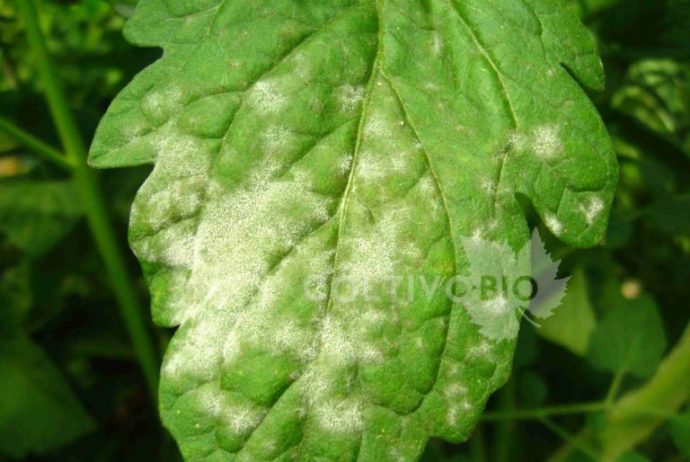
If you are interested in additional photos of powdery mildew of solanaceous crops (Leveillula taurica), click ⇒ here for the photo gallery.
Control, remedies, and organic management of tomato powdery mildew
Control of powdery mildew (white mold) on tomato and other solanaceous crops involves treatments with various products, including sulfur (see technical sheet), which has curative action, as well as several products with preventive action. In addition to sulfur, due to its effectiveness, products based on chitosan (see here) should be mentioned, as they are becoming increasingly popular in professional agriculture.
Commercially available products include both basic formulations containing chitosan and so-called COS-OGA, oligosaccharides derived from chitosan and oligogalacturonides extracted from pectins. These products stimulate the plant’s defenses by activating its natural defense mechanisms preventively and have proven to be excellent preventive treatments.
Other active ingredients worth mentioning are products based on essential oils such as eugenol, geraniol, and thymol, which act by contact and can be used preventively or at the first appearance of symptoms. In Italy, registered commercial formulations are available for both chitosan-based products and essential oils.
Sulfur-based treatments should be repeated at regular intervals of 7 days, reduced to 5 days in cases where the disease shows particularly high virulence. For other products, label instructions must be strictly followed.
For biological control of this disease, preparations based on the parasitic fungus Ampelomyces quisqualis are also available. This organism is capable of parasitizing and killing powdery mildew. Ampelomyces quisqualis should be used in alternation with sulfur treatments.
Among microbial-based products, the use of Bacillus pumilus should also be mentioned. In Italy, a registered commercial formulation exists for several crops, and it is compatible with copper and sulfur treatments.
You may also be interested in our technical sheet on “how to naturally and organically control the tomato leaf miner (Tuta absoluta)”, available via the link provided.
Additional alternative remedies
Other valid alternatives for limiting powdery mildew attacks include sodium silicate and potassium silicate. These products are not as effective as sulfur but represent an additional tool available to agronomists. Silicates act by strengthening plant tissues, making them less susceptible to parasitic attacks.
Another supportive measure in powdery mildew control is the use of bicarbonates, both sodium bicarbonate and potassium bicarbonate. The latter is a well-known natural remedy but is among the least effective options against powdery mildew and should therefore be used in combination with the other products described.
It is important to remember that effective control also depends on proper application of treatments. Thoroughly wet not only the upper leaf surface but also the underside. Avoid treatments during the hottest hours of the day. In all cases, application rates indicated on commercial product labels must be respected, and any incompatibilities must be checked.
We invite you to access the link below, where you will find a recommended list of useful products for powdery mildew control.
If you are interested in a list of commercial products for controlling powdery mildew of solanaceous crops (tomato and artichoke), click ⇒ here.