

The tomato leaf miner is a particularly dangerous insect pest of tomato. In this article, we will examine the life cycle, damage, and control strategies against Tuta absoluta using biological and natural methods.
How to identify damage, adults, and larvae
Also known as the tomato leaf miner, Tuta absoluta is scientifically classified as a leaf-mining insect (it creates mines between the upper and lower leaf surfaces). It is a microlepidopteran native to South America, first detected in Italy between 2007 and 2008.
Adult moths are approximately 5–7 mm long, with a wingspan of 9–11 mm. They have long, filiform antennae and gray wings mottled with lighter shades. Larvae range in color from pale yellow to light green, with a dark, visible head capsule.
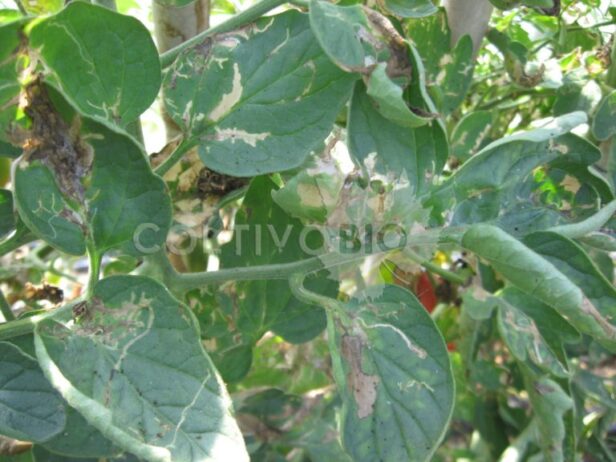
Young larvae cause damage by penetrating leaves, fruits, or more rarely stems, where they form galleries or mines. The damage is characteristic: the leaf appears hollowed out because the internal tissue (mesophyll) is consumed, while the epidermis remains intact, forming a protective “case” for the larva (Figure 1). Eventually, affected leaves necrotize and dry out.
Care must be taken not to confuse early tomato leaf miner damage with that caused by Liriomyza trifolii, another leaf miner that is much less damaging. Tuta absoluta does not attack roots.
A single larva can excavate multiple mines, moving continuously between nearby leaves. When fruits are present, larvae often prefer them, boring into the fruit near the peduncle and penetrating internally (Figure 2).
Damage thresholds vary depending on whether tomatoes are grown for fresh consumption or processing. In fresh-market tomatoes, even a single entry hole makes the fruit unmarketable. Yield loss is directly proportional to the number of mines on leaves, due to reduced photosynthetic capacity.
The most severe damage occurs in greenhouses during warm months, where, without treatments, losses can approach 100%. Since Tuta absoluta is now established in many environments, its control is essential for successful tomato production.
The main host plant is tomato, but other cultivated Solanaceae such as potato, pepper, and eggplant can also be attacked. Ornamental plants of the genus Solanum may also be affected.

Biological cycle of Tuta absoluta
Larvae and adults overwinter by seeking shelter in warmer sites; the species does not enter diapause. It can complete 10–12 generations per year. The duration of the life cycle depends on temperature and can be as short as 25 days in summer.
Tuta absoluta tolerates high temperatures, including those commonly found in greenhouses during summer. As temperatures decline, its activity decreases and stops around 15 °C. Adults are nocturnal and hide among leaves during the day. Their presence can be detected by shaking plants, as adults quickly fly to nearby vegetation.
Eggs are laid mainly on the underside of leaves, but during heavy infestations they may also be found on the upper surface. Each female lays an average of 200 eggs. Pupation usually occurs in the soil, and less frequently in plant debris.
Natural control methods
The most important physical control methods include insect-proof nets and mass trapping. Insect nets are mainly applicable in greenhouse cultivation and are not suitable for open-field production. Very fine mesh nets (aphid-proof) are used and also provide protection against other pests (e.g. noctuid moths).
Mass trapping is most effective when using pheromone traps. Containers filled with water and a thin layer of vaseline oil (about 2 mm thick) are used, with the pheromone dispenser suspended just above the liquid surface. Male moths attracted by pheromones drown in the water–oil mixture.
Pheromone traps are also useful for monitoring the onset of infestations. Pheromone capsules are available from specialized agricultural suppliers; for hobby use, adhesive pheromone strips are also available.
Biological control
The most effective control of tomato leaf miner infestations is achieved using insecticides, including products approved for organic farming. Biological active ingredients include:
-
Pyrethrum, effective when applied at the maximum permitted doses and preferably in the late evening, as it is highly photosensitive. Bumblebee hives must be removed 24–36 hours before and after treatment. Best results are obtained when used in combination with Bacillus thuringiensis.
Thorough wetting of vegetation is essential. Due to the aggressiveness of the pest, treatments must be frequent, following the shortest interval indicated on the product label.
-
Spinosad has proven to be the most effective active ingredient. As it acts by ingestion, it shows good selectivity toward beneficial insects. Its use is recommended in rotation with pyrethrum + Bacillus thuringiensis.
Products based on azadirachtin (neem oil) can also be used preventively, with repeated applications every 7–10 days. Several registered formulations are available in Italy.
In organic pest management, it is essential to alternate and combine different active ingredients over time.
Finally, the role of mirid predators should be emphasized. Beneficial insects such as Macrolophus pygmaeus are effective predators of Tuta absoluta eggs and larvae and are widely used and commercially available from biocontrol suppliers.