

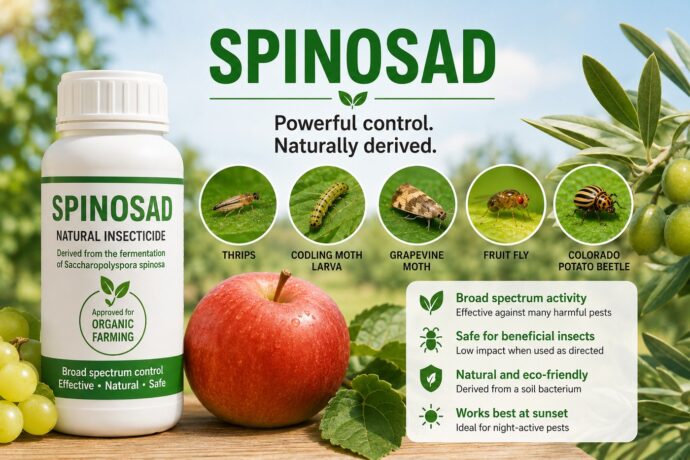
What is spinosad
The active ingredient spinosad comes from the fermentation of a common soil bacterium, Saccharopolyspora spinosa, discovered accidentally in 1982. Scientists studied the bacterium and discovered that it produces a neurotoxin effective against a wide variety of insects. In 1997, the United States Environmental Protection Agency (EPA) registered it for use as a pesticide.
This natural substance is a combination of two chemicals: spinosyn A and D. It is effective against a wide range of pests, including:
Thrips, plum moth, cotton bollworm, Cydia molesta, Anarsia lineatella, leafroller moths, pear psylla, cutworms, Pieris brassicae, European corn borer (Ostrinia nubilalis), wood-boring Lepidoptera (Cossus cossus and Zeuzera pyrina), leaf miners, Mediterranean fruit fly, olive fruit fly, Colorado potato beetle, sawflies, Crioceris asparagi, stink bugs, defoliating Lepidoptera, Metcalfa pruinosa, etc.
Although spinosad has a broad spectrum of activity, it is completely ineffective against aphids and scale insects and has only a partial effect against whiteflies.
How it works
This product is a neurotoxin and, when insects come into contact with the substance or ingest it, their muscles begin to contract involuntarily because it interferes with the transmission of nerve impulses. This causes paralysis within a short time and death within a few days. The substance is absorbed through ingestion and contact, although ingestion is considerably more effective. It is a contact product with slight cytotropic activity, meaning that it can penetrate the first cell layers of the leaves, allowing it to control leaf miners as well. There are also some medicines, personal care products and pet care products for dogs and cats that contain spinosad. It is a common ingredient in flea-control products for dogs and cats, as well as treatments for head lice in humans. One of the best aspects of products containing spinosad is that they are safe for people, pets and beneficial insects. Since it is produced through the fermentation of a bacterium commonly found in soil, this active ingredient can be used in organic farming.
Technical characteristics
Sunlight rapidly breaks down the substance. In sunlight, it degrades in as little as two days. With exposure to both sunlight and water, the product decomposes within one day. If exposed only to water, the product has a half-life of more than one month. Commercial formulations of spinosad insecticide contain co-formulants that keep the molecule active for up to 7–10 days. Spinosad binds rapidly and strongly to sediments and soil and can remain effective for several months in dark, low-oxygen environments. Unlike chemical insecticides, it does not tend to move through the soil and contaminate groundwater. Several field studies have shown that spinosad applied to the soil does not penetrate beyond a depth of approximately half a metre. This penetration capacity is sufficient for it to be effective as an insecticide without endangering water reserves. On the other hand, soil microbes break down the substance fairly quickly. When applied to the soil surface, a half-life of approximately three weeks is expected.
For most birds, this insecticide is non-toxic. For most fish species, it is completely non-toxic. It can have harmful effects on aquatic invertebrates (for example, snails). It is somewhat toxic to earthworms. One of the main disadvantages of spinosad is that it is quite toxic to bees if they come into contact with it immediately after application. Once the insecticide spray has dried, it does not harm bees or other beneficial insects, so it is very important to apply the product at sunset, after the bees have settled for the day. This allows it to dry overnight while the bees are resting. In any case, the labels of commercial products prohibit the use of the product during flowering. Since sunlight accelerates the degradation of the product, this strategy also helps the product to be more effective against insects that damage plants during the night (e.g. vine weevil).
Spinosad is also used in insecticidal protein bait formulations. These are formulations applied to part of the vegetation that attract target insects. By feeding on the protein component poisoned with spinosad, the insects die within a short time. These types of products are particularly useful against the olive fruit fly.
Where to buy spinosad
Spinosad-based insecticide formulations can be found at agricultural supply retailers. In addition, since it is a low-toxicity product, it is also sold online without particular precautions.
- Fertilome Spinosad: https://amzn.to/4fTrhBv
- Atticus Spliven Insecticide: https://amzn.to/4qeq2QU