

Every summer, I receive numerous questions from home gardeners growing tomatoes in their gardens or on balconies. One of the most common is always the same: “The plant is full of flowers, but no tomatoes are forming. Why?”
It can be a confusing situation. The plant looks healthy, grows vigorously and continues to produce new flowers, but after a few days they turn yellow and fall off without producing any fruit.
The first reaction is often to assume that something is wrong with the fertilisation. In reality, in my experience, this is only one of several possible causes and, in most cases, it is not even the most important one. Fruit formation depends on a very delicate process that is strongly influenced by climate and growing conditions.
Before looking for a solution, it is therefore essential to understand how a tomato fruit develops.
How a tomato develops: understanding fruit set
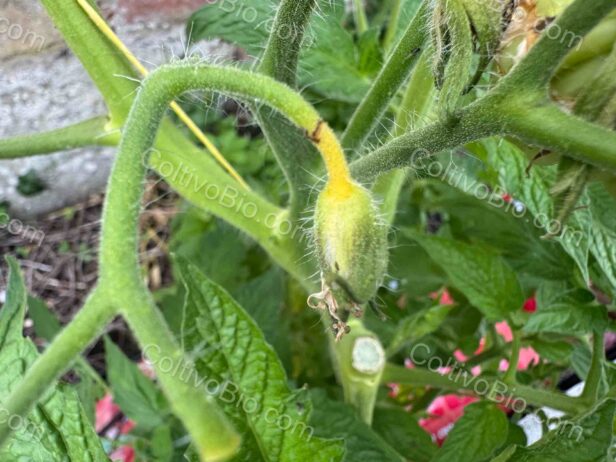
Every tomato develops from a flower. After the flower opens, pollen must reach the stigma, fertilise the ovules and initiate the development of the small fruit. This process is known as fruit set.
If everything happens correctly, after just a few days it is possible to see a small green tomato developing at the base of the flower.
If, on the other hand, the flower turns yellow, dries up and falls without leaving any fruit behind, this means that fertilisation did not occur or that the plant interrupted the process because of stress.
Be careful to distinguish between the two situations: if the flower falls without leaving a small tomato behind, the problem concerns fruit set. If the fruit has already formed and falls later, the cause is probably something else.
Summer heat is the most common cause
In recent years, summers have become increasingly hot, and this is undoubtedly one of the most common causes of poor fruit set.
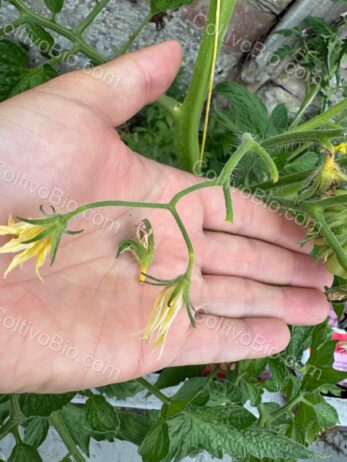
When temperatures consistently exceed 32–34°C, the flower may continue to open normally, but changes begin to occur inside it that interfere with fertilisation.
Pollen is one of the first components to be affected. It progressively loses viability and becomes less fertile. At the same time, the structure of the flower can also change.
Under normal conditions, the stigma remains protected inside the cone formed by the anthers, allowing pollen to reach it easily. Under intense heat, however, this balance can be disrupted and the stigma may protrude beyond the anther cone, a phenomenon known as stigma exsertion. When this happens, pollen has more difficulty reaching the stigma and the probability of successful fertilisation decreases considerably.
Even when some pollen grains remain viable, high temperatures can dehydrate the stigma and interfere with the growth of the pollen tube, which is essential for fertilisation of the ovule.
The result is always the same: the flower stops developing, turns yellow and falls off.
In my experience, this phenomenon is particularly evident during heatwaves. Perfectly fertilised plants can stop setting fruit for one or two weeks and then resume as soon as temperatures become more favourable.
How to help tomato plants during heatwaves
When the problem is caused by high temperatures, there is no miracle product. The main objective should be to reduce plant stress.
Correct irrigation helps keep the soil cool and reduces fluctuations in water availability. In greenhouses, good ventilation is essential, while in gardens that are particularly exposed to direct sunlight, light shade netting can be useful during the hottest days.
In recent years, numerous biostimulants (see here) have also become increasingly popular, including products based on seaweed extracts, amino acids or glycine betaine.
These products can help plants cope better with environmental stress and encourage faster recovery once climatic conditions improve. However, it is important to have realistic expectations: no biostimulant can keep pollen fertile if temperatures remain above 35°C for several consecutive days.
They can therefore provide valuable support, but they cannot replace correct crop management.
Pollinating insects make a difference
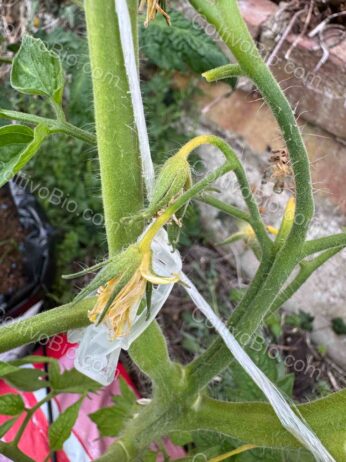
Many people think that tomatoes do not need pollinating insects because they are self-pollinating plants.
In reality, although tomato flowers contain both male and female reproductive organs, pollen still needs to be released from the anthers and reach the stigma.
This process is encouraged by vibrations caused by wind or by pollinating insects.
Among these, bumblebees are particularly efficient because they perform what is known as buzz pollination. By gripping the flower and rapidly vibrating their flight muscles, they release large quantities of pollen.
It is no coincidence that bumblebee colonies are commonly introduced into professional tomato greenhouses during flowering.
In home gardens, poor pollination is less common, but it can occur particularly in enclosed, poorly ventilated greenhouses where insect activity is limited.
If you are growing only a few plants, a simple trick is to gently shake the flower clusters during the cooler hours of the day. This light vibration encourages pollen release and can increase the percentage of successful fruit set.

Water and fertilisation: the most common mistakes
Incorrect water management can also reduce tomato production. Tomatoes prefer consistently moist soil, without repeatedly alternating between periods of drought and heavy irrigation. Sudden changes in water availability cause stress and can interfere with fruit production.
Likewise, constantly saturated soil reduces oxygen availability around the roots and prevents them from functioning properly.
Fertilisation also deserves attention.
The most common mistake is applying too much nitrogen. The plant responds by producing large amounts of foliage and vigorous vegetative growth, often at the expense of fruit production.
Among the micronutrients, boron plays an important role in pollen fertility and pollen tube growth. Boron deficiency is relatively uncommon in home gardens, but it can contribute to poor fruit set in particularly nutrient-poor soils or after prolonged periods of drought.
How to identify the problem
When a tomato plant is not producing fruit, the best approach is to carefully observe the plant before taking action.
Ask yourself:
- Has the weather been extremely hot over the last few days?
- Is the soil too dry or too wet?
- Is the plant producing excessive foliage?
- Is it growing in a poorly ventilated greenhouse?
- Are bees or bumblebees present during flowering?
Very often, these simple observations make it possible to quickly identify the cause of the problem and, if necessary, intervene with suitable support products.
Useful products
- Boron: https://amzn.to/4fNg2KN
- Seeweds biostimulant: https://amzn.to/4fO3cMt
- Flowering biostimulant: https://amzn.to/4wNvlZP