

What are plant biostimulants made from?
In recent years, the agricultural biostimulant sector has grown enormously, providing farmers with a powerful tool.
A “plant biostimulant” is any product that stimulates plant nutrition processes independently of its nutrient content, with the sole aim of improving one or more of the following characteristics of the plant or the plant rhizosphere:
- nutrient use efficiency;
- tolerance to abiotic stress;
- quality traits;
- availability of nutrients confined in the soil or rhizosphere.
A wide range of products capable of performing the functions listed above can be classified as biostimulants. From a technical standpoint, biostimulants can be divided into two broad categories: microbial and non-microbial. Microbial biostimulants consist of microorganisms or consortia of microorganisms, while all other biostimulants are classified as non-microbial.
Biostimulants can generally be obtained from the following raw materials:
- Alfalfa protein hydrolysate
- Hydrolyzed animal epithelium (solid or liquid)
- Liquid and/or solid extract of alfalfa, seaweed, and molasses
- Acid extract of seaweed belonging to the “Fucales” order
- Mycorrhizal fungi inoculum
How biostimulants work on plants
Biostimulants are used to reduce stress or increase fertilizer use efficiency, nutrient use efficiency in plants, increase photosynthesis, or perform plant defense functions. This last point is perhaps one of the most interesting aspects of using biostimulants, but it is important to note that the law does not allow biostimulants to be marketed or labeled with claims of plant protection against pathogens. Such a product would be considered a pesticide and would therefore be placed on the market under a different regulatory process. Many biostimulants, such as seaweed, contain laminarin, a compound that induces an increase in plant defenses, but this activity cannot be declared on the label.
The action of biostimulants is also aimed at reducing free radicals within the plant, compounds that form during periods of stress. A great deal of research has shown that biostimulants act on these compounds, helping plants overcome salinity stress, water stress, or extreme temperatures (both high and low).
Main biostimulants
Let’s now take a detailed look at the main compounds that have biostimulant activity, even if they do not fall within this category under Italian regulations and are therefore sold under other labels, such as specialty products or fertilizers.
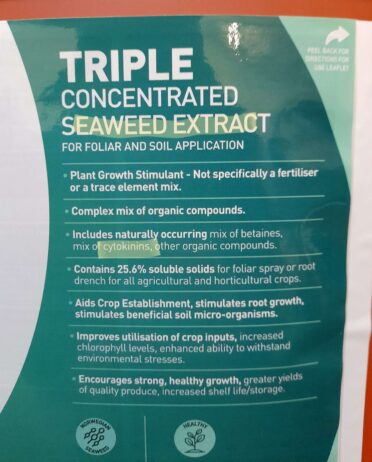
Seaweed-based compounds
These are products obtained from the processing of different species of seaweed, among which the most important are Ascophyllum nodosum and Laminaria digitata, as well as others belonging to the genera Durvillaea, Ecklonia, Fucus, and Sargassum. Seaweed contains compounds with specific hormone-like activity such as cytokinins, auxins, betaines, alginates, salicylic acid, and amino acids. Quality is directly influenced by the extraction process. The best products, those that maintain their chemical characteristics intact, are those extracted at low temperatures. Extraction with potassium hydroxide (alkaline extraction), on the other hand, reduces the amount of many components.
Seaweed can be applied both as foliar and root applications and performs important functions in recovery from abiotic stress, improving the uptake of nutrients such as nitrogen, and has a partial function in increasing plant defenses, although this cannot be declared, as explained above. A good product can be found here.
Humic substances
These are substances with biostimulant activity derived from the extraction of fossil humus such as leonardite deposits, although they can also be extracted from green compost. The main components of these substances are humic acids and fulvic acids. These compounds have been identified for years as essential components capable of providing multiple benefits to the soil. They directly influence root growth, generating better root development, which then results in better nutrient uptake. They provide tolerance to abiotic stress and help keep nutrients such as calcium available, preventing its retrogradation in some soils with alkaline pH. They improve cation exchange capacity, generating greater availability of nutrients to the plant, and have a pH-maintaining effect through a buffering action.
They can be sold in both liquid formulations (see here) and powder (like this one) or granules. Depending on the product, they can be applied both to the roots and as a foliar treatment, although because of their characteristics, their best activity is achieved when applied to the roots.
Protein hydrolysates
This is a very heterogeneous category of products because they are a mixture of amino acids and peptides of different types. Protein hydrolysates are divided into two main categories: those of animal origin and those of plant origin. Those of animal origin have a higher content of glycine and proline, while those of plant origin contain glutamic acid, aspartic acid, and tryptophan.
The composition, however, changes depending on the starting material, which can be leather, processing residues from the fish industry, or plant biomass, especially legumes. All these materials undergo chemical or enzymatic hydrolysis. It is therefore clear that, depending on the starting material and the type of hydrolysis, products with extremely different characteristics are obtained. The characteristics of hydrolysates can be summarized in the following activities:
- promote the uptake of water and nutrients,
- provide a moderate amount of nitrogen (especially those of animal origin)
- being largely composed of amino acids, they are precursors of many molecules with strong biological activity.
It has been scientifically proven that they help in the synthesis of auxins, an important plant hormone. They have an anti-stress function, helping the plant overcome difficult periods such as: - transplanting
- excessive heat
- extreme temperature conditions.
These biostimulants can be used with foliar or root treatments, although foliar application is preferred because of its faster effect. An example of this product can be found here
Mycorrhizal fungi inoculum
On ColtivoBio, we have an in-depth article on mycorrhizae and their benefits in agriculture that you can find at this link. Mycorrhizae play a fundamental role in phosphorus uptake and also appear to be involved in reducing environmental stress, especially salinity or water stress. Generally, these compounds are sold together with rhizosphere bacteria.
It has been scientifically proven that these bacteria contribute to creating a relationship with plant roots that benefits the plant itself. The rhizosphere can be compared to the microbiota of the human intestine: when it deteriorates or imbalances develop, problems also occur in the rest of the organism. The same thing happens in plants; negative effects on rhizosphere bacteria also affect the plant. This complex of bacteria also competes for space and nutrients with pathogenic microorganisms.
In addition to mycorrhizae and rhizosphere bacteria, these compounds are also sold with the addition of Trichoderma. Restoring beneficial microflora at the root level benefits the plant in several ways. These products can be sold either as powder (here is a good product) or granules (here is one of the best). Most products must be applied to the roots, although some types can be applied as foliar treatments.
Silicon
This product has been shown to have biostimulant properties with marked defense capabilities against foliar diseases, especially powdery mildew such as that affecting cucurbits. The mechanisms are not yet completely clear, but it appears to be able to create a physical barrier capable of preventing the adhesion of fungal hyphae and to stimulate the production of compounds with defense activity, such as phenols and phytoalexins. Research has also demonstrated the ability of this compound to help plants overcome water-deficit and salinity stress. The best silicon currently available on the market is that derived from potassium silicate. This biostimulant is used only for foliar treatments, see here a product