
Damping-off (Pythium)
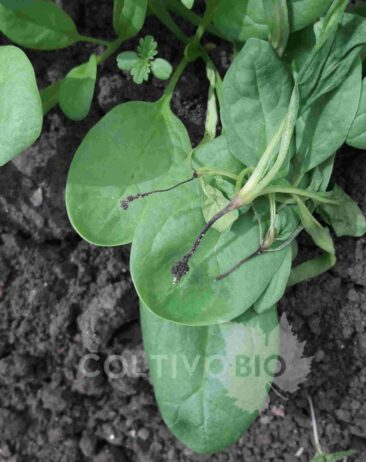
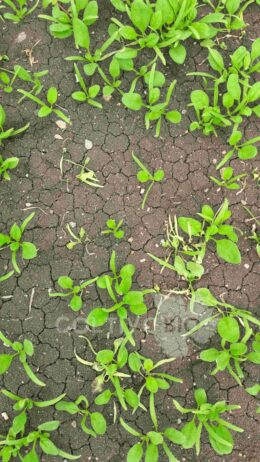
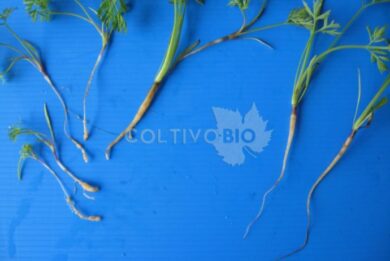
Plants attacked by fungi of the genus Pythium initially show slowed growth and chlorosis. After a few days, leaf wilting begins to appear, especially during the hottest hours of the day. These symptoms temporarily disappear during the cooler hours, such as at night, but reappear in the following days with increasing severity until the plants completely collapse and dry out at ground level (see image above).
Examination of the root system of affected plants reveals severely damaged roots with evident dark-colored necrosis and drying.Pythium species generally attack young seedlings and seedbeds, which is why this disease is commonly referred to as “damping-off of seedlings or nurseries.”
Many Pythium species are opportunistic pathogens and cause severe damage when specific conditions occur. Excessive irrigation and high temperatures are the main factors that trigger disease outbreaks. Excessive nitrogen availability also contributes to increased disease severity. For prevention, biofungicide formulations such as Trichoderma can be used. Control is much more difficult once symptoms become visible, as the disease primarily affects young plants and damage is often already irreversible.
For a complete technical description of the disease and additional control strategies, we invite you to consult our full technical data sheet on Pythium-induced damping-off (here).
Tomato fusarium wilt
The disease is caused by the pathogen Fusarium oxysporum f. sp. lycopersici. It is a serious disease that mainly affects professional farming operations, where high cropping intensity favors the spread and accumulation of inoculum. This fungal pathogen causes a tracheomycosis, meaning the blockage of the plant’s vascular system. In the early stages of infection, plants show delayed growth and pale green leaf coloration. As the disease progresses, leaves begin to lose color and turn yellow, usually without affecting the entire leaf at once. Later, larger portions of the leaf blade turn brown and dry out (see image below).
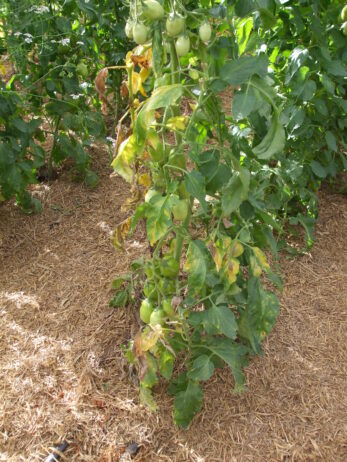
The key diagnostic symptom of Fusarium infection is the browning of the vascular tissues, which can be observed by cutting the stem either transversely or longitudinally. Fusarium wilt is difficult to control once established; therefore, disease prevention through both technical and agronomic measures is essential. The removal and destruction of suspected infected plants is critical in order to reduce the inoculum potential in the field. The main preventive measures available include soil solarization and the application of Trichoderma to the soil.
In professional production systems, tomato varieties tolerant to the disease are available, as well as plants grafted onto resistant (or, more accurately, highly tolerant) rootstocks. Crop rotation remains an effective and recommended control strategy.
For a complete technical description of the disease and additional management options, we invite you to consult our full technical data sheet on tomato Fusarium wilt (here).
Botrytis

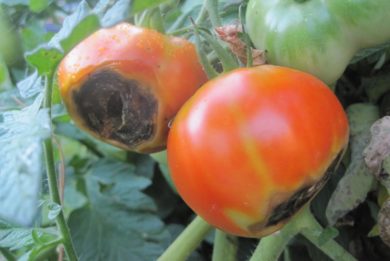
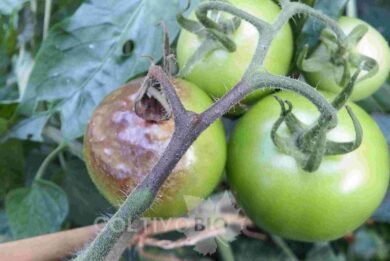
Also known as gray mold, botrytis attacks tomato fruits and flowers. On affected fruits, it appears as a gray-colored mold (see image above). Infected tissues lose turgidity, and the berries are irreversibly damaged and unmarketable. On flowers, the disease causes drying or flower abortion, followed by the development of the characteristic gray mold.
Botrytis can penetrate the plant either through the floral stigma, stimulated by secretions released by the flower, or by exploiting wounds of biotic origin, such as damage caused by Tuta absoluta.
Direct control of botrytis in organic farming can be achieved through the use of various biological plant protection products and corroborants. Among the commonly used products are copper salts, kaolin, and zeolite, as well as microbial-based products such as Bacillus amyloliquefaciens and Bacillus subtilis.
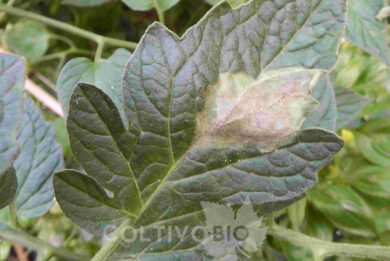
Tomato leaf mold
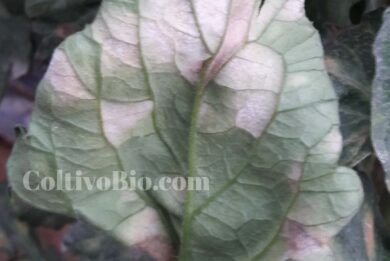
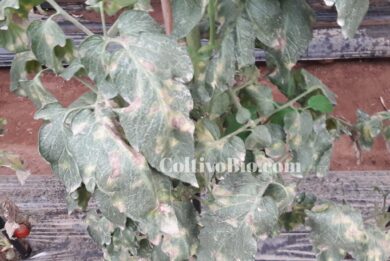
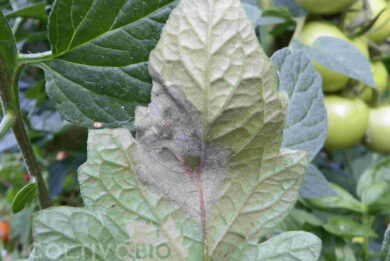
This disease is caused by the fungus Fulvia fulva. The first symptoms appear on the older basal leaves, where chlorotic spots with poorly defined margins develop on the upper leaf surface. Corresponding to these areas, a characteristic olive-colored mold forms on the underside of the leaves (see image above), which is a clear sign of the development of the fungus’s reproductive structures.
As the disease progresses, the spots enlarge and merge, leading to the drying and death of the affected leaves. More rarely, flowers, stems, and leaves may also be affected, on which the fungus causes dark, leathery black rots.
The disease is favored by high relative humidity, optimal temperatures between 22 and 24 °C, and the presence of infected plant residues. It occurs mainly in greenhouse production, where prevention focuses on reducing these favorable conditions through proper ventilation and thinning or pruning practices.
Copper-based treatments used to control other diseases also have a preventive effect against cladosporiosis.
Disease Agents: Bacterial Diseases
The main bacterial diseases affecting tomato crops are bacterial spot, bacterial speck, and bacterial canker.
Bacterial Spot
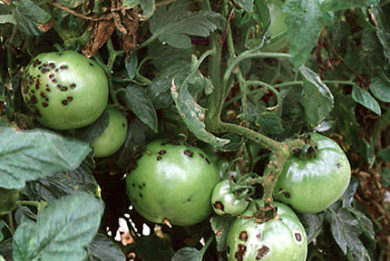
Tomato bacterial spot is caused by a complex of closely related Xanthomonas species, including X. perforans, X. euvesicatoria, X. vesicatoria and X. gardneri. This plant disease manifests as small, pinpoint necrotic lesions with irregular margins, mainly observed on the underside of the leaves. On immature fruits, bacterial spot causes sunken necrotic lesions surrounded by a dark green halo (see image above). As the fruit matures, these areas darken further and may crack, leading to fruit deformation. For a complete technical description of the disease and additional management options, we invite you to consult our full technical data sheet on bacterial spot of tomato (here).
Bacterial speck
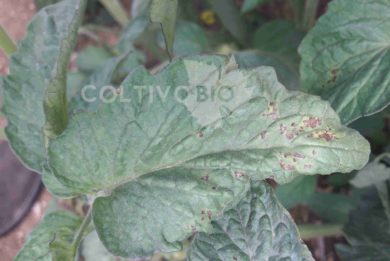
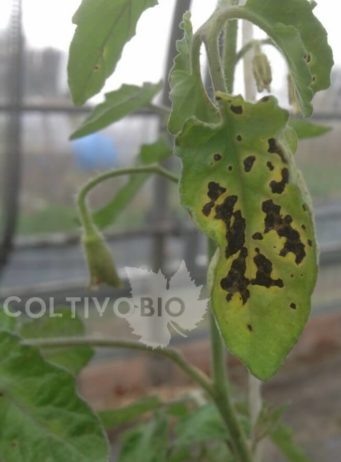
The so-called bacterial speck of tomato is a disease caused by the bacterium Pseudomonas syringae pv. tomato. On tomato plants, it appears as small, dark spots with well-defined margins that initially develop on the underside of the leaves. Over time, these lesions darken, becoming necrotic and surrounded by a clearly visible yellow halo, which can also be observed on the upper leaf surface (see image above).
On fruits, bacterial speck causes slightly raised scabby lesions approximately 1–2 mm in diameter. This results in significant damage to fresh-market tomatoes, making them effectively unmarketable, while causing minor or negligible economic losses in processing tomatoes.
For a complete technical description of the disease and additional management options, we invite you to consult our full technical data sheet on bacterial speck of tomato (here).
Bacterial canker of tomato
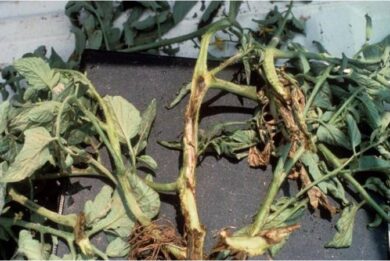
Bacterial canker of tomato is caused by the bacterium Clavibacter michiganensis subsp. michiganensis and is among the most serious bacterial diseases affecting tomato crops. This disease manifests as wilting of the affected plants, as the bacterium invades the vascular tissues, causing blockage and impairment of their function. By cutting the stem or leaf petiole either transversely or longitudinally, browning of the vascular tissue can be observed (see image above). Even more characteristic are the symptoms on the fruit: on immature tomatoes, bacterial canker causes very small pinpoint necrotic lesions surrounded by a distinct white halo.
There are no effective curative treatments for this disease; management is based almost entirely on preventive measures. Control involves removing infected plants at the first appearance of symptoms and destroying them away from healthy plants. Infected crop residues should not be incorporated into the soil, and crop rotations of 4–5 years should be adopted. Copper-based treatments are useful only in limiting the spread of bacteria and can help reduce bacterial speck and bacterial spot, but they are less effective against bacterial canker.
For a complete technical description of the disease and additional management options, we invite you to consult our full technical data sheet on bacterial canker of tomato (here).
Disease Agents: Viruses
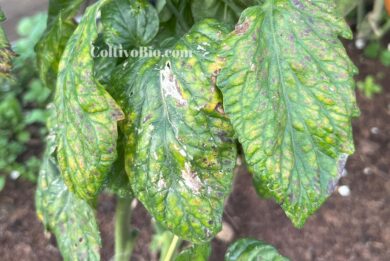
Tomatoes are affected by several viruses, many of which are difficult to identify for those without experience in plant pathology. In general, tomato viruses mainly express their symptoms on the leaves, and in some cases also on the fruits. Changes in leaf color toward pale yellow without tissue drying or mycelium formation, combined with tissue deformation or reduced plant growth, are clear indicators of a possible viral infection in tomato crops. It is not possible to cover all tomato viruses in this technical sheet; therefore, we will focus on the three most important ones.
Tomato Mosaic Virus (ToMV)
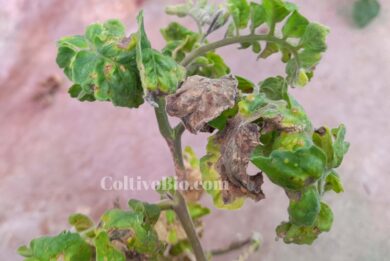
The first is ToMV, an acronym for Tomato Mosaic Virus, which causes leaf yellowing and stunted plant growth. The leaves show a characteristic mottled pattern (hence the term “mosaic”) with light green patches (see image below). Leaves may also appear deformed or have curled margins. As a result, crop yield is reduced.
On fruits, the virus causes the formation of yellow rings on the fruit surface, along with uneven ripening, leading to a decline in fruit quality. This virus is transmitted through contaminated tools and equipment, as well as through cultural operations carried out by workers who have come into contact with infected plants.
Tomato Spotted Wilt Virus (TSWV)
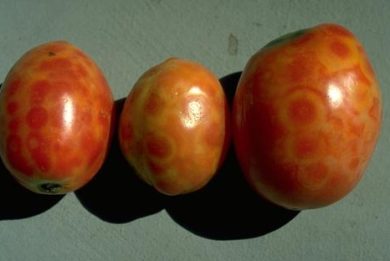
TSWV is the acronym for Tomato Spotted Wilt Virus. It causes reduced plant growth and the appearance of conspicuous concentric yellow rings on the leaves, as well as orange rings on fruits during ripening (see image below). As a result, both fruit yield and quality are significantly reduced. The main vector of this virus is the thrips Frankliniella occidentalis, which spreads the virus through its feeding activity.
Tomato Yellow Leaf Curl Virus (TYLCV)
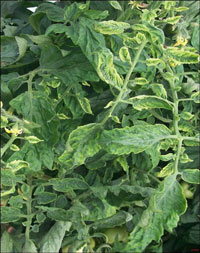
TYLCV, the acronym for Tomato Yellow Leaf Curl Virus, causes the development of small leaves with interveinal discoloration and upward curling of the leaf margins (see image below). Infected plants show stunted growth, resulting in significantly reduced yields. The main vector of this virus is the insect Bemisia tabaci, commonly known as the greenhouse whitefly. Through its feeding punctures, it infects tomato plants and transmits the virus.
Most common fungicides available online
- Sulfur: https://amzn.to/44cYH7j
- Copper: https://amzn.to/4gpw9ij
- Bacillus subtilis: https://amzn.to/4vhK6DH
- potassium bicarbonate: https://amzn.to/4we0MMz
- Trichoderma: https://amzn.to/3S3aIK1
- Chitosan: https://amzn.to/43FYAB3
Damage Agents: Insects and Nematodes
Tomato Leaf Miner (Tuta absoluta)
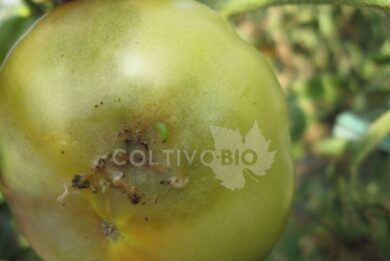
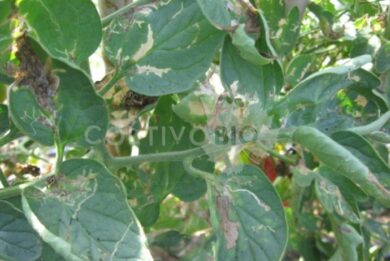
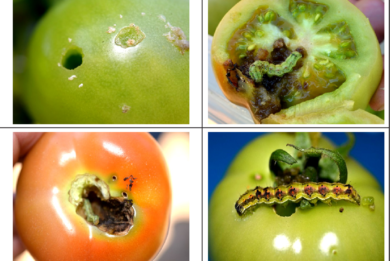
It is an insect (a lepidoptera) that arrived in Europe between 2007 and 2009 and has since become one of the most feared and damaging pests of tomato crops. The young larvae cause damage by penetrating fruits, leaves, and more rarely stems, where they create tunnels or mines (see image above). Leaf damage is characteristic and represents a clear sign of the presence of this pest, as the larvae form feeding galleries that are initially serpentine and later expand (see image above). Affected leaves become necrotic, while damaged fruits are unmarketable and highly susceptible to secondary rots and gray mold (Botrytis).
Control of Tuta absoluta relies on both chemical treatments and agronomic practices. Among the most important physical control measures are the use of insect-proof nets and mass trapping with pheromone traps. The most effective control of tomato leaf miner infestations is achieved through the use of insecticides. Biological active ingredients effective against this pest include pyrethrum, pyrethroids (View an example) Bacillus thuringiensis (Here is an example product), and, finally, spinosad, which has proven to be the most effective active ingredient.
For a complete technical description of the insect and additional control strategies, we invite you to consult our full technical data sheet on the tomato leaf miner (here).
Potato aphid