

Early blight of tomato and potato is caused by the fungus Alternaria solani. If not properly managed, this disease can cause severe damage to crops. Less experienced growers often confuse it with late blight, which is why correct identification is essential.
Identification and damage of the pathogen
This fungal disease is caused by Alternaria solani (syn. Alternaria porri f. sp. solani) and can affect both tomato and potato at young and mature stages. It is one of the main diseases of tomato and potato after late blight.
In young plants, it appears as more or less extensive necrotic lesions at the collar region (stem base), meaning the disease may already occur at the nursery stage.
If not controlled and under high inoculum pressure, these lesions may extend around the entire circumference of the stem, leading to seedling death. In early infections, necrotic spots may appear on cotyledon leaves. However, early blight attacks on young plants are relatively rare and usually occur only under heavy inoculum presence. Most infections occur on adult plants and primarily affect the foliage.
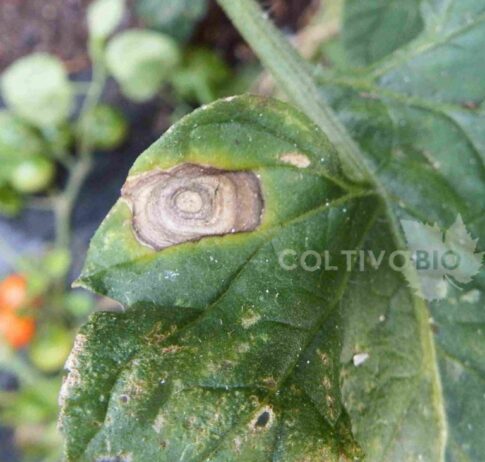
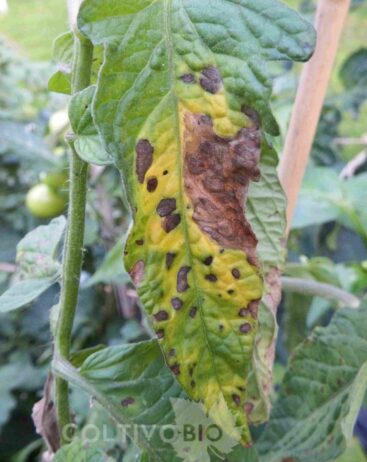
In mature plants, early blight causes necrotic lesions on stems, leaves, and fruits. On leaves, the disease is characterized by concentric necrotic spots surrounded by yellow halos (see Figure 1). Under high disease pressure, lesions may merge, leading to extensive leaf blight and drying (see Figure 2).
On fruits, large black spots with slightly sunken concentric rings appear. A dark, powdery layer composed of fungal hyphae and conidia may be visible. On potato tubers, early blight appears as dark, dry, slightly depressed necrotic areas.
Biological cycle of tomato early blight
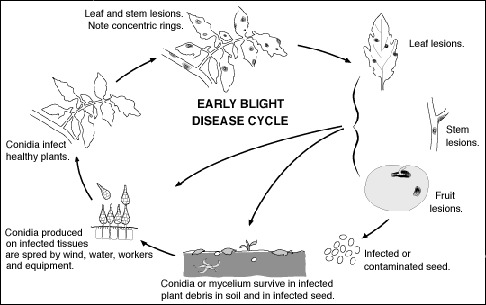
The fungus Alternaria solani survives in the soil, on contaminated seeds, or on infected plant residues. If seedborne, it can cause significant seedling losses in nurseries.
Spread is facilitated by rain and overhead irrigation systems, which disperse conidia throughout the crop environment. Early blight thrives in humid conditions with poor air circulation. It tolerates high temperatures well, with optimal growth at 28–30 °C, and conidia can germinate even at relatively low temperatures (around 10 °C).
Once conidia reach the leaves, they germinate and produce a germ tube that invades plant tissues (see Figure 3). Penetration may occur directly through the formation of appressoria that force entry into cells or indirectly through stomata.
Inside the host, the fungus spreads through plant tissues aided by enzymes that degrade cell walls and by toxins that kill affected cells. These toxins are responsible for the typical concentric necrotic lesions, which usually appear 2–3 days after infection, while conidia formation occurs after 3–5 days. The life cycle is therefore very short, resulting in repeated infection cycles.
Control of tomato early blight
Control of Alternaria solani is mainly preventive and agronomic. Key agronomic strategies include:
- Using certified disease-free seeds
- Adopting crop rotations of at least three years with legumes or cereals
- Incorporating crop residues through deep plowing at the end of the season to reduce fungal inoculum
- Avoiding overhead irrigation and preferring drip irrigation
- Selecting varieties tolerant to early blight
In organic farming, ongoing early blight infections can be managed with copper-based products. Preventive treatments with Bacillus amyloliquefaciens and Bacillus subtilis are also recommended. These antagonistic bacteria help prevent early blight infections in both tomato and potato when applied in advance.
In tomato crops, it is good practice to remove older basal leaves, as they are more susceptible to early blight. Basal leaves are also often the first to be attacked by pests such as the red spider mite or the tomato russet mite. Therefore, removing older lower leaves provides significant preventive benefits.