

Copper-based products are among the most common fungicides and bacteriostatic agents used in agriculture. In this article, we will examine all the different types, their characteristics, and their use in both organic and conventional agriculture.
How copper works in agriculture
Copper is one of the most important products in plant protection. It has a preventive action against pathogenic fungi and many phytopathogenic bacteria (bactericidal and bacteriostatic activity). Its usefulness has been widely reassessed in a positive way over recent decades. Even today, in organic farming, copper remains one of the most effective products, just consider its importance in controlling grapevine downy mildew.
In all its forms, copper is a contact product. The only exceptions are chelated copper and copper peptides, which are partially absorbed at the substomatal chamber level. This makes peptides and chelates somewhat more effective than other copper types; however, they also have higher phytotoxicity and must therefore be used with caution. These products are generally marketed as fertilizers.
Copper exerts its activity when it transforms into the cupric ion (Cu²⁺). For fungi and bacteria, this ion is an essential micronutrient for growth; however, excessive absorption and accumulation negatively affect enzymatic processes, transpiration, and respiration in bacteria. In fungi, copper ions replace hydrogen and magnesium ions within the chitin cell wall, also causing denaturation of proteins and amino acids in the cell membrane. Activation of these processes following copper application leads to the death of phytopathogenic fungi and bacteria.
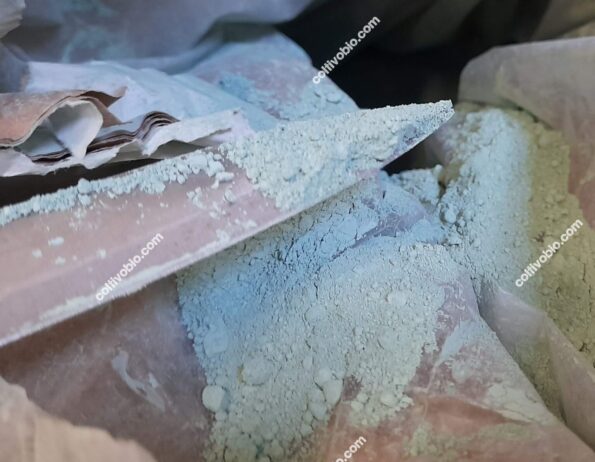
Types of copper
The main forms in which copper is used as a crop protection product are: cuprous oxide, copper hydroxide, copper oxychloride, and copper sulfate.
-
Cuprous oxide is the least commonly used form of copper in agriculture, both because it is the most phytotoxic among copper-based products and because it has low water suspendability (it tends to precipitate). On the other hand, it has good adhesion to treated plant surfaces and strong bactericidal activity.
-
Copper hydroxide is the copper salt with the fastest action. It is therefore ideal for use after adverse weather events (strong wind, hail, late frosts) or pruning, to prevent rapid pathogen entry through wounds (application within 24–48 hours of the event). An example is the use of copper hydroxide against olive knot disease. Generally, copper hydroxide provides protection for no more than 7–10 days after application.
-
Copper oxychlorides have an intermediate speed of action among copper salts and effectiveness comparable to Bordeaux mixture, with the advantage of faster preparation. They also have excellent bactericidal activity. A classic use of these products is against olive leaf spot (“peacock spot”).
-
Copper sulfate is highly soluble in water but has poor adhesion (it is easily washed off) and is very phytotoxic and acidic. Consequently, the most commonly used form of this copper salt is copper sulfate neutralized with calcium hydroxide, known as Bordeaux mixture (see below). Copper sulfate is the copper salt with the slowest action but provides protection lasting more than 20 days. For this reason, it is often used at the end of crop cycles (post-harvest) and during the leaf-fall (dormant) stage. Nevertheless, registered formulations exist for use during full vegetative growth.
-
Bordeaux mixtures are produced by neutralizing copper sulfate with calcium hydroxide. Depending on the amount of calcium hydroxide added, they are classified as acidic or neutral/basic. Acidic mixtures are less persistent, faster-acting, and more phytotoxic. Neutral/basic mixtures are more persistent, slower-acting, and less phytotoxic. These are commonly used, for example, in post-harvest or late-winter treatments against peach leaf curl.
There is also another mixture known as Burgundy mixture, in which copper sulfate is neutralized with sodium carbonate. This formulation is little known and rarely used.
Copper formulations
Copper used in agriculture is sold in two formulations: powder and liquid. Powder formulations are the most common but have the disadvantage of requiring weighing at the time of use and tend to be messy. Liquid formulations are more practical, as they can be dosed using a graduated measuring cup.
You may also be interested in the technical sheet on “the proper use of sulfur as a fungicide in agriculture” (here).
Copper-based fertilizers and biostimulants
In recent years, products containing copper that are not registered as plant protection products have been developed. In these products, copper may be present in various forms and registered as a fertilizer or biostimulant. In many of these formulations, copper still exhibits fungicidal and bacteriostatic activity. Labeling a product as a fertilizer is often a legal way to avoid registering it as a pesticide, which would involve more complex and costly regulatory procedures.
In biostimulant products, copper is usually present at lower concentrations but is made effective through the addition of compounds such as amino acids, seaweed extracts, and resistance inducers.
How to use copper correctly
For effective use of all copper salts, it is essential that application equipment is perfectly functional and that spray nozzles are clean. This is because copper is a contact product and must be applied uniformly. Product accumulation on vegetation is harmful, as excess copper due to uneven distribution can cause roughness on fruits or leaves in the affected areas.
Copper dosage must always follow the instructions on the commercial product label, as it varies depending on production characteristics, the disease being controlled, and application methods.
Treatments should also be avoided during the hottest hours of the day.
Finally, the use of copper is not recommended in mixtures with polysulfides, products based on Bacillus thuringiensis, codling moth granulosis virus, or pyrethrum.