

Identification
The disease is caused by the pathogen Fusarium oxysporum f. sp. lycopersici, where f. sp. stands for forma specialis, indicating a host-specific pathogen—in this case, tomato. It is a rather serious disease that mainly affects professional farming operations, where intensive cultivation favors the spread and accumulation of inoculum. This fungal pathogen causes a tracheomycosis, that is, the blockage of the plant’s vascular vessels.
There are several races of this pathogen, which can be distinguished by slightly different symptoms. In general, the symptoms common to all races can be summarized as follows. At the early stages of infection, plants show delayed growth and pale green leaf coloration. As the disease progresses, the leaves begin to lose color and turn yellow, usually not affecting the entire leaf. Subsequently, larger portions of the leaf blade turn brown and dry out (see photo below).
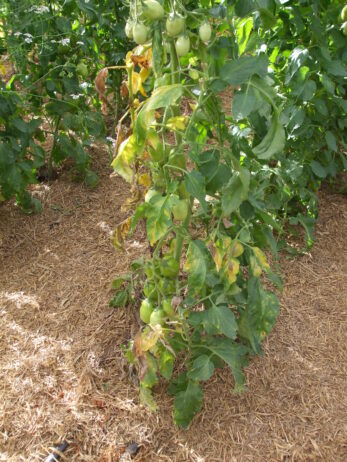
Vegetative apices tend to wilt, especially during the hottest hours of the day. These symptoms may be confused with a severe nematode infestation. The key symptom indicating the presence of Fusarium is the browning of the vascular tissues, which can be observed by dissecting the stem either crosswise or lengthwise. When affected by the fungus, the vessels appear brown (see photo below).
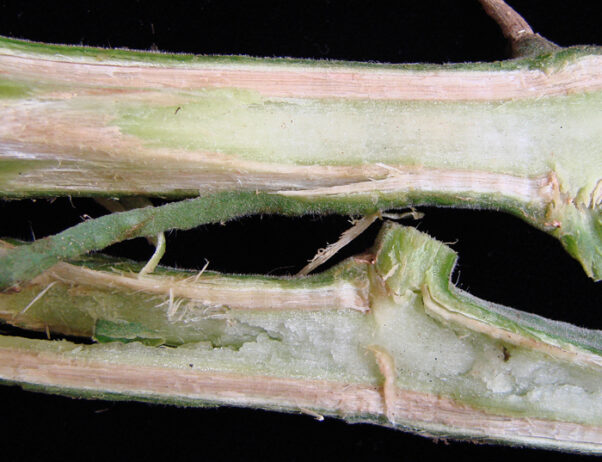
This is the main confirmation of Fusarium infection in the plant, although similar symptoms may also be caused by Verticillium spp., which generally produces less pronounced vascular browning.
Biological cycle
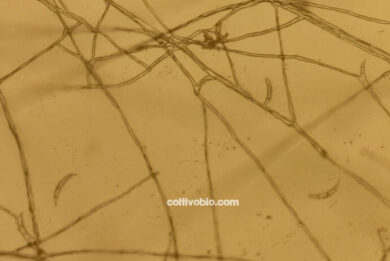
The fungus survives in the soil and on infected crop residues as conidia, the main reproductive structures of Fusarium. Fusarium conidia are characteristic and can be observed only under a microscope, with a typical spindle-shaped structure resembling a banana (see photo below). They can survive in the soil for up to two years. Fusarium oxysporum can also produce more durable survival structures called chlamydospores, which can persist in cultivation areas for several years.
By the time symptoms appear, Fusarium has already begun to develop its reproductive structures.
It is therefore essential to identify and remove suspected plants promptly.
The pathogen generally prefers medium-to-high temperatures, with an optimum around 28 °C. It is particularly dangerous in greenhouses where, due to high temperatures and short cropping cycles, it can develop aggressively, although it can also be harmful in open-field conditions.
Control and prevention
Plants that are poorly nourished in terms of calcium are more susceptible to the disease.
Fusarium wilt is difficult to cure; therefore, prevention through technical and agronomic measures is essential. Removing suspected plants is crucial to reduce the inoculum potential in the field. Preventive measures mainly include soil solarization and the application of Trichoderma to the soil.
For less experienced growers, soil solarization consists of covering bare soil with a plastic film during the hottest periods of the year, such as June, July, or August. The soil must be moistened beforehand. The temperature increase created by the greenhouse effect leads to the inactivation of many pathogens, including Fusarium. The plastic sheet should remain in place for at least 60 days.
Trichoderma is an antagonistic fungus with predatory and preventive activity against many soilborne fungi, including Fusarium. Application must be preventive and is usually carried out at transplanting, although it is also common practice to inoculate it in the nursery directly in seedbeds. The application of Bacillus subtilis through the irrigation system before transplanting is also useful.
Some studies have shown that soilborne diseases, including Fusarium, develop more easily in acidic soil pH. Therefore, in particularly susceptible situations, the addition of organic matter or fertilizers with an acidic reaction may favor the development of Fusarium wilt.
In professional agriculture, tomato varieties tolerant to the disease and plants grafted onto resistant (or more accurately, highly tolerant) rootstocks are available. Crop rotation remains a valid control measure.
Management of Fusarium therefore involves the combined use of several of the methods listed above. The use of tolerant rootstocks on solarized soils subsequently inoculated with Trichoderma (see here) provides a strong basis for effective prevention.