

Bacterial speck is a bacterial disease affecting tomato. In this technical factsheet, we will explain how to identify this disease and how to prevent it in a professional manner.
Symptoms and disease description
The disease is caused by the bacterium Pseudomonas syringae pv. tomato, which is responsible for the so-called bacterial speck of tomato. It is one of the three most important bacterial diseases affecting tomato, together with bacterial canker of tomato and bacterial spot of tomato.
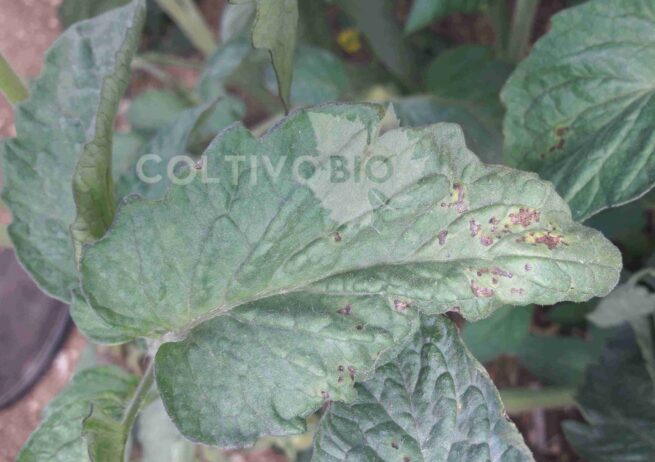
This bacterial disease appears on tomato plants as small, dark spots with well-defined margins, initially developing on the lower leaf surface. Over time, these lesions darken, becoming necrotic and surrounded by a distinct yellow halo, which is also visible on the upper leaf surface (see Figures 1 and 2).
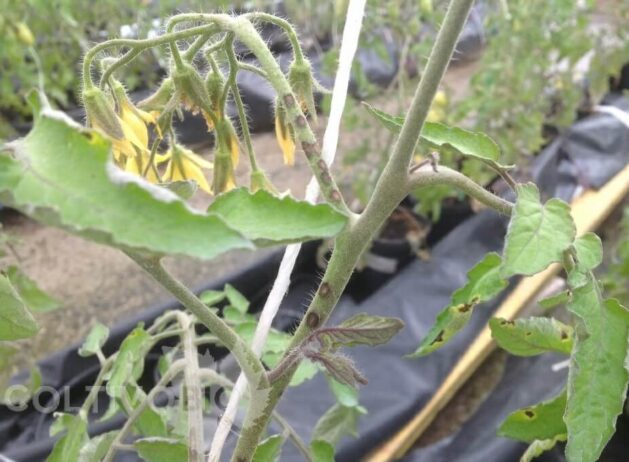
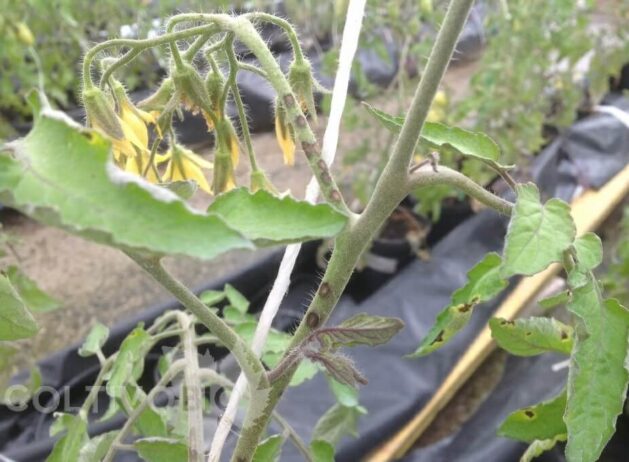
On stems, the disease causes irregular necrotic lesions (see Figure 3). These symptoms can easily be confused with those of bacterial spot of tomato (Xanthomonas vesicatoria), from which it differs mainly in the type of damage caused to the fruit.
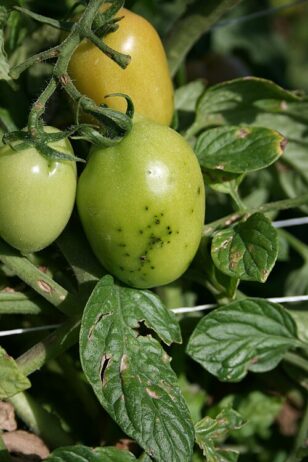
On fruits, bacterial speck causes slightly raised, corky lesions approximately 1–2 mm in diameter (see Figure 4), whereas bacterial spot produces slightly sunken circular lesions larger than 2 mm.
Bacterial speck causes severe economic damage to fresh-market tomatoes, making them unmarketable, while losses are lower or negligible in processing tomatoes.
The bacterium survives on the surface of green plant tissues, where it can persist and multiply. Disease symptoms occur only under specific environmental conditions, namely temperatures between 13 and 20 °C and the presence of free water on leaf surfaces or relative humidity above 80%.
The bacterium enters the plant through stomata or micro-wounds. Wind, rain, and overhead irrigation contribute to disease spread in the field.
Control and prevention of bacterial speck
The bacterium can survive in the soil for several years; therefore, the incorporation of infected crop residues increases the inoculum and disease pressure. For this reason, long crop rotations (3–4 years) are recommended.
Pseudomonas syringae pv. tomato has also been isolated from the rhizosphere of spontaneous plants such as Stellaria spp. and Lamium spp., as well as cultivated crops like wheat and sugar beet (Beta vulgaris). Consequently, special attention should be paid to the previous presence of these species when establishing new tomato crops.
Management strategies for this bacterial disease are mainly preventive. In addition to crop rotation, it is essential to use healthy seed or seed treated chemically or thermally.
Among seed disinfection techniques, it is worth mentioning the method involving seed extraction after fruit fermentation. Seeds are collected from crushed tomato fruits and left to ferment with pulp and seeds together, allowing the activation of lactic acid bacteria. After fermentation (approximately 3 days in the dark), the resulting pH reduction leads to the elimination of Pseudomonas bacteria inside the seed.
Another control option is the use of copper-based products. Copper treatments should be applied immediately after transplanting (or sowing) and continued until the appearance of the first flower cluster. Copper has a preventive, not curative, effect.
Application rates, timing, and treatment intervals must strictly follow the instructions provided on the product label.