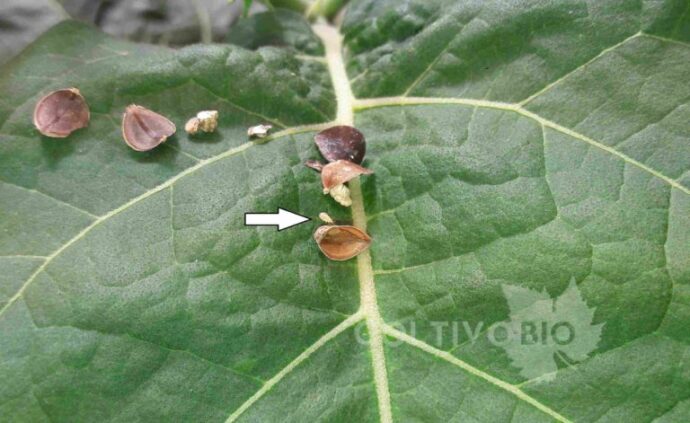

Identification and damage caused by thrips
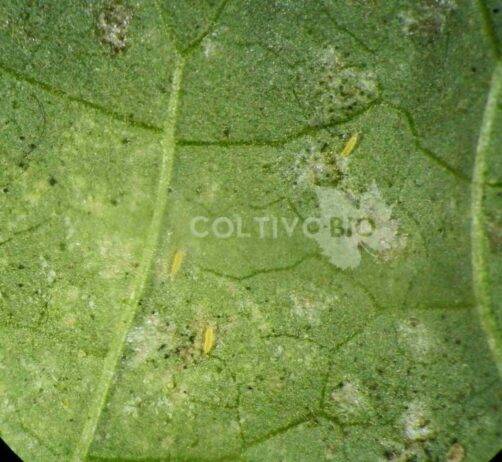
Thrips are small insects that, as adults, can reach about 1.4 mm in length. The most important species causing damage to tomato and vegetables in general are Thrips tabaci and Frankliniella occidentalis, both belonging to the family Thripidae (see Figure 1).
Frankliniella occidentalis is commonly known as the western flower thrips or greenhouse thrips, while Thrips tabaci is commonly referred to as the onion thrips.
These insects are highly polyphagous (they feed on many plant species). Among vegetable crops they attack Solanaceae, Liliaceae, Leguminosae, Cucurbitaceae, and Asteraceae. Among ornamental plants: chrysanthemum, geranium, Saintpaulia, carnation, rose, cyclamen, and poinsettia. In fruit crops, both stone fruits and pome fruits can be attacked.
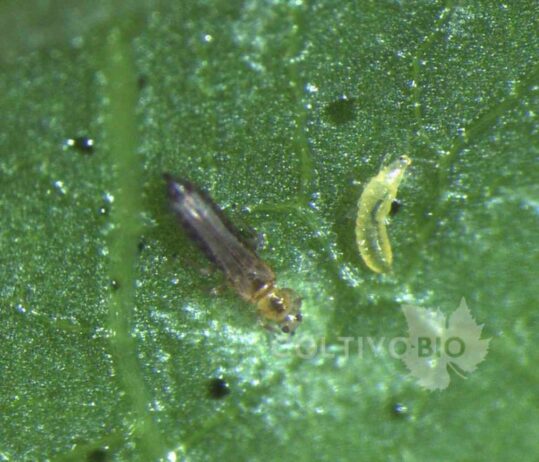
In juvenile stages, thrips are very light-colored or transparent. Adult thrips are yellowish-ochre, becoming darker with blackish streaks on the dorsal area and abdomen.
Plant damage is caused by the insect’s piercing-sucking mouthparts, both in adults and larvae. Thrips damage affects all above-ground (epigeal) plant parts. In addition to feeding damage, injury is also caused by oviposition, due to wounds created when eggs are inserted into plant tissues.
Thrips feeding damage on leaves appears as depigmented areas, which take on a silvery appearance and later become necrotic (see Figure 2). Leaf curling is also observed, followed by leaf desiccation. This process is due to the presence of toxic substances in thrips saliva.
On flowers, thrips damage appears as localized or widespread discoloration, which may develop into necrotic tissue. On fruits, feeding punctures cause corky tissue formation (suberization) and deformation. Oviposition also results in tissue deformation and corking in the area pierced by the ovipositor, the structure females use to insert eggs into plant tissues.
In addition to direct damage, serious indirect damage must be considered due to thrips acting as virus vectors. Both species transmit TSWV (Tomato spotted wilt virus) and can also spread some fungal diseases, including Alternaria porri.
We also recommend reading our technical factsheet on: “Greenhouse whitefly: proper biological control” (available via the link).
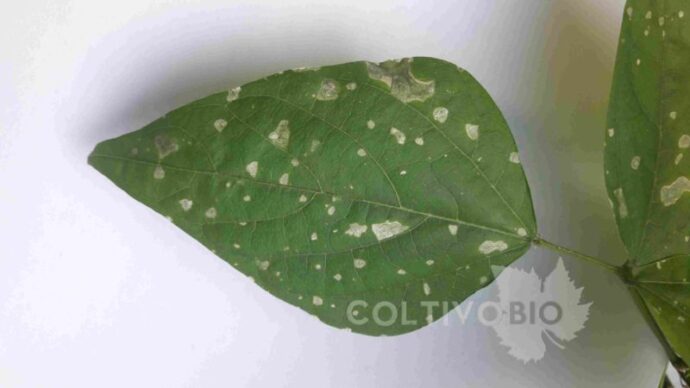
Biological cycle of thrips
The number of generations per year of Frankliniella occidentalis varies between 6 and 7. The length of the life cycle is influenced by temperature and shortens as temperature increases. The western flower thrips lays between 40 and 100 eggs during a female’s lifetime and mainly reproduces by parthenogenesis (females reproduce without fertilization).
Eggs can be laid in any plant tissue. The overwintering stage is the adult, which shelters in soil and various protected sites such as crop residues.
The biological cycle of both thrips species described includes the following stages: egg, two larval stages (early larva and mature larva), two pupal stages (prepupa and pupa), and finally the adult (see Figure 3).
Damage is caused by adults and larval stages, while the two pupal stages do not feed and usually occur in the soil, only rarely remaining on leaves. Pupal stages are immobile and move only when disturbed.
For Thrips tabaci, the life cycle is similar, with females laying up to 80 eggs per individual. Activity resumes depending on temperature: it begins earlier in mild climates or protected cultivation (late winter) and later in open fields and colder areas (early summer).
Activity of Frankliniella occidentalis and Thrips tabaci continues as long as temperatures allow, typically until late summer or early autumn.
Thrips control: biological insecticides and natural remedies
Thrips infestations require careful attention because early damage is mild and often invisible, but can suddenly become severe. Mobile stages during the day hide in plant crevices (such as between flower petals) and in the soil.
Their presence can be detected by vigorously shaking flowers or shoots into a white plastic cup, allowing mobile forms to be seen at the bottom. Another monitoring method involves the use of white or blue sticky traps, approximately one trap every 50 m². Sticky traps are also used as an agronomic strategy to reduce thrips populations.
Commercially available blue-colored plastic films and adhesive rolls can be placed along crop rows to create mass trapping systems.
Control using natural insecticides requires intervention even when few individuals are detected, using products based on azadirachtin and spinosad, combined with mineral oils and paraffin oils.
In protected cultivation, biological control can be implemented by releasing beneficial insects, including the effective predatory bug Orius laevigatus (see Figure 4) and related species such as Orius niger and Orius majusculus. Another important biological control agent is the predatory mite Amblyseius cucumeris, also highly effective against thrips.