

Rose rust is a common disease that affects roses and is considered the second most serious fungal disease after black spot. In this technical guide we will examine, from a scientific perspective, the damage caused by this fungus, its biological cycle, and how to effectively prevent and control the disease.
Identification and damage
The causal agents of this disease are several fungi belonging to the genus Phragmidium. Nine species have been identified, but the most common are P. americanum, P. speciosum, P. fusiforme, P. tuberculatum, and the most common species affecting roses is Phragmidium mucronatum. This disease can also occur on other plants belonging to the Rosaceae family, such as wild blackberry (bramble). It is one of the most common rose diseases after black spot.
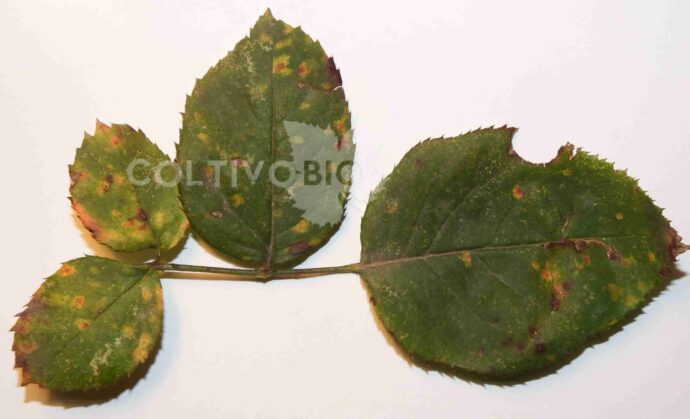
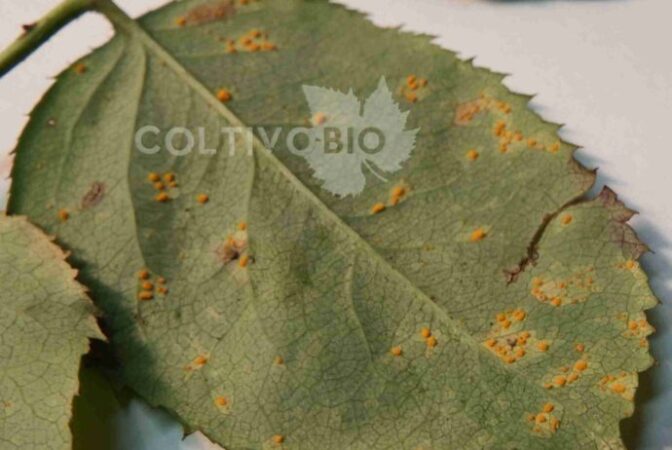
Affected plants develop small dark red or maroon spots on the upper leaf surface, surrounded by a lighter yellowish halo (see Figure 1). On the underside of the leaf, orange pustules develop corresponding to these spots; when mature, they appear powdery (see Figure 2). These symptoms may also occur on leaf petioles and young stems.
Affected organs become deformed and lose photosynthetic capacity. This leads to plant decline and premature leaf drop. Severely infected plants show poor aesthetic appearance and produce fewer flowers. It should be noted that susceptibility varies greatly among rose varieties. Some lose their leaves with only a few pustules, while others retain leaves even when heavily covered. Toward the end of summer, small black dots develop among the pustules on the underside of leaves; these are teliospores, which allow the fungus to survive until the following year.
Biological cycle of rose rust
The biological cycle of rust fungi is complex because it usually involves two different host plants, although in the case of rose rust the secondary host is not known. Here the cycle on roses is simplified.
The first symptoms appear in early spring with the formation of maroon spots on the upper leaf surface, as described above. The optimal temperature for disease development is 18–21 °C, with leaf wetness or dew lasting 2–4 hours.
The first stage of disease development involves the formation of teliospores, visible on the underside of leaves as orange powdery masses within the pustules. Teliospores germinate and release basidiospores, which are spread by wind and infect other plant organs through stomatal openings, continuing and multiplying the infection.
Toward the end of summer, uredospores develop, whose function is to allow the fungus to overwinter. Their presence appears as small black dots on the underside of leaves or on young shoots. Uredospores remaining on fallen leaves or woody parts survive the winter and initiate new infections the following year by germinating, colonizing tissues, and producing new pustules and teliospores.
Control and treatment of the disease
One of the first preventive measures when establishing new rose plantings, especially in areas with rainy and humid springs, is to choose varieties tolerant to this disease. Nurseries can provide tolerant cultivars.
In existing plantings, leaves showing early symptoms should be removed, and during green pruning all symptomatic shoots should be cut away. This helps reduce disease pressure during the current season. Additional pruning aimed at removing symptomatic woody parts should be carried out in early autumn to reduce the presence of uredospores.
Several chemical products are registered for controlling rose rust, including organic copper-based products in various formulations. Copper treatments are preventive in nature.
Treatments based on azadirachtin have a mild fungicidal effect and can help contain the disease, while also being effective against sawflies and argid pests.
Among plant strengtheners (corroborants), soybean oil can be used for its ability to stimulate plant defenses and its secondary effect against spider mites. Finally, corroborants based on silica, bentonite, and kaolin have a dehydrating and barrier effect that helps limit pathogen entry.