

Black rot of grapevine is a fungal disease that can cause severe crop losses under favorable conditions. In this technical guide, we will examine how to identify the disease through detailed photographs and how to prevent it.
Identification and damage
Black rot is an important fungal disease of grapevine that can cause severe crop losses under favorable environmental conditions. In recent years, disease pressure has increased in many wine-growing regions, particularly during seasons characterized by frequent rainfall and prolonged periods of high humidity.
The disease is caused by the ascomycete fungus Guignardia bidwellii, which generally behaves as a secondary pathogen in vineyards. However, since the 1980s, damage caused by this pathogen has become increasingly frequent, particularly on grape clusters. Although considered an opportunistic pathogen, in vineyards where it becomes established it may behave as a primary pathogen.
Disease development is strongly influenced by weather conditions and is favored by rainfall and high humidity during cluster development.
The most critical period extends from the end of flowering until veraison. If this period is characterized by dry conditions and low humidity, the disease generally remains limited. Proper management should be integrated with grapevine downy mildew and grapevine powdery mildew control programs, since some treatments used against these diseases may also provide activity against black rot.
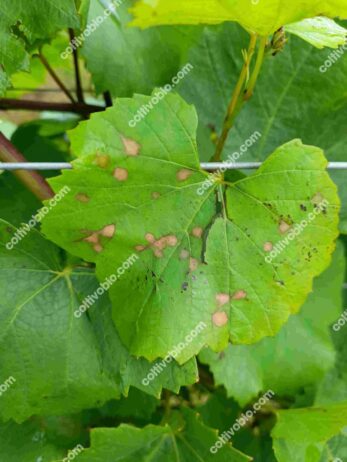
The first symptoms appear on leaves as small necrotic lesions with irregular margins, typically measuring between 4 and 10 mm in diameter (see Photo 1).
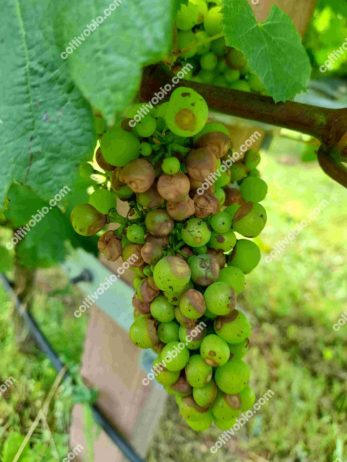
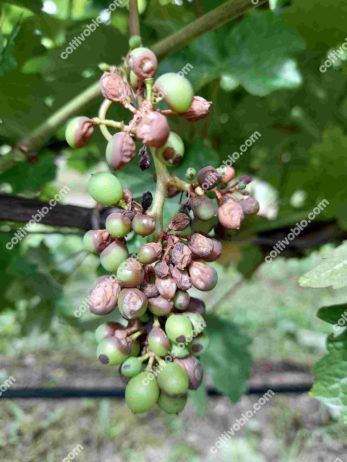
Later, young berries develop sunken lesions with a scalded appearance and a light brown coloration. These berries subsequently shrivel and dry out (see Photo 2), eventually forming the characteristic “mummies” (see Photo 3).
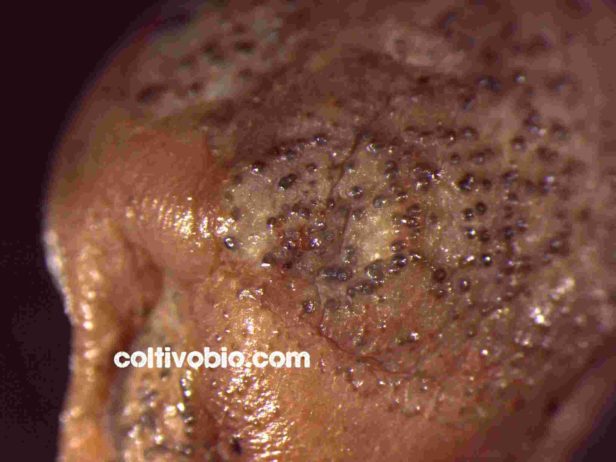
Before the berries completely dry, small black dots appear on their surface. These structures are pycnidia and/or perithecia, which are the reproductive organs of the fungus. Pycnidia and perithecia also develop within leaf lesions.
Over time, leaf lesions expand and increase in number, potentially causing the entire leaf to dry out. Infected berries eventually shrivel completely, and severe infections may result in the loss of the entire cluster.
Biological cycle of black rot
Black rot survives the winter primarily on mummified berries and other infected tissues in the form of perithecia.
Perithecia are survival structures produced through the sexual reproduction of the fungus. During spring, with the arrival of the first rains, these structures release ascospores, which are dispersed and initiate primary infections.
The first organs typically affected are the leaves, where the characteristic necrotic lesions develop. However, young clusters at the end of flowering may also become infected.
Subsequently, pycnidia develop on infected tissues and appear as small black dots on leaves and berries (see Photo 4). These structures produce conidia, which are responsible for secondary infections that aggressively attack berries until veraison.
Toward the end of summer, the fungus produces new perithecia, allowing it to survive the winter and initiate infections again the following spring.
Control and prevention of black rot
As described in the biological cycle, black rot survives within the vineyard mainly as perithecia on infected tissues, especially mummified berries.
Prevention therefore relies heavily on sanitation practices. Infected clusters and, when possible, infected leaves should be removed during summer pruning. Plant debris should be removed from the vineyard and buried or destroyed.
Good canopy ventilation is also essential. This can be achieved through appropriate canopy management practices, including shoot thinning and early leaf removal where feasible.
During winter pruning, all remaining infected clusters should be removed and taken out of the vineyard.
Special attention should also be paid to abandoned vineyards nearby, as they may serve as a significant source of inoculum.
In organic viticulture, prevention is the most important management tool because the most effective synthetic fungicides are not permitted.
Nevertheless, copper-based treatments and sulfur applications may provide some activity against grapevine black rot.
In integrated pest management programs, the disease is also controlled using fungicides belonging to the dithiocarbamate, triazole, and strobilurin groups.
Most common fungicides available online
- Sulfur: https://amzn.to/44cYH7j
- Copper: https://amzn.to/4gpw9ij