

Fig wax scale is an insect pest that primarily attacks fig trees. Controlling this scale can be particularly difficult, so timely action at the right stages of its life cycle is essential. This technical guide covers the biology and management of this pest. Fig wax scale is also present in the United States, where it has been reported, particularly in Florida. This article contains affiliate links. We may earn a commission from qualifying purchases.
Identification and damage
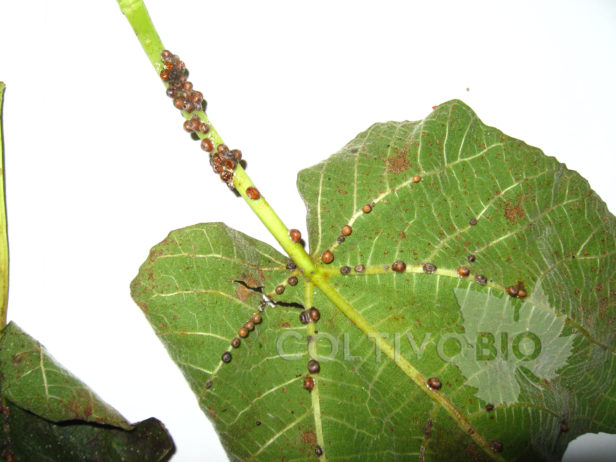
Ceroplastes rusci is an insect in the Coccidae family with a distinctive appearance. Its main host is the fig tree (Ficus carica), although it can also infest citrus and olive trees. At first glance, it looks like a small hemisphere attached to the leaf, usually along the main leaf veins (see photo above). The visible part consists of a tough waxy protective covering positioned over the insect’s chitinous exoskeleton. Adult females are generally larger than males, and their color ranges from gray to brick red.
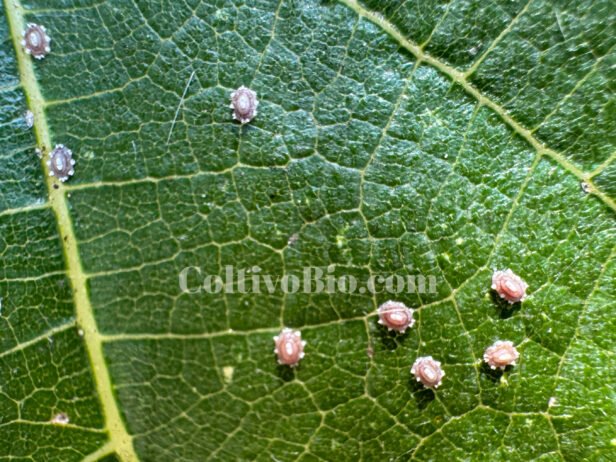
The young nymphs are smaller and less rounded than adult females. They have a flattened shape and characteristic white waxy projections on the surface of their body, so that the youngest individuals can resemble small stars. There is therefore a marked morphological difference between juvenile stages and adult females (see photos below).
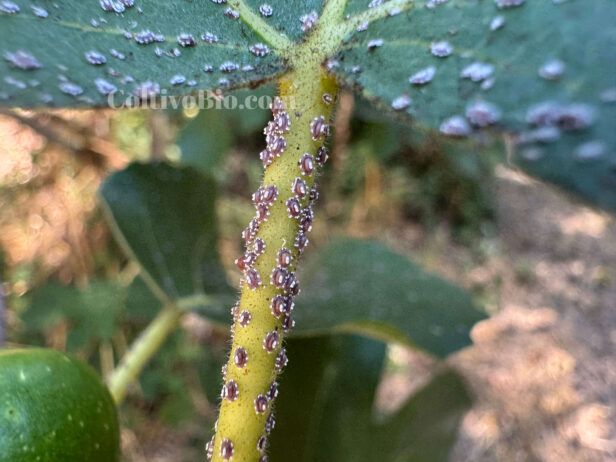
Damage is caused by the production of honeydew, which coats fruit and leaves, resulting in economic losses, reduced photosynthetic activity, and the development of sooty mold. In severe infestations, the tree may become weakened and decline.
Fig wax scale life cycle
In Mediterranean growing conditions, Ceroplastes rusci usually completes one generation per year. Under favorable conditions in southern Italy, however, a second generation may occur. Females can produce up to 1,500 eggs, which hatch into young nymphs.
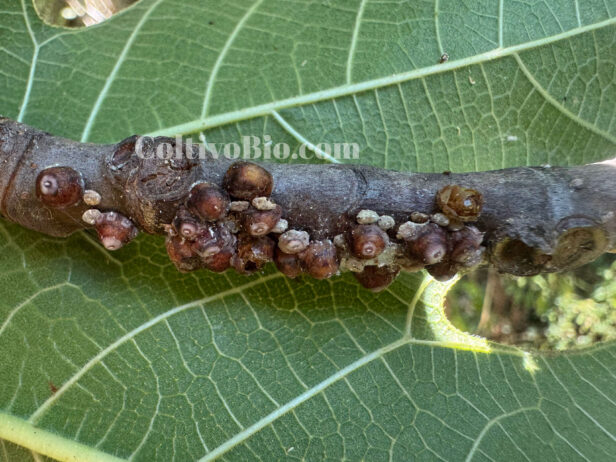
The nymphs of this scale insect tend to spread across different plant structures, including leaves, especially near the main veins, and branches. Individuals established on leaves do not survive the winter on deciduous hosts because they are removed when leaves fall in autumn. Those located on woody plant parts, however, may overwinter and resume development the following spring.
Control and natural management options for fig wax scale
Controlling this insect can be particularly difficult because adults, thanks to their tough waxy protective covering, can escape the effects of many insecticidal active ingredients. The strategy is therefore to target the nymphal stage shortly after egg hatch, when the young nymphs move in search of new feeding sites and their protective covering does not yet provide adequate protection.
It is therefore important to monitor egg laying and, at the first emergence of nymphs, apply one or more treatments with natural pyrethrum (see the technical product guide here) combined with horticultural mineral oil (see the technical guide here).
Summer horticultural oil applications can also be useful against adults (see the list below), as these products create a film over the insect that can lead to death by suffocation. Treatments with potassium soap (see the technical guide here) may provide moderate control of this insect, but they are especially useful for washing away honeydew and sooty mold.
Always use products registered for the crop and pest in your country, and carefully follow label directions, rates, timing, and safety precautions.
Ceroplastes rusci is preyed upon by lady beetles such as Chilocorus bipustulatus and Exochomus quadripustulatus, as well as parasitic wasps including Scutellista cyanea and Tetrastichus ceroplastophilus.
Insecticides and products available online
- Horticultural oil insecticide: https://amzn.to/4xBBKYw
- Potassium soap insecticide: https://amzn.to/3USZGrT