

The whitefly (also known as greenhouse whitefly) is a phytophagous insect that, under certain conditions, is very difficult to control. In this technical factsheet, we will examine the damage, control strategies, biological cycle, and natural remedies against Trialeurodes vaporariorum and Bemisia tabaci.
Identification and damage caused by whitefly
Whiteflies are insects belonging to the order Hemiptera, family Aleyrodidae, and are easy to recognize due to their characteristic appearance. Among the various aleyrodid species, the two most important in horticulture are Trialeurodes vaporariorum and Bemisia tabaci.
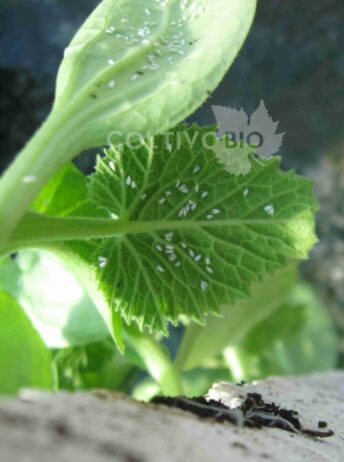
Adult whiteflies resemble small gnats (hence the common name “whitefly”), are no more than 2 mm long, and have two large white wings that cover the entire body, leaving only the yellow head visible (see Figures 1 and 2).

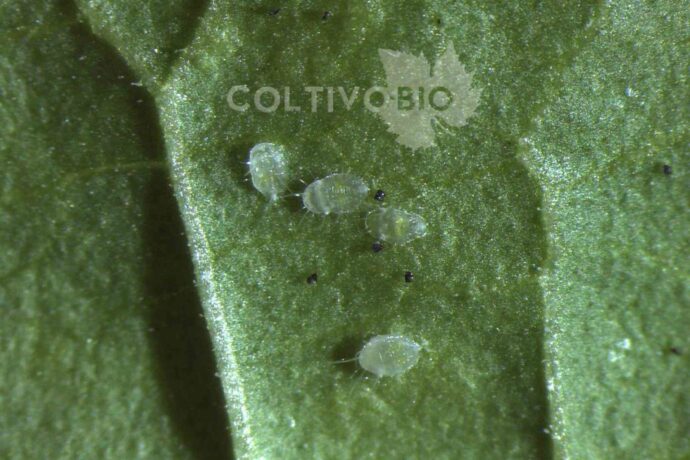
The juvenile stages are called nymphs, which appear as small, oval, scale-like plates with tufts of hairs or setae that may be more or less pronounced. This feature is difficult to see with the naked eye but allows morphological differentiation between the two species (see Figure 3).
When disturbed, adult whiteflies take flight in large numbers, moving in a zig-zag pattern and quickly seeking shelter in surrounding vegetation within a 20–30 cm radius.
Damage is caused mainly by the production of honeydew by both nymphs and adults. Honeydew contaminates leaves and fruits, leading to reduced market value, decreased photosynthetic activity, and the development of sooty mold (growth of saprophytic fungi on leaf surfaces).
Whitefly infestations can easily escape early detection and result in severe damage. In addition, aleyrodids are vectors of several plant viruses. Host plants include many species such as tomato, zucchini, pepper, poinsettia, gerbera, chrysanthemum, numerous Solanaceae, Cucurbitaceae, and many ornamental plants.
You may also be interested in our technical factsheet on: “How to control tomato leaf miner using biological methods”
Biological cycle of whitefly
In warm environments or under greenhouse conditions, both Trialeurodes vaporariorum and Bemisia tabaci can reproduce continuously or overwinter outdoors on wild host plants.
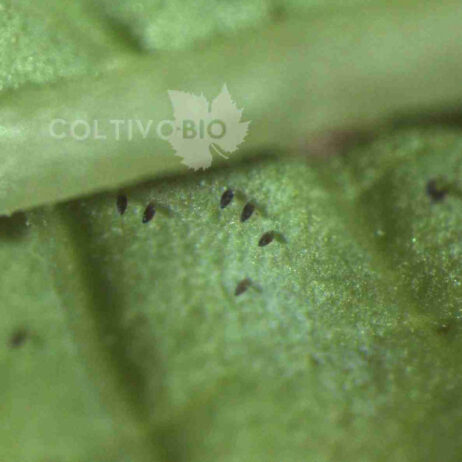
The biological cycle includes the following stages: egg, nymphs (four instars), pupa, and adult. Eggs are laid in clusters and have an elongated flask-like shape ending in a point (see Figure 4). Egg color is initially white, turning dark brown as they mature. Eggs are very small and not visible to the naked eye, requiring observation under a stereomicroscope.
Biological control and management of whitefly
There are no truly effective home-made natural remedies against whitefly, despite the many “miracle recipes” found online based on garlic, nettle extracts, and similar substances. Whitefly is a highly specialized insect, capable of rapid reproduction and of developing resistance even to chemical insecticides due to its genetic adaptability. Therefore, it cannot be controlled with improvised home remedies.
Garlic macerates, in particular, are not recommended, as no authoritative plant pathology texts or experienced agronomists recognize them as an effective control method for whitefly.
Effective management relies on integrated agronomic strategies using proven tools. First, yellow sticky chromotropic traps are useful for detecting whitefly presence in the field and for assisting in direct control, as many adults are captured by these traps.
The following active ingredients can be used for control:
- the entomopathogenic fungus Beauveria bassiana,
- summer or vegetable oils,
- pyrethrum,
- azadirachtin.
When using pyrethrum, special care must be taken to protect beneficial insects. Releases of beneficial insects should not occur until at least 48 hours after pyrethrum application, and bumblebee hives should be closed for at least 24 hours.
Azadirachtin acts more slowly on whitefly and is mainly effective against younger stages.
The highest level of biological control is achieved through the use of parasitoids: Encarsia formosa, which is more effective against Trialeurodes vaporariorum, and Eretmocerus mundus, which is more effective against Bemisia tabaci. When released correctly, these parasitoids can significantly reduce whitefly infestations.
Care must be taken with sticky traps, as they may also capture beneficial parasitoids. Therefore, when releasing these parasitoids, chromotropic traps should be removed.
Finally, it is important to mention the predatory activity of Macrolophus caliginosus / pygmaeus, a beneficial insect naturally present in the Mediterranean region, which preys on aleyrodids and other arthropods.