

In this guide, you will find all the basic information you need to grow raspberries, explained in a simple and accessible way even for those starting from scratch. The advice you will read comes from direct field experience and techniques used on professional farms, adapted to the needs of home growers.
One of the greatest difficulties for those approaching this crop for the first time is understanding how raspberries renew their canes and which growth produces fruit. Management differs considerably between summer-bearing and everbearing varieties. This article contains affiliate links. We may earn a commission from qualifying purchases.
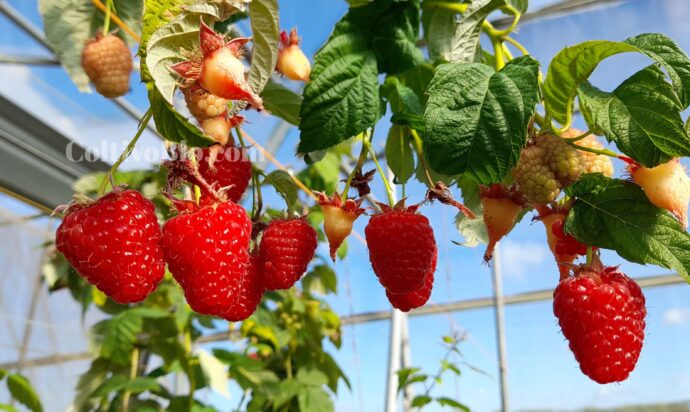
Climate and exposure: watch out for high temperatures
A fundamental aspect is that raspberries are very sensitive to high temperatures, especially when these are associated with intense sunlight and water shortage.
In areas characterized by hot summers, when possible, the ideal solution is to grow raspberries under shade netting, in order to limit excessive sunlight and reduce stress on the plants and fruit.
Water availability must be constant. Raspberries have a relatively shallow root system and can quickly become stressed when the soil or growing medium becomes too dry.
Growing raspberries in the ground
Raspberries prefer fertile, well-drained, slightly acidic soils rich in organic matter. Waterlogging must be avoided because it can promote root asphyxia and root rot.
Plants are normally trained along rows using posts and support wires to keep the canes organized.
Plant spacing and canopy management are particularly important. Vegetation that is too dense not only makes pest and disease management more difficult, but also complicates fruit harvesting. Fruit produced inside an excessively dense canopy becomes difficult to reach, and flowers located deeper within the canopy may also be less accessible to pollinating insects.
It is therefore important to maintain a sufficiently open canopy by selecting an appropriate number of canes according to the variety and plant vigor.
Irrigation
Raspberries require a fairly constant water supply throughout the season, particularly during flowering, fruit set, fruit development, and ripening.
Drip irrigation is generally the best solution because it allows water to be delivered directly to the root zone without unnecessarily wetting the vegetation.
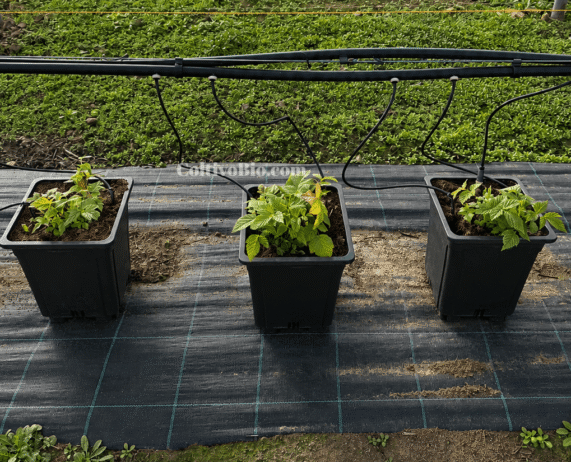
For container-grown raspberries, the best solution, also used in professional production systems, is drippers positioned directly in each individual container. This system allows water and, when necessary, fertilizers to be distributed precisely and uniformly.
For raspberries grown in the ground, pressure-compensating dripline placed along the row is particularly suitable. Pressure compensation helps maintain a more uniform flow rate along the line, which is particularly important in professional production systems and longer rows.
However, the right balance must be found: raspberries are sensitive to drought, but at the same time they do not tolerate constantly saturated soils or growing media. The goal is therefore to maintain a regular water supply while avoiding both water stress and waterlogging.
Mulching and weed control
In my experience, weeds are one of the main weaknesses of growing raspberries in the ground.
The problem is also related to the particular way in which the plant renews its vegetation. The root system continuously produces new suckers, which will form the canes for future production.
This makes it more difficult to use mechanical equipment such as string trimmers or mowers directly underneath the plants: while removing weeds, there is a risk of accidentally cutting the young replacement suckers as well.
For this reason, I recommend establishing good mulch from the time of planting. In the field, it is preferable to use a durable, long-lasting fabric ground cover such as Mypex, avoiding lightweight plastic films. Raspberries are a perennial crop, and the mulch must be strong enough to remain functional for several years.
Alternatively, organic mulch can be used. One of the most interesting materials is pine bark, which also helps maintain more stable soil moisture. However, this is a realistic solution mainly for small plantings: over areas of several hectares, distributing and periodically replacing large quantities of organic material would become difficult to sustain.
Fertilization
Raspberries are very demanding from a nutritional standpoint. Detailed fertilization management would require a dedicated article; however, in this guide we can simplify it by describing a practical and easily applicable method.
For field-grown raspberries, before planting it is advisable to incorporate pelletized manure with a high organic matter content into the soil, which is readily available from agricultural supply stores or online (see the end of the article). During the season, management can be simplified by using a standard NPK 20-20-20 fertilizer, applied through fertigation.
To make fertilization slightly more complete, from the beginning of flowering, potassium sulfate can be added to increase potassium availability, an element that is particularly important during fruit formation and ripening.
Container-grown raspberries require greater attention. The limited volume of growing medium reduces the amount of nutrients available, and plants can quickly develop deficiencies.
Here too, we can adopt a simple solution: at planting, a slow-release fertilizer, such as Osmocote or equivalent products, can be incorporated into the growing medium. During the season, NPK 20-20-20 fertilizer can also be applied through the irrigation water if necessary.
As with field-grown raspberries, potassium sulfate can be added from flowering onward to support fruit formation and quality.
This represents one of the simplest methods for managing raspberry fertilization without getting into the greater complexity of professional fertilization programs.
Growing raspberries in containers
Given these considerations, growing raspberries in containers can be easier to manage than growing them in the ground, especially when the growing area is not very large.
Containers provide greater control over weeds, the growing medium, nutrition, and irrigation, avoiding many of the difficulties associated with managing the area directly beneath the plants.
It is necessary to use sufficiently large containers and a light, well-drained, organic matter-rich, slightly acidic growing medium. Drainage must be excellent.
To further improve the physical characteristics of the growing medium, adding coconut coir at approximately 20–30% can be particularly useful. When mixed with a slightly acidic growing medium, coconut coir creates a light, porous, and particularly well-drained growing medium, while at the same time maintaining good moisture-holding capacity.
The main critical point is irrigation. During hot days, the limited volume of growing medium can dry out quickly, making frequent irrigation necessary. Nutrition must also be managed more precisely because the amount of nutrients available in the container is limited.
Supporting the canes
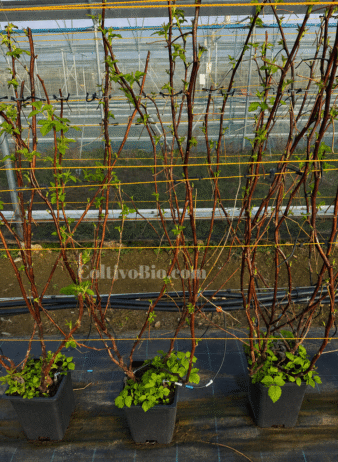
Both container-grown and in-ground raspberries require a support structure. The canes can reach considerable lengths and, as the weight of the vegetation and especially the fruit increases, they tend to bend and fall toward the ground.
The most commonly used solution consists of a structure with posts and support wires, similar to those used for grapevines. The wires are stretched along the row at different heights and are used to keep the canes upright.
The canes can be tied to the wires or guided and kept between parallel wires, depending on the training system used. This prevents them from falling outward or reaching the ground.
Correct vertical positioning of the canes also facilitates light penetration into the canopy, air circulation, treatments, and especially fruit harvesting, keeping the vegetation organized and easily accessible.
How raspberries produce fruit
For those with no experience growing this crop, probably the most difficult part is understanding how raspberries produce fruit and which canes should be kept or removed.
The fundamental distinction is between summer-bearing and everbearing raspberries.
Summer-bearing raspberries
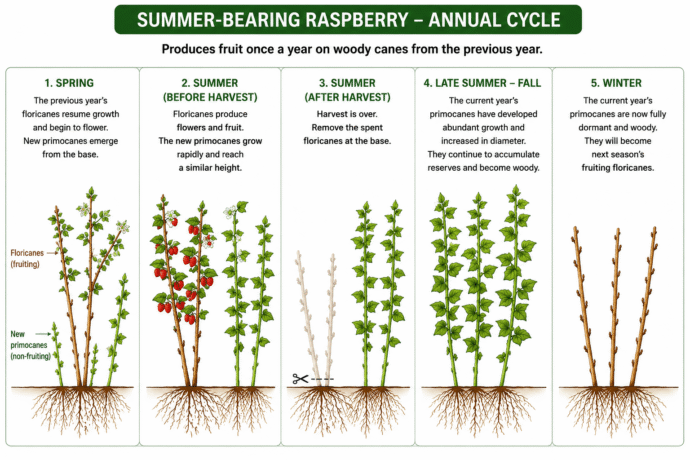
In summer-bearing raspberries, fruit is produced on woody canes that developed during the previous year.
During the season, two types of growth therefore coexist on the same plant. On one side, there are generally 3–4 woody canes that are producing fruit; at the same time, new root suckers emerge from the base.
Among these, approximately 3–5 new suckers should be selected, depending on the variety and plant vigor. These are green, tender, vigorous canes that will not produce during the current season, but they must be allowed to grow because they represent the following year’s production.
During the summer, they will progressively reach the height of the fruiting canes and, as the season progresses, will begin to become woody.
Once harvesting is complete, the old canes that have produced fruit can be removed at the base. This frees up space and light for the new suckers.
During the fall, these new canes complete the process of becoming woody. After winter pruning, only the canes that developed during the previous year will therefore remain, now woody and ready to become the fruiting canes of the following spring.
The principle is simple: while one generation of canes produces fruit, the generation that will produce the following year is being trained at the same time.
Note: during the first year after planting, summer-bearing raspberry plants generally do not produce fruit. The exception is nursery plants purchased with already developed two-year-old canes, which may produce fruit during the first year of cultivation.
Everbearing raspberries: how to obtain two crops
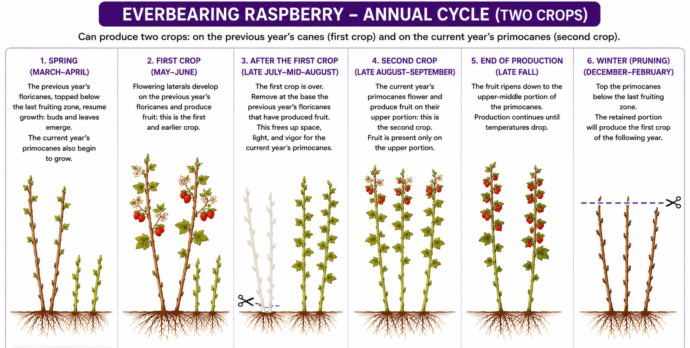
Management of everbearing raspberries is different because, with proper pruning, it is possible to obtain two crops in the same year.
At the beginning of spring, the canes retained from the previous year are present. During winter pruning, these have already been topped below the last area that produced fruit during the previous season.
As vegetative growth resumes, flowering laterals develop from the buds on the retained portion. These will produce the first, earlier crop.
At the same time, new suckers for the current year begin to develop from the base. At this stage, they are still small and must be selected and allowed to grow.
Once the first crop has finished, generally during the summer, the woody canes from the previous year (floricanes) that have produced fruit can be completely removed at the base.
This operation is very important because it frees up space within the canopy and allows light to better reach the new suckers. It also reduces competition for water and nutrients precisely when the new canes need to quickly complete their development.
Toward the end of summer, the current year’s suckers (primocanes) begin to flower and produce fruit on their upper portions. The second crop then begins and can continue through the fall until lower temperatures stop fruit development and ripening.
During the fall, the new canes progressively begin to become woody. In winter they are retained, but the upper portion that has already produced fruit is removed, making the cut immediately below the last fruiting area.
The remaining portion of the cane will produce the first crop of the following season, while new suckers will once again emerge from the base and provide the subsequent late-summer crop.
The period between the two crops in everbearing raspberries
An important aspect is that everbearing raspberries generally have a period of no production or greatly reduced production between the two harvests.
The first crop on the canes retained from the previous year ends before the new suckers are ready to begin producing the second crop.
On specialized farms, this production gap can be reduced by growing summer-bearing and everbearing varieties at the same time. Through proper variety selection, the production period of some summer-bearing varieties can overlap at least partially with the interval between the two crops of everbearing varieties, ensuring greater continuity of harvest.
It should also be considered that, generally and with potentially significant differences among varieties, the second crop of everbearing raspberries tends to be smaller in quantity than the first.
For professional production, it therefore becomes important not only to choose between summer-bearing and everbearing varieties, but also to combine varieties with different ripening periods to spread the harvest over a longer period.
Main pest and disease problems
Among the most common raspberry pests are aphids, two-spotted spider mites and other mites. During fruit ripening, particular attention should be paid to Drosophila suzukii, especially when very ripe fruit is present.
Among diseases, Botrytis, root rots, and cane diseases can become important, especially when favored by high humidity, waterlogging, and excessively dense vegetation.
Proper canopy management therefore simultaneously improves light exposure, air circulation, pollination, ease of harvesting, and pest and disease management.
Harvest
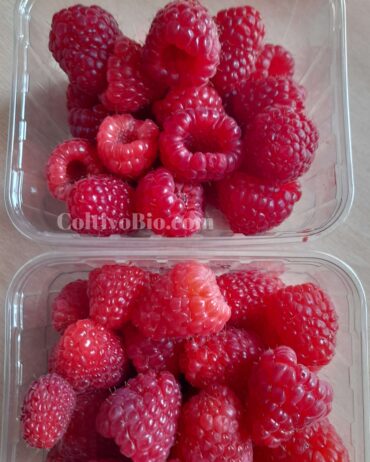
Raspberries are extremely delicate fruit with a very short shelf life. Raspberries should be harvested when they have reached the correct color and the fruit separates easily from the receptacle. After harvest, they must be refrigerated as quickly as possible because they are extremely delicate and perishable.
During the production period, it is preferable to harvest frequently, preferably during the cooler hours of the day. Avoiding leaving overripe fruit on the plant also helps limit rots and reduce conditions favorable to the development of Drosophila suzukii.
Useful products
- Coconut coir: https://amzn.to/4wzW2Ak
- Mulch Weed Barrier Fabric : https://amzn.to/4x1g5c2
- 20-20-20 fertilizer: https://amzn.to/4x2T88h
- Drip irrigation with timer: https://amzn.to/4zqO8fs
- Dripline irrigation: https://amzn.to/4hHMoYK