

Bacterial spot of tomato is a bacterial disease caused by Xanthomonas vesicatoria. This disease can also affect pepper. Below are the symptoms, damage, and management strategies for this plant pathology.
Symptoms and damage of the bacterial disease
The bacterium Xanthomonas vesicatoria is the causal agent of bacterial spot of tomato, one of the three most dangerous bacterial diseases affecting this crop, together with bacterial canker of tomato and bacterial speck.
The disease initially appears as small necrotic spots with irregular margins, mainly visible on the underside of the leaves. In some cases, necrosis may expand to involve large portions of the leaf margins.
Leaf symptoms can be confused with those caused by Pseudomonas syringae pv. tomato; however, bacterial spot is distinguished by its characteristic fruit symptoms.
On immature fruits, the disease causes sunken necrotic lesions surrounded by a dark green halo. As the fruit ripens, these areas darken and often crack, leading to fruit deformation and allowing the entry of secondary pathogens.
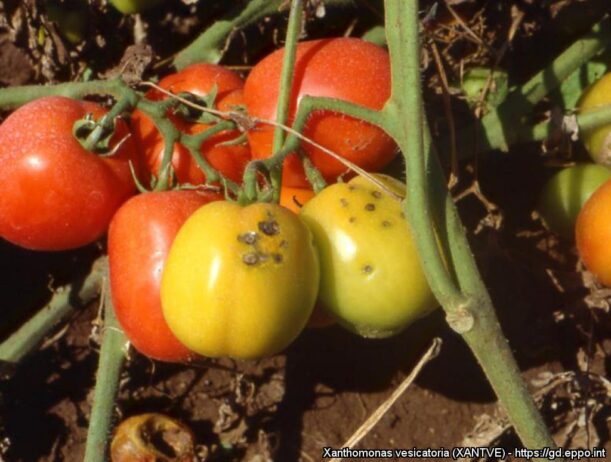
Pepper plants can also be infected, showing similar symptoms. Yield losses can be severe, particularly in processing tomatoes, while fresh-market tomatoes affected by bacterial spot are unmarketable due to visible fruit damage.
The development of the bacterium is favored by high relative humidity and temperatures between 22 and 26 °C. Infection occurs through stomata and wounds, making adverse weather events such as hailstorms and strong winds especially risky. In these cases, treatments with copper-based products are recommended within 24–48 hours.
Humans also play an important role in disease spread, both through agronomic practices that cause plant injuries and through the use of infected seed.
Control and management of bacterial spot of tomato
There is no curative treatment for this disease; management is therefore mainly preventive. Preventive strategies include:
- Crop rotations of 2–3 years, considering that the bacterium can also survive in the rhizosphere of crops such as wheat, soybean, Solanum spp., and Datura stramonium.
- Careful monitoring of environmental conditions that favor disease development.
- Use of copper-based products, which can help limit bacterial spread.
Copper salts should be applied at 7–10 day intervals, starting from transplanting or sowing until the formation of the first flower cluster, strictly following the dosages indicated on the product label.