

Citrus scab is a fungal disease caused by Elsinoë fawcettii. The fungus attacks young leaves, shoots, twigs and fruit, producing raised, rough lesions. The inside of the fruit is normally not damaged, but affected fruit may become misshapen and lose its commercial value.
How to recognise citrus scab
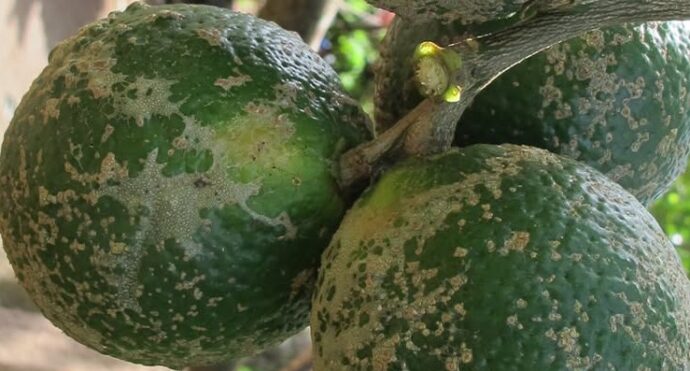
The first symptoms on young leaves are very small, pale or water-soaked spots. These spots later become raised, yellowish or light-brown growths with a rough, wart-like surface. Badly affected leaves may become wrinkled, twisted or smaller than normal.
Young shoots and twigs can develop similar hard, rough growths. On fruit, the lesions are raised, corky and irregular. They may appear as separate small bumps or join together to cover a larger part of the peel. Older lesions often become darker, cracked and deeply marked. If infection starts when the fruit is very young, it may cause deformation or early fruit drop.
These symptoms can look similar to citrus canker, melanose, thrips damage or marks caused by wind and rubbing. For this reason, citrus scab can be difficult to identify accurately from photographs alone.
Which citrus plants are affected?
Lemon, sour orange, grapefruit, mandarin and tangelo are among the most susceptible citrus plants. The disease can also be serious in nurseries, especially on susceptible rootstocks such as rough lemon, sour orange and trifoliate orange.
Most sweet orange varieties are less susceptible to E. fawcettii. A similar disease called sweet orange scab is mainly caused by another fungus, Elsinoë australis.
How the disease spreads
The fungus survives in old scab lesions on leaves, fruit and twigs. When conditions are wet, these lesions produce spores. Rain and water from overhead irrigation splash the spores onto young plant tissue.
Citrus scab is favoured by frequent rain, long periods of high humidity and temperatures of about 24–27°C. Young leaves are most at risk soon after they open. Fruit remains susceptible from petal fall for approximately two to three months.
Where is citrus scab found?
The disease is common in many warm, humid citrus-growing regions. In the United States, it has a restricted distribution and has been reported in Alabama, Florida, Georgia, Hawaii, Louisiana, Mississippi and Texas.
The pathogen is considered absent from the United Kingdom. The UK Plant Health Risk Register considers it a low risk because citrus plants are not widely grown in the country. No statutory action is indicated in Great Britain, while E. fawcettii remains a regulated quarantine pest in Northern Ireland.
Prevention and control
Start with healthy planting material and remove badly infected fruit, shoots and pruning waste. Pruning can improve air movement through the tree, while avoiding overhead irrigation reduces the spread of spores and keeps the leaves dry.
Fungicide treatments work best when they protect new leaves and young fruit before infection occurs. In areas where the disease is present, treatments may be needed during the spring growth period, at petal fall and again a few weeks later. Copper fungicides and other registered products can be used, depending on local recommendations. Always follow the product label and rotate fungicides with different modes of action to reduce the risk of resistance.
Sources: EPPO Global Database, University of Florida IFAS, UK Plant Health Risk Register.