

Aphids are among the most common pests found on vegetables, fruit trees, berries, and ornamental plants. These small, soft-bodied insects usually gather on young shoots, stems, flower buds, and the undersides of leaves, where they feed by sucking plant sap.
Light infestations often cause little damage, but large aphid colonies can reduce plant growth and cause yellowing, distorted shoots, and severely curled leaves. Aphids reproduce very quickly, so a small colony can become a serious infestation in a short period of time. This article contains affiliate links. We may earn a commission from qualifying purchases.
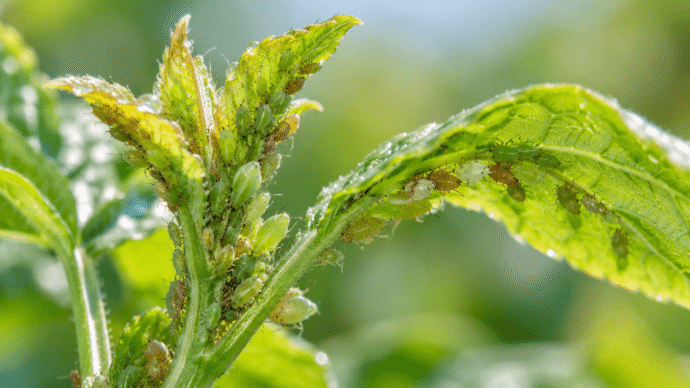
Honeydew and sooty mold
One of the easiest signs of an aphid infestation is the presence of honeydew, a sticky sugary substance excreted by aphids while feeding.
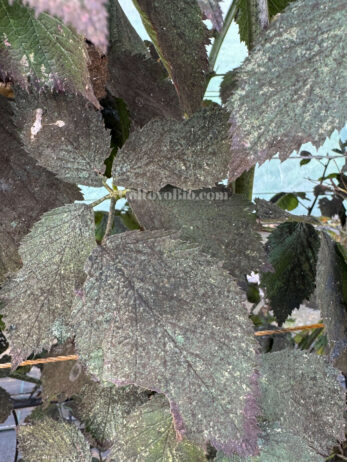
Honeydew accumulates on leaves, fruit, branches, and surfaces underneath the plant. Sooty mold fungi can then grow on this sugary material, producing the characteristic black coating seen on heavily infested plants.
Sooty mold usually grows on the surface rather than directly infecting plant tissues, but heavy growth can reduce photosynthesis and make fruit and ornamental plants unattractive.
Controlling the aphids also stops the production of new honeydew. Existing honeydew and sooty mold can gradually disappear with weathering or can sometimes be washed from the canopy.
Before using an insecticide
Not every aphid infestation needs treatment. Lady beetles, lacewing larvae, hoverfly larvae, and parasitic wasps can naturally reduce aphid populations.
A strong jet of water can also remove colonies from many garden plants.
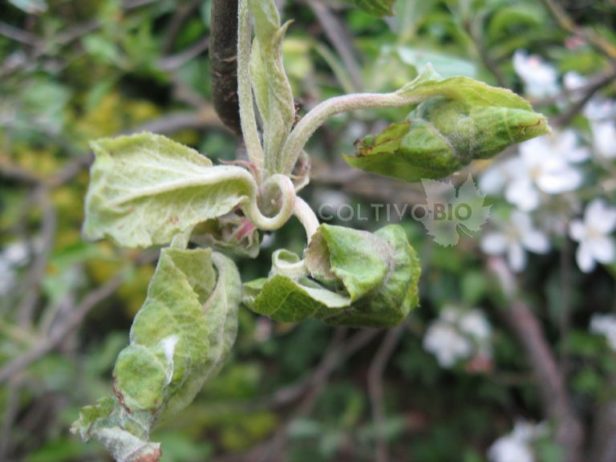
When populations continue to increase or plant growth becomes distorted, insecticides may be necessary. The most important question is whether the aphids are still exposed or are already protected inside curled leaves.
This makes a major difference because contact insecticides only work when the spray reaches the insect. UC IPM specifically notes that aphids hidden inside curled leaves are not effectively controlled by contact pesticides. (ipm.ucanr.edu)
Neem oil and azadirachtin
Neem-based products are widely used against aphids, but neem oil and azadirachtin have different modes of action.
Neem oil works primarily through direct contact (here an example of product), while azadirachtin interferes with insect feeding, growth, and development. Azadirachtin also has translaminar and limited systemic activity, allowing it to penetrate plant tissues and potentially affect aphids that are not directly exposed to the spray.
Unlike contact-only insecticides, azadirachtin may therefore provide some control of aphids protected inside curled leaves. However, its systemic activity varies depending on the formulation and plant species, and thorough spray coverage remains important.
Horticultural oil
Horticultural oils, sometimes called mineral or horticultural oils, can provide very good aphid control when the insects are exposed.
The oil works primarily through physical contact, so both the upper and lower leaf surfaces must be covered (here an example of product).
Again, the limitation is curled foliage. If the aphids have caused leaves to fold around the colony, the oil may never reach them. Avoid applications during extreme heat or on severely water-stressed plants because phytotoxicity can occur.
Pyrethrum and pyrethrins
Pyrethrins are natural insecticidal compounds originally obtained from chrysanthemum flowers (see here an example). They provide rapid contact activity against aphids and many other insects.
Their effect is relatively fast but generally short-lived. Like oils, however, they cannot control aphids that the spray cannot reach.
Pyrethrins are also broad-spectrum insecticides and can kill predators and other beneficial insects, so they should be used selectively rather than spraying the entire garden unnecessarily.
Synthetic contact insecticides
Several synthetic contact or residual insecticides are also available in the United States. Depending on the product and use site, active ingredients can include bifenthrin, cyfluthrin, lambda-cyhalothrin, permethrin, and other pyrethroids.
These products can provide longer residual activity than soaps, oils, or natural pyrethrins, but they can also have a greater impact on beneficial insects. University of Minnesota Extension warns that broad-spectrum residual insecticides can sometimes make aphid problems worse by removing their natural enemies.
They also retain the same fundamental weakness as other contact sprays: if the aphids are protected inside tightly curled leaves, coverage can be poor.
When aphids are feeding inside curled leaves, systemic insecticides can provide an important advantage because the active ingredient moves into plant tissues and reaches insects while they feed.
Imidacloprid is one of the best-known systemic insecticides used against aphids in the United States. Current EPA labels include aphids on ornamentals and various agricultural crops. Systemic applications can be especially useful on trees, shrubs, and other plants where complete spray coverage is difficult.
Dinotefuran is another systemic neonicotinoid registered in the United States for aphids and other sap-feeding insects. Depending on the product, it can be used on trees, shrubs, ornamentals, and certain agricultural crops.
These systemic neonicotinoids are highly effective but require particular attention around flowering plants because they can be hazardous to pollinators. Applications must follow the specific label and any state restrictions.
Acetamiprid
Acetamiprid is another neonicotinoid with systemic activity and is registered in the United States against aphids on a range of crops and ornamentals.
Unlike a purely contact treatment, its movement into plant tissue can improve control of insects feeding in locations that are difficult to reach with spray alone. Current EPA labels include aphids on several crop groups, although the permitted uses, rates, pre-harvest intervals, and number of applications depend on the individual product and crop.
For this reason, acetamiprid should never be treated as a universal aphid treatment: the crop must appear on the product label.
Spirotetramat
For professional and agricultural use, spirotetramat provides another interesting option.
It is a systemic insecticide particularly suited to sap-feeding pests such as aphids, scales, and whiteflies. Unlike contact products, it moves within the plant after uptake and can therefore reach insects feeding on protected plant tissues.
EPA-approved labels in 2026 include aphid control on several U.S. crops, including leafy vegetables and hops.
Spirotetramat is mainly relevant to professional crop protection rather than the typical backyard garden, and permitted uses must always be checked on the specific label.
Contact or systemic: which is better?
The answer depends mainly on the stage of the infestation.
If aphids are exposed on young shoots or on the underside of open leaves, neem, horticultural oil, pyrethrins, or other contact insecticides can provide effective control with good coverage.
If leaves have already become severely curled and the colonies are protected inside them, repeatedly spraying contact insecticides may achieve very little.
In these situations, pruning severely infested shoots may be practical on small plants, while an appropriately labeled systemic insecticide may provide much better control on plants where treatment is justified.
Do not forget beneficial insects
Aphids have many natural enemies, and these should be considered before choosing a product.
Lady beetles, lacewings, hoverfly larvae, and parasitic wasps can eliminate large numbers of aphids. Broad-spectrum insecticides can remove these beneficial insects and sometimes allow aphid populations to recover rapidly afterward.
The objective of an IPM program is therefore not simply to choose the strongest insecticide. It is to select the product that provides sufficient control while causing the least unnecessary disruption to the crop ecosystem.
A note for U.S. gardeners
In the United States, always verify that the specific pesticide product is labeled for the plant and use site you intend to treat. This is especially important for vegetables, berries, and fruit trees intended for consumption.
EPA explains that food-crop pesticide uses are limited to the crops or crop groups specifically permitted on the label. State regulations can impose additional restrictions.
For this reason, the active ingredients discussed here should be considered examples of tools available for aphid management, not universal recommendations for every crop.
The product label remains the final reference for legal use, application method, timing, pre-harvest interval, and safety precautions.
Useful products
- neem oil https://amzn.to/4yYGjwr
- horticulture oil: https://amzn.to/4yhMuLY
- pyrethrum: https://amzn.to/3T7nOH1