

Healthy soil is the foundation of a productive garden, and one of the best ways to improve it is to increase its organic matter.
Soil organic matter improves structure, water retention, drainage, nutrient availability, and biological activity. It can make heavy soils easier to work and help sandy soils retain water and nutrients.
For home gardeners, the basic principle is simple: keep adding organic material to the soil and avoid practices that make it disappear too quickly.
What is soil organic matter?
Soil organic matter comes mainly from decomposing plant and animal materials. It includes dead roots, leaves, grass clippings, crop residues, compost, manure, microorganisms, and partially decomposed plant material.
Soil organisms gradually break these materials down. Some nutrients are released and become available to plants, while part of the carbon remains in the soil as more stable organic matter.
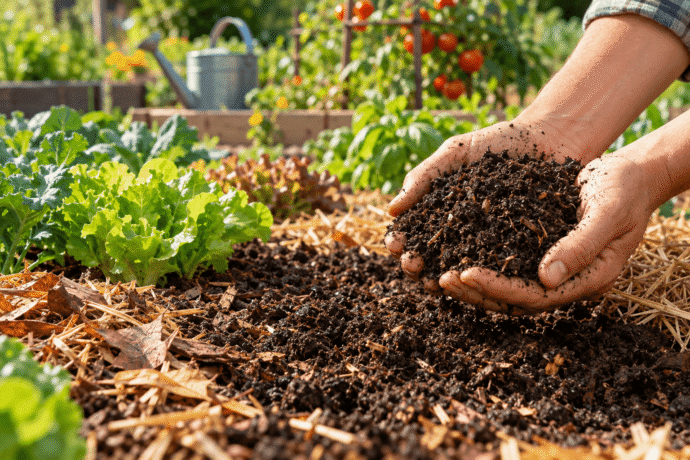
Why is organic matter important?
Organic matter helps soil hold water, retain nutrients, develop better structure, support earthworms and microorganisms, reduce compaction, and resist erosion.
This is especially important in vegetable gardens, where crops are harvested regularly and large amounts of plant material are removed every year.
1. Add compost regularly
For most home gardeners, compost is the easiest way to increase organic matter.
It can be made from vegetable scraps, leaves, grass clippings, and garden waste. Finished compost can be spread over the soil surface or lightly incorporated into the top layer.
Adding compost once or twice a year can gradually improve soil structure and biological activity.
2. Do not leave the soil bare
Bare soil loses moisture quickly and is more exposed to erosion and temperature extremes.
Use organic mulches such as shredded leaves, straw, grass clippings, wood chips, or compost.
As mulch decomposes, it contributes organic matter while also reducing weeds and the need for frequent watering.
Around fruit trees and perennial plants, mulch can remain in place for long periods. Avoid piling it directly against trunks or stems.
3. Leave healthy plant residues in the garden
Healthy leaves, roots, and crop residues can return organic material to the soil.
Small residues can be chopped and composted or left to decompose. Old roots are particularly useful because they break down directly in the soil and help improve structure.
Diseased plant material, however, should usually be removed to reduce the risk of carrying pathogens into the next crop.
4. Use fall leaves
Fall leaves are one of the best free sources of organic matter for gardeners.
They can be composted, shredded and used as mulch, added to garden beds, or turned into leaf mold.
Shredding helps them break down faster and prevents them from forming a dense layer.
5. Grow cover crops
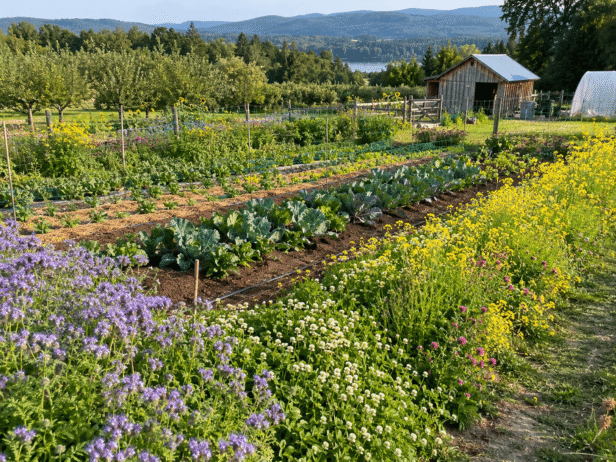
Cover crops are not only for farms. They can also be grown in vegetable gardens when beds would otherwise remain empty.
Common options include crimson clover, winter rye, oats, field peas, hairy vetch, and buckwheat.
They protect the soil, produce biomass, and add organic material through both their shoots and roots.
For small gardens, choose species that are easy to terminate before they produce seed.
6. Avoid excessive digging
Repeated deep digging or rototilling can break soil aggregates and accelerate organic matter decomposition.
It can also disturb earthworms and beneficial fungi.
Digging may still be useful when establishing a new garden or correcting severe compaction, but once the soil is in good condition, frequent deep cultivation is usually unnecessary.
Adding compost to the surface and allowing roots and soil organisms to incorporate it gradually can be a better long-term approach.
7. Use grass clippings carefully
Grass clippings contain nutrients and organic material and can be composted or used as a thin mulch.
Avoid applying a thick layer of fresh grass because it can become compacted and slimy.
Also avoid clippings from lawns recently treated with herbicides unless you know they are safe to use in the garden.
8. Use manure correctly
Animal manure can add both organic matter and nutrients, but fresh manure should be used carefully because it may contain high levels of nitrogen, salts, and human pathogens.
For vegetable gardens, properly composted manure is generally the better option.
Do not overapply it. Repeated heavy applications can lead to excessive nutrient levels, especially nitrogen.
9. Keep plants growing
Living plants are one of the main ways carbon enters the soil.
Through photosynthesis, plants capture carbon dioxide and transfer part of that carbon below ground through their roots.
Vegetables, flowers, grasses, shrubs, and cover crops all contribute to this process.
Keeping living roots in the soil for as much of the year as possible helps support soil biological activity.
10. Rotate your vegetables
Growing the same crop in the same place every year is rarely ideal.
Crop rotation introduces different root systems and plant residues while also helping reduce pest and disease problems.
Rotating tomatoes with beans, leafy vegetables, root crops, and cover crops creates more diversity both above and below ground.
11. Protect the soil from erosion
Organic matter is concentrated mainly in the upper soil layers, which are also the most exposed to erosion.
Mulch, cover crops, vegetation, and permanent pathways help protect valuable topsoil from heavy rain and runoff.
Protecting the organic matter already present is just as important as adding more.
Can you add too much organic matter?
Yes. Organic matter is beneficial, but excessive amounts of compost or manure can create nutrient imbalances.
Raised beds, for example, can develop very high phosphorus levels after years of heavy compost applications.
Compost should be used as a soil amendment, not as a complete replacement for soil.
How long does it take?
Improving soil organic matter is a gradual process.
You may notice better structure and water retention relatively quickly, but significant increases in stable organic matter usually take longer.
The best results come from repeating good practices every year.