

Eriophyid mites include several species of extremely small mites that can cause a characteristic bronzing of the foliage. As the infestation develops, leaves gradually lose their normal green colour and may become bronze, dark or appear scorched. When populations reach high levels, these symptoms can affect a substantial part of the canopy.
📷 Original field photos
The images in this article are original photographs taken by me during field monitoring and crop inspections. The symptoms shown therefore come from real cases observed directly on crops.
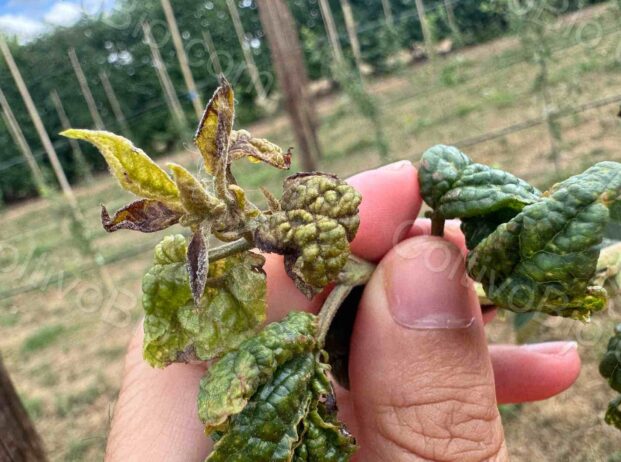
Symptoms and damage caused by eriophyid mites on plum
Eriophyid mites are extremely small, generally measuring only a few tenths of a millimetre, making them virtually impossible to identify correctly with the naked eye. They have a characteristic elongated, worm-like body and, unlike most other mites, only two pairs of legs, located at the front of the body.
To see them clearly, a high-magnification hand lens or, preferably, a stereomicroscope or microscope is required. For this reason, infestations are often first detected through the symptoms they cause on the foliage.
Eriophyid mites feed by piercing the surface cells of plant tissues and extracting their contents. On plum trees, damage mainly affects the leaves, causing what is commonly described as leaf russeting or bronzing.
During the early stages of an infestation, leaves may gradually lose their normal glossy appearance. As the infestation progresses, they develop a characteristic bronze or rusty colour.
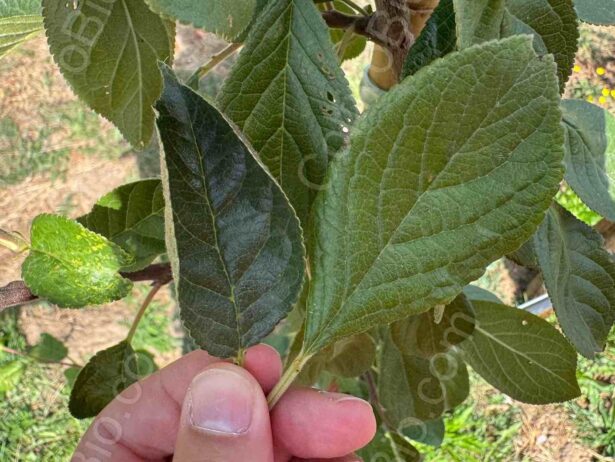
As mite populations increase, the leaves develop a characteristic bronze or dark colour and may eventually appear scorched.
Eriophyid mites are found mainly on the underside of the leaves and close to the veins.
Heavy infestations can cause leaf deformation, reduced leaf expansion and premature leaf drop.
Bronzing reduces the photosynthetically active leaf area, potentially affecting plant growth, particularly in young trees.
These symptoms should be distinguished from those caused by water stress, high temperatures or phytotoxicity. Whenever possible, the diagnosis should be confirmed by directly observing the mites under magnification.
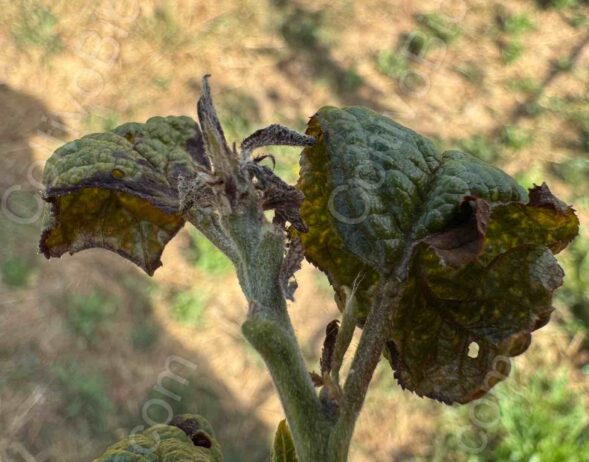
Life cycle and favourable conditions
Eriophyid mites have a rapid life cycle and can produce numerous generations throughout the growing season. They overwinter mainly as adult females, sheltered inside buds or in cracks and crevices in the bark.
Populations increase particularly rapidly under hot, dry conditions. Their development is naturally limited by beneficial organisms, especially predatory mites.
The use of broad-spectrum insecticides, such as pyrethroids, can reduce predator populations and indirectly favour eriophyid mite outbreaks.
Care should also be taken when using natural pyrethrum. Although generally less persistent than synthetic pyrethroids, it is not selective and can still affect beneficial organisms. Excessive use can therefore disrupt the biological balance of the orchard and reduce the natural control of phytophagous mites.
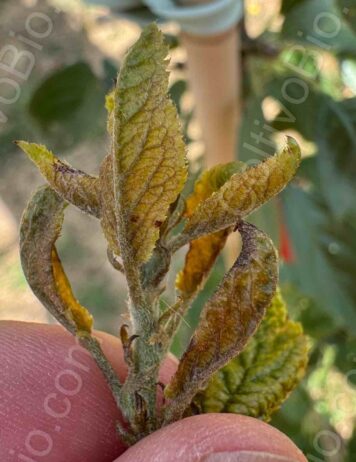
Monitoring and control strategies
Monitoring is mainly based on visual inspection of the foliage and leaf sampling. It is important not to wait until bronzing affects a substantial part of the canopy, as by the time symptoms become clearly visible, leaf damage has already occurred.
Control is relatively straightforward and can be based mainly on horticultural mineral oils, silicone-based products and sulphur, where these products are authorised and used according to label instructions.
Horticultural mineral oil acts mainly through physical contact and can effectively help reduce mite populations. Thorough coverage of the foliage is essential because its effectiveness depends on direct contact with mites present on the leaf surface.
Silicone-based products can also provide useful physical control of eriophyid mites.
Although primarily used as a fungicide, sulphur also has well-known acaricidal activity and can contribute to eriophyid mite control. Where sulphur is already included in spray programmes for fungal disease control, it may therefore provide an additional effect against mite populations.
When using mineral oils and sulphur, particular attention should be paid to high temperatures, intervals between applications and product label instructions, as incorrect use can increase the risk of phytotoxicity.
Insecticidal soap is another useful option. It has a physical action similar to horticultural mineral oil and, although generally slightly less effective, can be safer to use under high-temperature conditions.
Another important part of the strategy is the conservation of beneficial organisms, particularly predatory mites. Among these, Amblyseius andersoni (readily available online) can contribute to the natural control of eriophyid mite populations by feeding on these small plant-feeding mites.
Useful products
- Horticultural mineral oil: https://amzn.to/4zeXzyk
- Sulphur: https://amzn.to/45pKp3V
- Insecticidal soap: https://amzn.to/4qhbFLF