

Azadirachtin or neem oil is an insecticide widely used in organic agriculture. In this technical fact sheet, we will examine the mode of action, use, and characteristics of this product. At the end of the article, you will find a list of commercial products based on this active ingredient.
What azadirachtin or neem oil is and how it is used
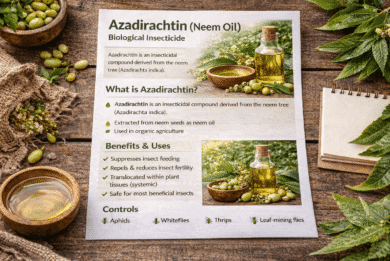
Azadirachtin (Azadirachta indica) is derived from a tree native to the Indian subcontinent. The active ingredient is extracted both from the seeds producing an oil with insecticidal properties (neem oil) and from plant extracts (leaves and shoots).
Several insecticidal active compounds have been identified in this plant, but the most important are azadirachtin A and azadirachtin E. Among these, azadirachtin A is the one whose concentration is declared in commercial formulations.
Its mode of action is based on a chitin-inhibiting effect, meaning it disrupts the development of juvenile insect stages by preventing molting. The stress caused to the insect leads to death within a few days demonstrated. For this reason, azadirachtin is not effective against adult insects.
It also has repellent activity, reduces adult fertility, and decreases egg viability. Unlike pyrethrum, azadirachtin has systemic activity, meaning it can be translocated within plant tissues, allowing it to control insects that were not directly hit by the spray. This characteristic also makes it suitable for use via fertigation.
This natural insecticide is absorbed by phytophagous insects both by contact and, primarily, by ingestion. Azadirachtin-based products are highly selective toward beneficial insects, preserving most natural enemies—an especially valued feature in organic farming.
These characteristics make azadirachtin ideal for controlling difficult pests such as:
- gray apple aphid
- thrips
- whiteflies
- leaf-mining flies (Agromyzidae)
These pests are particularly difficult to manage in biological control systems. Recent studies have also demonstrated its effectiveness against root-knot nematodes, and commercial formulations are already registered for this use.
Azadirachtin-based products are also marketed as fertilizers. Processing residues of the neem plant still contain part of the insecticidal active compounds and are sold as powders or pellets for soil application. In these products, efficacy varies depending on the degree of processing and the residual amount of active ingredient remaining after extraction.
Unlike products sold as insecticides (plant protection products), where the active ingredient concentration is clearly stated on the label, the actual insecticidal and/or repellent effectiveness of azadirachtin-based fertilizers and oils depends largely on the reliability of the manufacturer.
For optimal insecticidal efficacy, it is recommended to use spray solutions with a pH of around 6.5 and to avoid solutions with a pH above 7; in such cases, the solution should be acidified. Products based on azadirachtin are permitted in organic agriculture.
The purchase of ready-to-use products is not recommended, as they contain low concentrations of active ingredient and azadirachtin requires repeated applications over time. Concentrated products are more cost-effective.