

Identification and damage caused by the insect
Claudius pectinicornis is an insect belonging to the order Hymenoptera whose larvae cause damage to plants in the Rosaceae family, especially cultivated roses. The common name of this insect is rose sawfly or black rose sawfly. The adult resembles a small black wasp about 5–6 mm long (see image above).
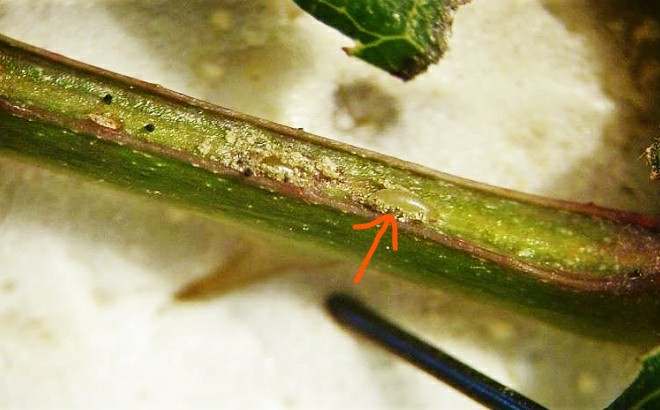
This insect lays eggs on leaf petioles, so it is important to recognize the signs of oviposition, which this technical sheet will help you identify. The sawfly lays its eggs by making linear incisions on the upper side of the leaf petiole. For inexperienced observers, these signs may go unnoticed, but they are an important warning signal of infestation (see Figure 1).
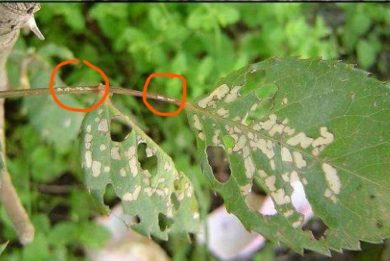
Once the eggs hatch, the larvae move onto the leaf blade and begin feeding. The larvae range in color from green to pale yellow. Rose sawfly larvae feed in a characteristic way: they remain hidden on the underside of the leaf and feed while leaving most of the upper surface and veins intact. As a result, the leaf appears skeletonized and transparent (dried out) in the areas where the larvae have fed (see Figure 2).
Similar damage can be caused by other insects belonging to the Argidae family (rose argid sawfly), but their larvae feed starting from the leaf margins and consume almost the entire leaf, usually leaving only the main vein intact. Care should therefore be taken not to confuse damage caused by different species.
Biological cycle of the rose sawfly
After completing their feeding activity, Claudius pectinicornis larvae pupate near the infested leaves. Only the last generation, which overwinters, pupates in the soil within the first few centimeters of the ground. In early spring, adults emerge from the soil and begin a new infestation cycle. The rose sawfly can complete up to 2–3 generations per year.
Natural remedies for controlling the rose sawfly
insecticide for controlling black rose sawfly attacks is pyrethrum and spinosad, effective against this insect, spinosad is effective against sawfly species in general. This means that applications targeting other pests such as thrips or leaf miners may also have a secondary effect against rose sawfly.
Both pyrethrum and spinosad mainly act on larval stages, although they may also affect adults. These products provide rapid knockdown action and are recommended when infestations are already present.
Summer horticultural oil also has some effectiveness against this insect, although weaker. This oil can be mixed with pyrethrum to obtain a synergistic effect.
All these products are available at specialized agricultural stores or nurseries. When only a few rose plants are affected, larvae can also be removed manually from the underside of leaves.
Insecticides for rose sawfly
- Pyrethrum
- Spinosad
- Horticultural oil