

The box tree moth (Cydalima perspectalis) is a moth native to Asia that has rapidly spread across Europe in recent years, becoming one of the most important pests of boxwood (Buxus spp.). Its destructive potential is linked not only to the voracious feeding behavior of the larvae but also to its ability to produce multiple generations per year, making infestations particularly difficult to control.
This article contains affiliate links. We may earn a commission from qualifying purchases.
Identification
Like many moths, the box tree moth goes through four stages of development: egg, larva, pupa, and adult. Eggs are laid on the underside of leaves and, once hatched, give rise to green larvae with dark stripes, which are the stage responsible for plant damage (see photos below). The larvae develop by actively feeding on the foliage and, at the end of their development, pupate within the canopy, often protected by silk webbing. Under favorable conditions, multiple generations may occur during the growing season, often overlapping and making management more challenging.
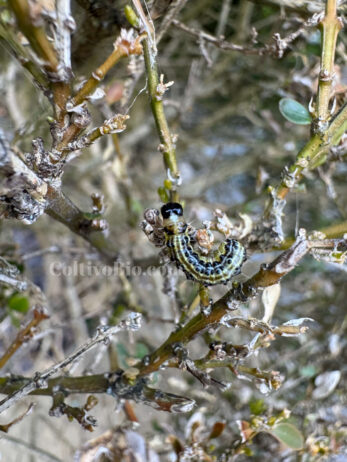
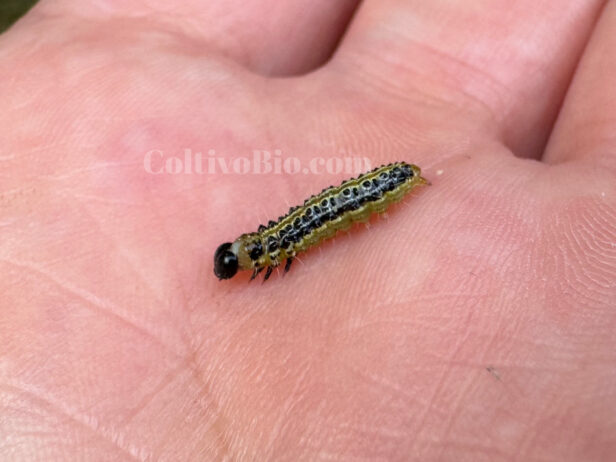
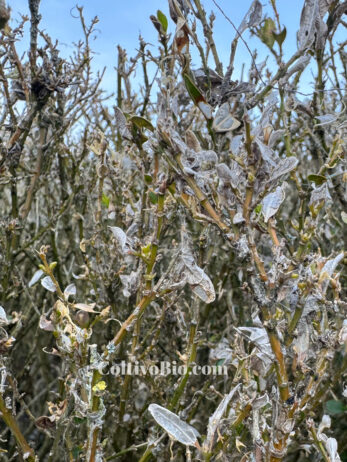
The symptoms of infestation are initially difficult to detect. In the early stages, superficial feeding damage on the leaf surface and the presence of fine silk threads within the canopy can be observed. As the infestation progresses, the damage becomes more evident: leaves are progressively skeletonized, and dark frass accumulates among the branches (see photo below). The foliage takes on a dry, untidy appearance and is often covered with webbing. In severe infestations, the larvae may also feed on the bark of young shoots, causing rapid plant decline and complete defoliation. Mature plants subjected to repeated defoliation may eventually die, which is not uncommon during severe outbreaks.
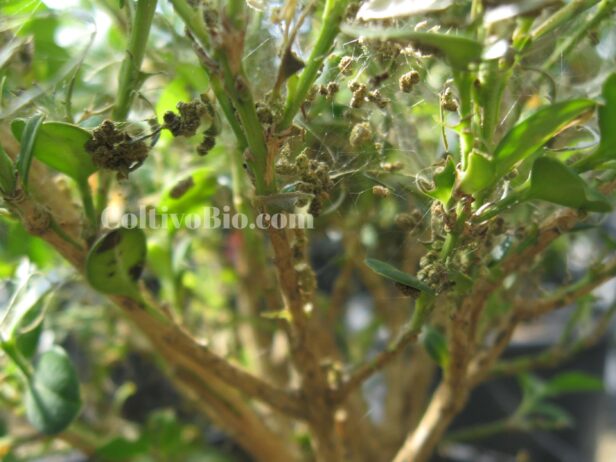
After the emergence of the first generation, adult moths can be easily observed on boxwood plants. During the day, they frequently rest on the foliage, making them relatively easy to detect and identify, even for non-specialists. Visual inspection of plants is therefore a useful tool for the early detection of infestations. Depending on climatic conditions, the box tree moth may produce between two and four generations per year, with higher numbers occurring in regions characterized by longer growing seasons and warmer temperatures (see photo below).
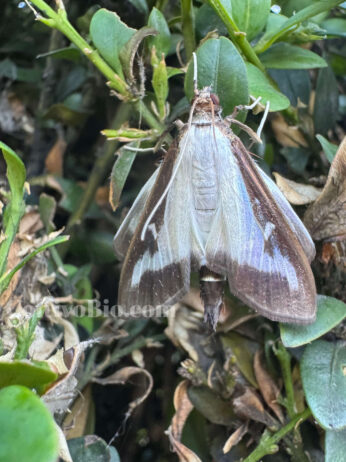
One of the most critical aspects of box tree moth management is the difficulty of detecting infestations during the early stages. Larvae tend to develop within the inner canopy, where they are difficult to spot, often resulting in interventions being delayed until significant damage has already occurred. Consequently, regular visual inspections are essential. Growers should carefully examine the interior of plants, where the first colonies typically establish. Alternatively, for a more professional monitoring strategy, pheromone traps can be used to detect adult flight activity and predict egg-laying periods, as discussed in the section below.
Insecticides to use
When considering control strategies, it is important to emphasize that treatment effectiveness largely depends on timing. Products based on Bacillus thuringiensis var. kurstaki are highly effective during the early stages of infestation. This microorganism acts through ingestion and selectively targets lepidopteran larvae, providing excellent control when caterpillars are still young. However, its effectiveness decreases significantly against older larvae, making a more comprehensive control strategy necessary.
When infestations are already advanced, insecticides with a rapid knockdown effect may be required. Active ingredients such as pyrethrin and spinosad provide fast action and effective suppression of larval populations. These products act through both contact and ingestion but must be applied carefully to ensure adequate penetration into the canopy, where the larvae are located. Pyrethroid insecticides provide rapid contact control of box tree moth larvae and generally offer longer residual activity than pyrethrin-based products.

Like all plants, roses are susceptible to attacks from pests and diseases caused by fungi and insects. In this practical guide, we provide an overview of the main plant health problems affecting roses.
An often-overlooked factor is the difficulty of achieving thorough spray coverage. Since the box tree moth develops in protected inner areas of the plant, it is essential that treatments reach the interior portions of the canopy. Without adequate coverage, even highly effective products may deliver unsatisfactory results.
There is no single definitive solution for box tree moth control. Successful management requires a strategy based on continuous monitoring, timely interventions, and, when necessary, repeated treatments. The objective is not only to eliminate the current infestation but also to prevent subsequent generations, which can develop very rapidly.
Use of pheromone traps
Pheromone traps can be used against the box tree moth according to two main strategies.
The first approach is monitoring. In this case, traps act as an early warning system. The capture of the first adults indicates the beginning of the flight period, allowing growers to initiate visual inspections and search for early symptoms and young larvae. This information helps optimize treatment timing.
Alternatively, traps can be used for mass trapping. By reducing the number of adult males present in the environment, the probability of successful mating is lowered, thereby reducing the overall intensity of the infestation.
It is important to note that pheromone traps attract only males. This means that females fertilized elsewhere may still reach the plant and lay eggs. For this reason, pheromone traps should not be considered a standalone solution but rather integrated with targeted insecticide applications.
Further below, you will find a link to purchase this type of pheromone trap.
Insecticides for Box Tree Moth Control
- Bacillus thuringiensis kurstaki insecticide: https://amzn.to/4xM8jDy
- Pyrethrin insecticide: https://amzn.to/4xJYcPB
- Pyrethroid insecticide: https://amzn.to/4eoWmMG
- Spinosad: https://amzn.to/4uSH9IG