

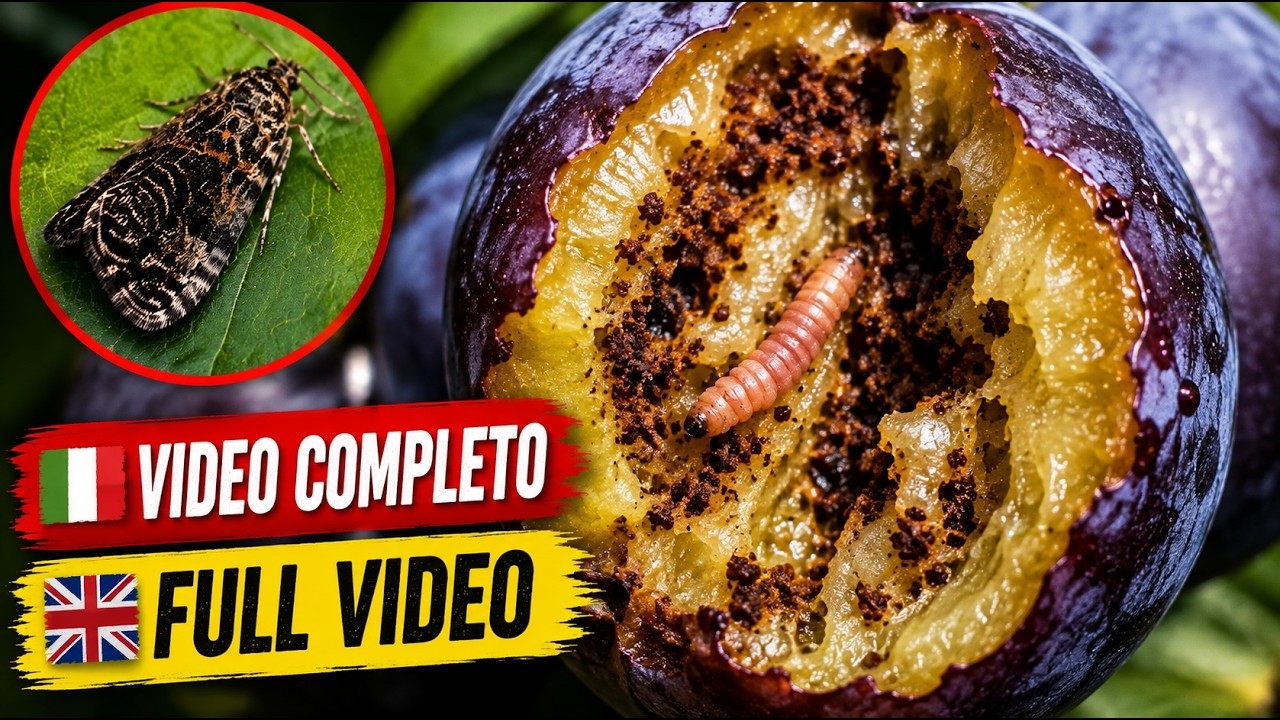
he plum fruit moth, currently classified as Grapholita funebrana (Treitschke, 1835) and still widely known as Cydia funebrana, is one of the main fruit-feeding pests of plum trees. The larvae penetrate the fruits (plums), where they feed on the flesh, causing direct damage to production, premature fruit drop and greater susceptibility to secondary disorders.
📷 Original photos from the field
The images in this article are original photographs taken personally during monitoring and field observation activities. The symptoms shown therefore refer to real cases observed directly on crops.
Description of the insect
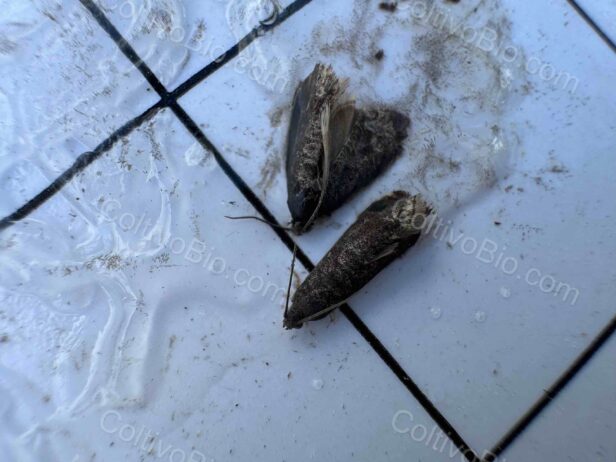
The adult of Grapholita funebrana is a small moth belonging to the Tortricidae family, with a wingspan of approximately 12–15 mm (see photo below). It is widespread in the main European plum-growing areas, with pressure varying according to climate, cultivar and ripening period. The forewings are greyish-brown, with lighter and darker mottling that makes the adult difficult to see on the vegetation. The eggs, small and flattened, are laid mainly on the surface of the fruits. The larvae are initially pale and progressively become pinkish or reddish. At maturity, they reach approximately 10–12 mm in length. It is the larval stage that causes direct damage to the fruits.
Symptoms and damage on plum fruits
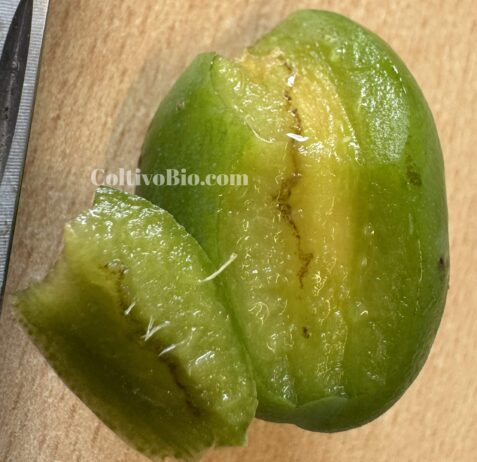
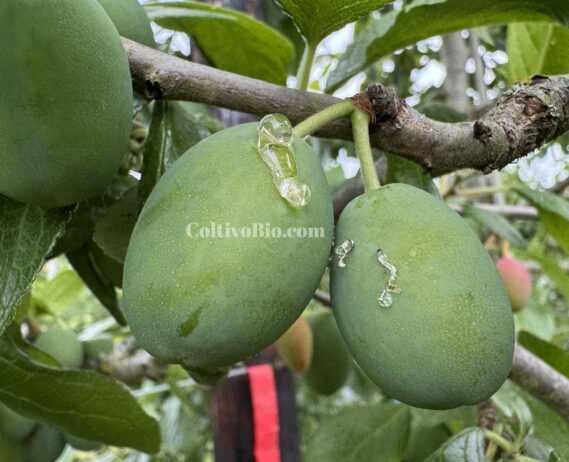
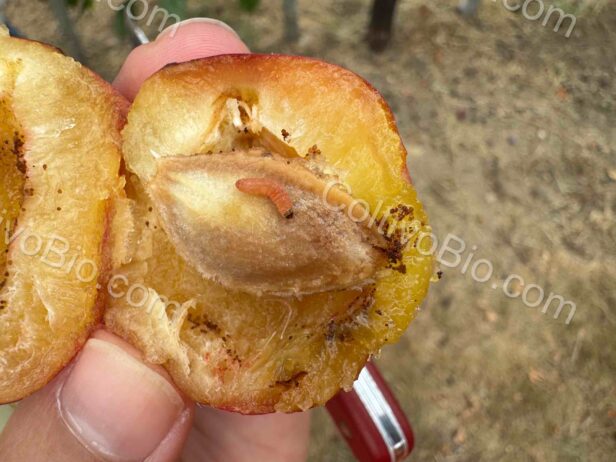
After hatching, the young larva quickly penetrates the fruit, feeding on the flesh and often moving towards the stone (see photo below). Inside, tunnels, feeding damage, frass and the characteristic pinkish larva can be observed. The entry point may show gumming, although this is not a symptom exclusive to Cydia (see photo below). An important sign is the premature colouring of infested fruits compared with healthy ones. Infestations can also cause premature fruit drop and favour rots and secondary disorders.
Life cycle of the plum fruit moth
Grapholita funebrana overwinters mainly as a mature larva, protected inside a cocoon located in cracks in the bark, in protected areas of the trunk, at the base of the trees or in other shelters available in the orchard.
As spring temperatures increase, pupation occurs, followed by the emergence of adults.
The beginning and duration of the flights vary according to the geographical area and, above all, the seasonal climatic conditions. This variability makes a control strategy based exclusively on predetermined dates unreliable.
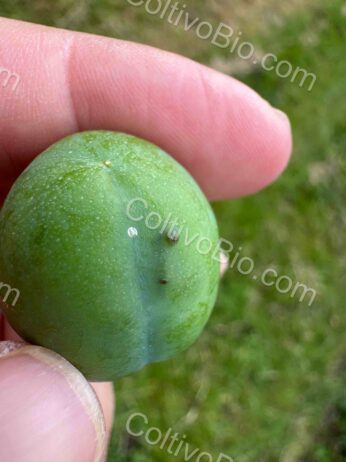
After mating, the females begin laying eggs. The eggs are laid mainly on the surface of young fruits (see photo below).
After hatching, the newly emerged larvae remain exposed only for a relatively short period before penetrating the plum. This stage represents one of the key moments for timing control treatments.
Once larval development is complete, the larvae leave the fruit and reach protected areas where they complete the cycle or, in the case of the last generation, prepare for overwintering.
Number of generations
Grapholita funebrana generally develops two generations per year, which can become three in warmer areas.
In orchards with cultivars having different ripening periods, a generation of Cydia developed on early varieties can give rise to the following generation, which will find fruits still susceptible to attack on later cultivars. The simultaneous presence of early and late varieties can therefore favour the continuity of the infestation and prolong the risk period during the season.
Monitoring the plum fruit moth with pheromone traps
The first control strategy is monitoring with pheromone traps, which attract and catch adult males, allowing the progression of flights to be monitored. As an operational reference, approximately 10 catches per trap per week indicate significant pressure and the need to consider a treatment. In organic farming, it is preferable to adopt a more precautionary threshold, around 5 catches per week. Monitoring must continue throughout the season in order to detect subsequent generations as well.
Direct monitoring of fruits
The traps should be combined with direct inspection of the fruits to assess the actual incidence of the infestation. Particular attention should be paid to fruits showing premature colouring, gumming or abnormal fruit drop. Suspected fruits can be cut open to look for tunnels, feeding damage, frass and larvae. When possible, it is also useful to identify eggs on the surface of the fruits. Monitoring must continue until harvest is fully completed.
Control strategy against Cydia
The fundamental aspect is to intercept the pest before the young larvae penetrate the fruits. Once it has penetrated the plum, the larva is physically protected and the effectiveness of many control methods decreases considerably. The objective of the strategy is therefore not to intervene when larvae are observed inside the fruits, but to protect the crop during the egg-laying stage and especially during the period between egg hatching and larval penetration.
Bacillus thuringiensis var. kurstaki
In organic control, one of the methods that can be used is Bacillus thuringiensis var. kurstaki (Btk). Its effectiveness is closely linked to the correct timing of the treatment, since it must be ingested by the young larvae. The application must therefore target the stage before penetration into the fruit. The treatment must ensure good and uniform coverage of the surface of the fruits and the affected vegetation. Persistence is relatively limited and, under conditions of prolonged pest pressure, subsequent applications are necessary, generally at short intervals and always according to the label of the commercial product used. Bacillus does not have a knockdown action against adults.
Mineral oils
Mineral oils (see here), when authorised for the specific use and used under appropriate conditions, can represent an additional tool within the strategy. Their action is mainly physical and can particularly affect the eggs, on which the oily film can interfere with gas exchange. Combined with Bacillus thuringiensis, it improves its effectiveness and persistence on the vegetation; attention must be paid to the risk of phytotoxicity if used in the presence of high temperatures.
Pyrethrum
Natural pyrethrum (see here) can be considered especially when monitoring shows a strong increase in adult activity.
Unlike Bacillus, it has insecticidal action by contact and can help knock down the population of adults present in the orchard, consequently reducing the potential for mating and egg laying.
In the presence of particularly high peaks, for example with 30–40 or more adults caught weekly, a knockdown treatment may become more relevant within the overall strategy.
The main limitation of pyrethrum is its low selectivity. It is a broad-spectrum insecticide that can also affect many beneficial organisms. Its use must therefore be carefully evaluated, especially in integrated pest management programmes and in orchards where beneficial fauna are to be preserved.
Spinosad
Another active substance that can be included in the strategy is spinosad (see here), characterised by insecticidal activity mainly through ingestion and contact.
In the case of Grapholita funebrana, the treatment must be correctly timed against the young larvae, before they are able to penetrate the fruits. Here too, monitoring of the flights is therefore of fundamental importance.
Spinosad represents an interesting tool in organic and integrated pest management programmes, also thanks to its greater selectivity towards beneficial fauna compared with broad-spectrum insecticides.
Azadirachtin (neem oil)
Azadirachtin (see here) certainly does not represent the main tool for controlling plum Cydia, but, when used to control other pests, it can have a secondary action on young larvae.
Azadirachtin can be particularly interesting when other susceptible pests, such as aphids, are present in the orchard at the same time. In these situations, the treatment may be justified mainly by the need to control aphids, while at the same time obtaining a complementary action against young Cydia larvae.
It should not, however, be considered on its own as the main control tool under conditions of high Grapholita funebrana pressure.
Kaolin and zeolite
Kaolin can be used as a complementary method. The coating of the fruit surface modifies its visual and physical characteristics and can interfere with the females’ recognition of the egg-laying site.
It is not a primary control method against the plum fruit moth, but it can be included in a broader strategy, especially when its use is also intended for other agronomic purposes.
One example is periods characterised by particularly high temperatures and strong solar radiation, during which kaolin can simultaneously contribute to fruit protection and the mitigation of heat stress.
For similar purposes, zeolite-based products can also be used, depending on the specific instructions and conditions of use.
Mating disruption
Mating disruption can represent an additional tool in the integrated management of Grapholita funebrana, especially over sufficiently large areas and under conditions favourable to its application.
The technique is based on the release of the species’ sex pheromone, interfering with encounters between males and females and helping to reduce mating.
However, it does not replace population monitoring and direct inspection of the fruits.
Removal of infested and fallen fruits
The removal of infested and fallen fruits helps to interrupt the Cydia life cycle and reduce the population destined for subsequent generations and overwintering. Reducing infestation during the season therefore also means progressively reducing pest pressure in subsequent years.
If you are interested in a video dedicated to the management of this insect, click on this link to access the official Coltivo Bio channel and watch the full video on the topic: https://youtu.be/HMyb3Rmij-I?si=NtoIlPwYcvYDYZKi
Useful insecticides
- Bacillus thuringiensis: https://amzn.to/45p2kI0
- Pyrethrum: https://amzn.to/4xH1ClI
- Azadirachtin (neem oil): https://amzn.to/4zfm1zI
- Kaolin: https://amzn.to/4wW1BKF
- Spinosad: https://amzn.to/4bK40zo
- Horticultural mineral oil: https://amzn.to/4zeXzyk