

20-10-10 fertilizer is a three-component mineral fertilizer used when the main goal is to stimulate vegetative plant growth. The most frequently asked questions concern what it means, how it differs from balanced fertilizers, when it should be applied, and which crops it can be used on.
What is 20-10-10 fertilizer?
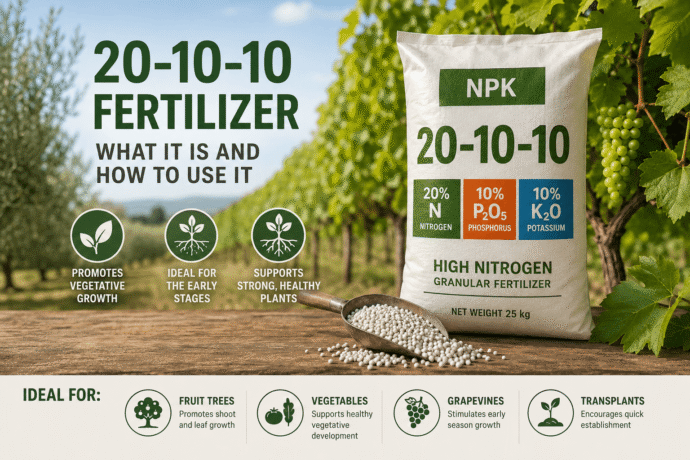
20-10-10 fertilizer is an unbalanced fertilizer with a 2:1:1 ratio, also described as a high-nitrogen fertilizer, because it contains a high concentration of nitrogen compared with the other two macronutrients:
- Nitrogen (N) 20%
- Phosphorus (P₂O₅) 10%
- Potassium (K₂O) 10%
Nitrogen is therefore present at twice the amount of phosphorus and potassium, a characteristic that makes this product particularly suitable for promoting vigor, shoot growth, and leaf development.
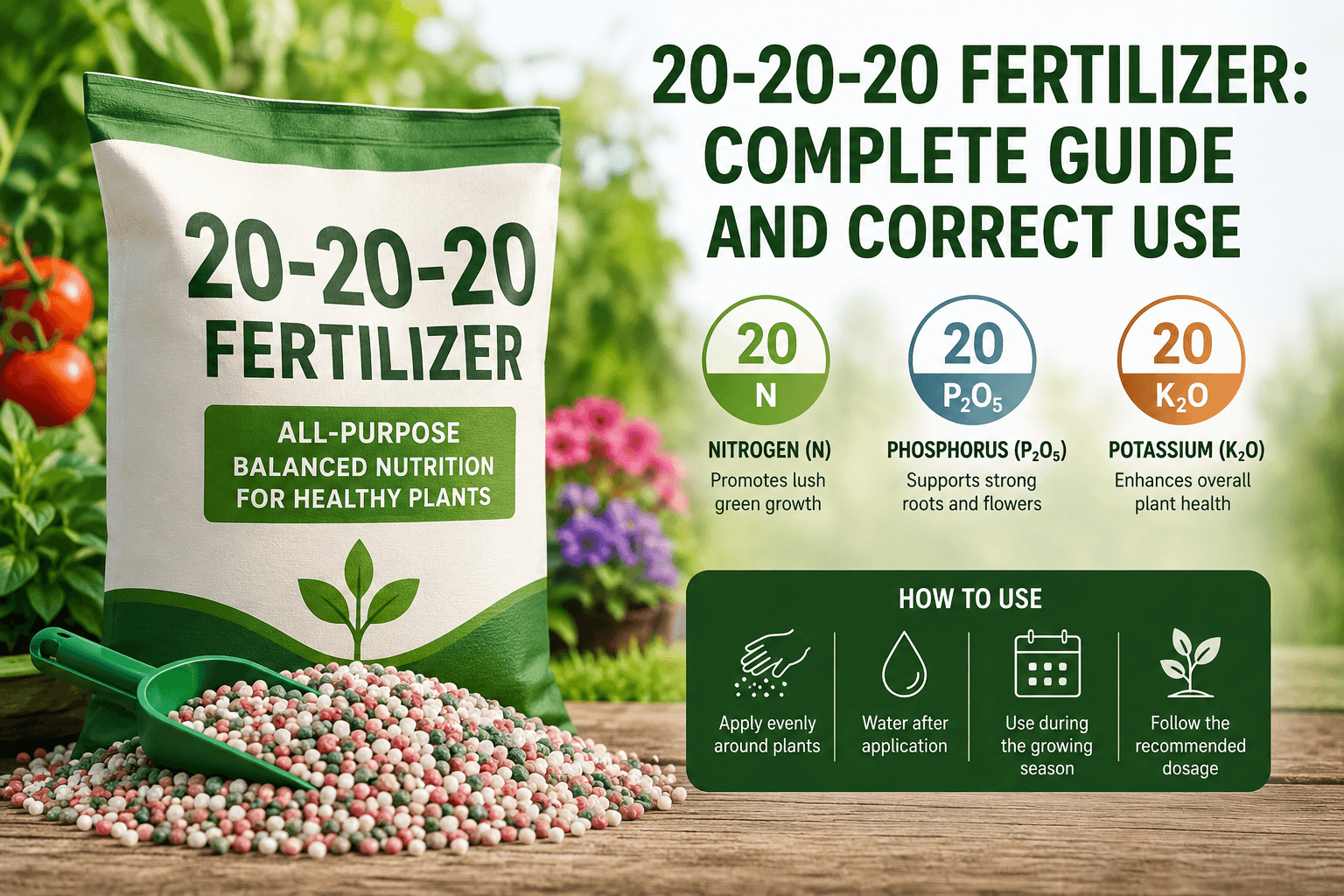
A balanced fertilizer with a 1:1:1 ratio, on the other hand, is 20-20-20, which we discussed here.
What is it used for?
20-10-10 is used when there is a need to push plant growth, meaning in all situations where supporting vegetative growth is the priority. It is therefore suitable:
- during periods when no fruit is present
- from bud break through pre-flowering and flowering
- after transplanting vegetable crops, to promote rapid establishment
- on grapevines early in the season, to stimulate shoot growth
Use on lawns
20-10-10 fertilizer can be effectively used on lawns and turfgrass, especially when the goal is to support:
- vigorous vegetative growth
- a dense and healthy lawn
- recovery from periods of slow growth or nitrogen deficiency
Thanks to its relatively high nitrogen content, 20-10-10 is particularly suitable for promoting leaf growth and maintaining a dense, green turf.
However, it is important to avoid excessive applications, as too much nitrogen can cause overly rapid growth, increase mowing requirements, and make the turf more susceptible to certain diseases and environmental stresses.
Use on grapevines
20-10-10 fertilizer is widely used in viticulture because of its versatility, relatively low cost, and ease of application when formulated as granules. Generally, an application of this product is followed by another application of a fertilizer with a high potassium content, usually potassium sulfate, which makes it possible to reach the amount of potassium required for proper fruit ripening.
Forms of nitrogen and behavior in the soil
A fundamental aspect of 20-10-10 fertilizer concerns the form in which nitrogen is present. In most cases, it is supplied as a mixture of two or more of the following forms:
- nitrate nitrogen
- ammonium nitrogen
- urea nitrogen
Nitrate nitrogen is the form most rapidly absorbed by plants, but it is also the most susceptible to leaching. This means that if it is applied before heavy rainfall or to irrigated crops receiving excessive amounts of water, it can easily be washed into deeper soil layers, reducing the effectiveness of fertilization.
For this reason, when using a fertilizer with a high nitrate nitrogen content, it is essential to:
- avoid applications before heavy rainfall
- carefully manage irrigation amounts
Formulations containing ammonium or urea nitrogen, on the other hand, have greater persistence over time. In these cases, nitrogen must undergo chemical transformations in the soil before becoming fully available to the plant, therefore providing a more gradual and prolonged release. Ammonium nitrogen also binds to soil colloids, almost completely reducing the possibility of being washed away by heavy rainfall. For example, some formulations contain 9.5% nitrate nitrogen and 10.5% ammonium nitrogen, while others contain 8.0% ammonium nitrogen and 12.0% urea nitrogen. The first, because it contains nitrate nitrogen, has a faster effect but is also slightly more susceptible to nitrogen leaching in the event of heavy rainfall. The second, on the other hand, is a slower-acting fertilizer. Each commercial product may contain different combinations of the three forms of nitrogen.
Application rates: the role of nitrogen
As with all nitrogen fertilizers, the application rate of 20-10-10 depends on the amount of nitrogen that needs to be applied.
Let’s look at a practical example:
- Crop: vineyard
- Average yield: about 12 metric tons per hectare
- Target: 40 kg of nitrogen per hectare
- Fertilizer used: 20-10-10 (20% nitrogen)
To supply 40 kg of nitrogen, it will be necessary to apply:
200 kg of 20-10-10 fertilizer per hectare
In fact:
- 200 kg × 20% = 40 kg of nitrogen
Application methods
Because it is a granular product, it needs rainfall or sprinkler irrigation to dissolve and become effective. However, applying granular products such as this one without rainfall or adequate irrigation can promote nitrogen loss in gaseous form. It is therefore essential, after applying granular 20-10-10 fertilizer, to lightly incorporate it into the soil or irrigate, in order to promote dissolution of the product and its movement toward the root system. Care must also be taken with sprinkler-irrigated crops, because excessive irrigation can cause nutrients, particularly nitrogen, to move into deeper soil layers, where they are unlikely to be absorbed by plants and may be lost through leaching.
Commercial formulations
In most cases, this product is sold in granular formulations, which allow broadcast application over large areas. However, some water-soluble 20-10-10 fertilizers are also available in powder form. Some formulations are also enriched with micronutrients, although products of this type are relatively uncommon on the market. In contrast, 20-10-10 fertilizers formulated with magnesium or sulfur as secondary nutrients are very common.
NitroPlus 20-10-10 Fertilizer: https://amzn.to/3S7AFbK
Conclusions
20-10-10 fertilizer is a technical product designed to stimulate vegetative growth, ideal during the early stages of the crop cycle, after transplanting, and in nitrogen-deficient soils. The application rate and timing should take into account both the crop’s nitrogen requirements and the form of nitrogen present, in order to maximize effectiveness and reduce losses through leaching.