

In this technical sheet we will see how to identify tomato late blight and how to effectively prevent it through the use of good agronomic practices and preventive natural remedies. At the end of the article you will find a link to access a list of fungicides for the treatment and prevention of this typical tomato disease.
What tomato late blight is and how it develops
Late blight is a disease that affects tomato and potato crops. This plant pathology is caused by the oomycete Phytophthora infestans. In the past, this microorganism was classified among fungi; today, however, it is classified within the phylum of oomycetes. It is still common to find this disease classified as fungal, especially in older educational texts. In any case, prevention and control methods for this plant disease are similar to those used against many fungal diseases.
Late blight is a very dangerous disease for both tomato and potato, and in tomatoes it can also attack and compromise the fruits. This pathology develops under climatic conditions of rainfall and mild temperatures. Rain is the main means of dispersion of zoospores, which are the agents responsible for the spread of late blight. Once released into the environment, as we will see later in the life cycle, they reach the leaf surface and plant tissues and then enter the host through the stomatal openings.
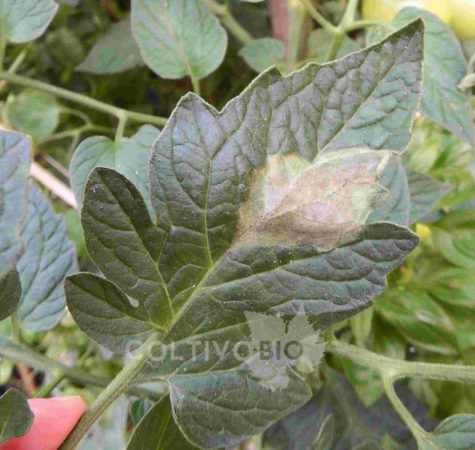
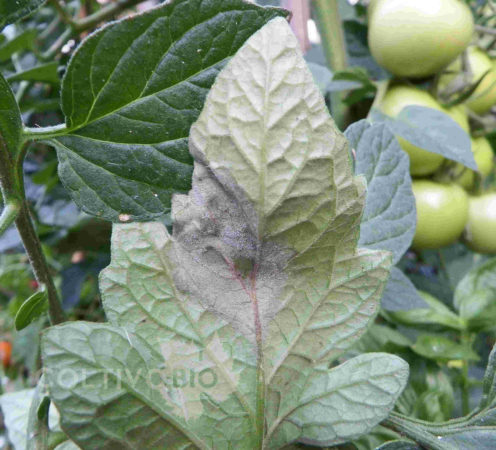
The most typical symptoms appear on the leaves, with the formation of necrotic areas that look “water-soaked” and discolored (see Figure 1). Subsequently, on the underside of the leaves corresponding to these areas, a whitish mycelium can be observed, similar to a light white mold (see Figure 2). This formation is the unmistakable symptom of the presence of late blight and indicates the production of new zoospores ready to be released into the environment.
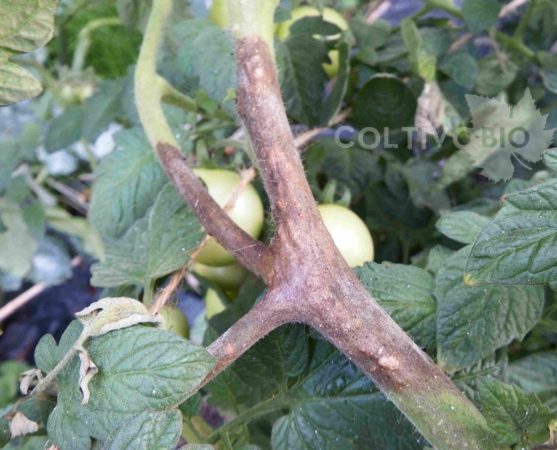
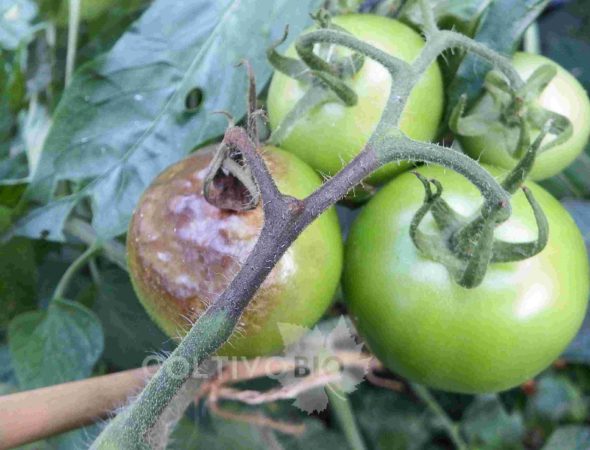
Symptoms of tomato late blight infection can also appear on stems and clusters, where they manifest as dark areas with a rotting appearance but firm to the touch, which develop until they surround the entire stem (see Figures 3 and 4). Sporulation on these affected organs is rarer.
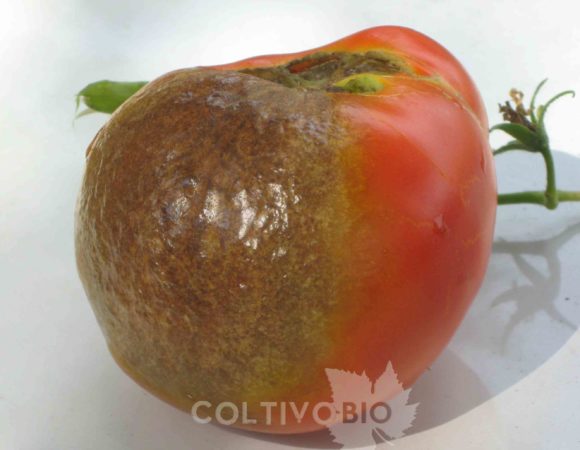
Finally, tomato fruits can also be affected, showing very characteristic symptoms. Fruits affected by late blight, whether green or ripe, develop large patches with a rough surface and bronze reflections, similar to sunscald (see Figure 5). The affected tissues initially remain firm and rough to the touch; later, but more slowly than on leaves, the typical whitish mold appears, followed by tissue softening.
Tomato late blight therefore causes both quantitative damage, due to the destruction of the leaf apparatus and the consequent reduction of photosynthetic activity, and qualitative damage. Fruits affected by the disease are unmarketable, and early and/or latent infections can also develop after harvest, manifesting damage in the days following harvest. In addition to their poor appearance, fruits affected by tomato late blight also have a rancid taste.
Biological cycle of tomato late blight
Late blight survives in the growing environment as overwintering mycelium or as oospores in plant residues from previous infected crops left on the soil. For this reason, the very first infections occur on plant tissues closest to the ground, as these are more susceptible to infection by zoospores originating from plant residues.
Oospores are the survival structures of the disease, from which zoospores are released in spring. An important factor for this disease is the presence of a film of water on the leaf surface, which allows zoospores to move across the leaf surface using their flagella. Zoospores move in search of stomata through which they enter and invade the plant.
Events such as rain, fog, and dew wet the leaf surface, and if these conditions persist for 10–12 consecutive hours together with temperatures above 10 °C, they are considered high-risk factors for infection. Infection caused by zoospores released from overwintering oospores is called primary infection. Subsequent infections caused by zoospores produced on the underside of the leaves are defined as secondary infections, as they occur later in time than the initial ones.
If you are interested in additional photos of tomato late blight, click here ⇒ for the photo gallery.
Correct prevention and control of the disease
The defense of tomato crops against late blight mainly concerns open-field tomatoes, as greenhouse tomatoes are less susceptible due to the difficulty of prolonged leaf wetness. However, high humidity and dew can still create favorable conditions for the disease even in greenhouses.
The main defense strategy in organic farming involves the use of good agronomic practices, such as:
- the use of disease-resistant cultivars,
- crop rotation,
- the use of healthy, certified seeds,
- avoiding overhead irrigation.
Among available remedies, the most effective remains the use of copper-based products (see product technical sheet). Copper treatments must be applied preventively, remembering to treat before and immediately after heavy rainfall when temperatures range between 10 and 25 °C. Under these conditions, treatments should be applied at intervals not exceeding 5 days and continued until temperature and humidity conditions return to non-risk levels, which are: more than 10 days since a rainfall event or temperatures outside the 10–25 °C range. If favorable conditions persist, treatments should continue.
Among applicable remedies, the use of Bordeaux mixture should be mentioned, as it has greater resistance to wash-off and can be applied before rainfall. Immediately afterward, rapid-action copper formulations such as copper hydroxide or copper oxychloride can be used.
It should also be remembered that copper-based treatments are effective against other tomato diseases such as Alternaria.
It is clear that the control of tomato late blight must be carried out according to climatic conditions; therefore, it is essential to monitor weather forecasts and rainfall.
Control of late blight is always preventive in nature. It should also be remembered that some copper-based fertilizers are able to control late blight, especially when supplemented with seaweed extracts, resistance inducers, chitosan, etc.
Among natural remedies, products based on microorganisms with competitive activity against the pathogen and the ability to stimulate the plant’s natural defenses should be highlighted. These include products based on Bacillus amyloliquefaciens plantarum, for which a registered commercial formulation exists in Italy, and Pythium oligandrum, which also has a registered commercial formulation.
It should also be mentioned that the use of sulfur (see technical sheet) for treatments against tomato powdery mildew has a mild collateral effect against late blight.
Remember that effective control also depends on effective product application. Thoroughly wet not only the upper leaf surface but also the underside. The use of a sprayer is preferable for product distribution. In all cases, application rates indicated on commercial product labels must be respected, and any incompatibilities should be checked.
“If you are interested in learning more about tomato diseases, read our complete technical sheet available at the following link: Tomato diseases, identification with photos.“