
This scientific article explores all the characteristics and uses of Trichoderma in agriculture. Trichoderma is a powerful tool for the biological control of many root pathogens in both organic and conventional agriculture. Since it is a living product, it must be used with appropriate care in order to maximize its effectiveness. In addition to formulations registered as plant protection products, this microorganism has recently also been marketed as a soil amendment or biostimulant, often in combination with other microorganisms. To better understand how to use it correctly, the article provides two practical examples of application.
What Trichoderma is: morphological description
A considerable number of microorganisms live in the soil, some of which provide significant benefits to plants through their activity and presence. Among these, fungal species belonging to the genus Trichoderma play a primary role. Numerous studies have highlighted the excellent biocontrol properties of these fungi, and today more than 50 commercial Trichoderma-based products are available worldwide. Among the most important formulations used in agriculture are those based on Trichoderma harzianum and Trichoderma viride.
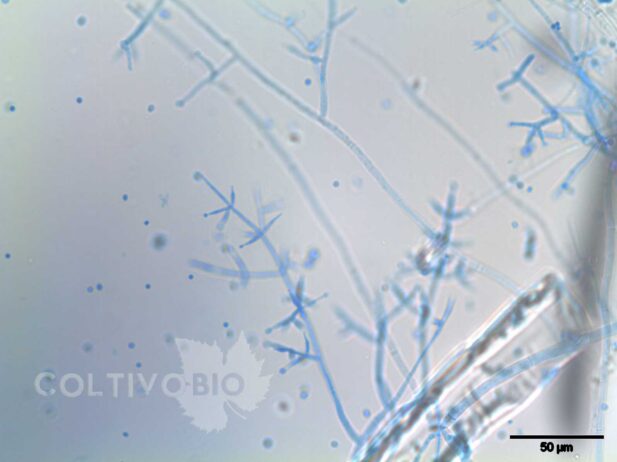
Trichoderma species produce a mycelium ranging from intense green to very light green, with a fluffy appearance. This genus sporulates abundantly, and conidiophores are produced in large numbers throughout the mycelium. They consist of a central axis with lateral branches that form a characteristic pyramid-like structure (see Photo 1). The conidiogenous cells are phialides, which may be cylindrical, subglobose, or more often flask-shaped; this feature is a key taxonomic character. The unicellular conidia are green, with smooth or rough walls, ellipsoidal, elongated, or rarely globose in shape, about 3–5 μm in size, and occur singly or in gelatinous clusters.
These fungi also develop resting structures such as chlamydospores, which are found intercalary or terminally in the hyphae; they may be unicellular or multicellular, with variable shape and color ranging from green to yellow.
How it works and its modes of action in agriculture
The biocontrol activity of Trichoderma against plant pathogens has been known since the 1920s and is expressed through several mechanisms that act simultaneously to determine its antagonistic capacity. Among these, mycoparasitism represents the direct physical action exerted on pathogen structures through specialized hyphae known as appressoria.
Attracted by chemotropism, Trichoderma grows its hyphae toward the pathogen and, once contact is made, coils around it with its growth structures, some of which are involved in penetration, aided by the secretion of lytic enzymes. After penetrating the cell wall of the target fungus, the final phase consists of digesting the cellular contents, leading to the death of the pathogenic fungus.
As with many other fungi, Trichoderma also exhibits a form of biocontrol known as antibiosis. This mechanism involves the production of compounds that inhibit the growth and development of pathogenic microorganisms, exerting lethal activity when they penetrate and accumulate within cells. These secondary metabolites may be volatile—spreading through the soil’s gaseous phase—or non-volatile, becoming absorbed and localized in soil particles colonized by the producing fungus. Among the compounds identified by research are gliotoxin, trichodermin, gliovirin, and trichozianines, which control various fungi and bacteria.
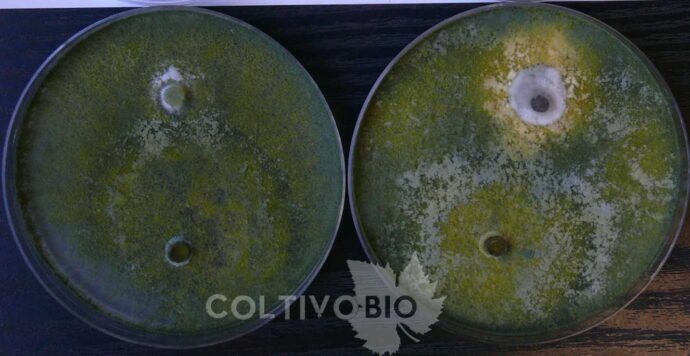
Trichoderma also competes for space and nutrients, effectively depriving potential pathogens of resources and reducing their danger and inoculum potential. This effectiveness derives from the saprophytic nature of Trichoderma, which allows it to colonize substrates more rapidly than many pathogens. Competition for elements such as carbon, nitrogen, and iron favors faster-growing microorganisms like Trichoderma (see Figure 2).
Finally, another important mechanism is induced resistance. Recent studies have shown that Trichoderma species can induce systemic and/or localized resistance in plants against many soilborne pathogens by activating the jasmonic acid signaling pathway. Trichoderma can colonize the rhizosphere of the host plant and produce molecules capable of eliciting plant defense responses, such as avirulence gene homologs (Avr) and enzymatic and non-enzymatic proteins. The plant responds by producing biochemical deposits that limit further pathogen development, effectively turning it into a “failed pathogen.”
In simpler terms, Trichoderma “tricks” the plant into responding as if it were under pathogen attack (although it is not pathogenic), prompting the plant to activate its defenses. Any real pathogen then encounters a more resistant plant, while its growth is further limited by antibiotic and lytic substances produced by Trichoderma, as well as by hyperparasitism. The Trichoderma–plant interaction also results in enhanced vegetative growth and increased productivity. For these reasons, Trichoderma is marketed by many agrochemical companies as a biological fungicide.
Among its most common uses, Trichoderma is applied preventively against vascular wilts (such as Fusarium spp. and Verticillium spp.), in the control of Sclerotinia, cereal foot rot, and seedling damping-off caused by Pythium.
How to use Trichoderma correctly and which products to use
It is worth mentioning that the combined use of Trichoderma with mycorrhizae is now common practice among professional farmers; the use of fungal inoculants for disease prevention is widely established in professional agriculture. Numerous commercial Trichoderma formulations are available, differing mainly in two aspects: the species and the strain.
Currently, the most widely used Trichoderma species in agriculture as biological fungicides are Trichoderma harzianum, Trichoderma viride, Trichoderma asperellum, and Trichoderma gamsii. As for strains, there are many, and their selection is often a commercial choice made by individual companies for their target markets.
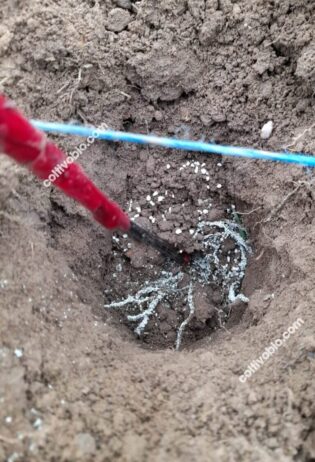
Trichoderma-based products are available in various formulations: liquids, wettable powders, and solid forms such as granules or pellets (see Figure 3). These products are mixed with inert materials, dispersants, or organic matter. Liquid and wettable powder formulations are intended for application with sprayers for pre-sowing treatments and, less frequently, for foliar applications. Wettable powders can also be used for seed and bulb treatments. Granular or pelleted products are applied with fertilizer spreaders or appropriate equipment and can also be placed directly into transplant holes.
Liquid and wettable powder formulations can also be applied through localized irrigation systems, both in vegetable crops and orchards. A key concept to remember is that Trichoderma benefits from organic fertilization. As a saprophytic fungus, it colonizes and grows on added organic matter, resulting in two advantages: an increase in Trichoderma populations over time and the creation of refuge sites within the organic matter. Therefore, successful Trichoderma inoculation should be accompanied by the application of organic matter such as compost, manure, digestate, or organic pellets.
In the case of soil solarization, Trichoderma should be applied immediately after removing the plastic film, at the end of the treatment. Solarization creates a partial biological vacuum, making it the ideal time for Trichoderma colonization. The same principle applies to other soil sterilization methods such as biofumigation, steam sterilization, or chemical fumigation (in the latter case, Trichoderma should be applied only after confirming that the chemical agent is no longer present in the soil).
Commercial product types
Trichoderma-based products are generally registered as plant protection products. Recently, other products containing Trichoderma have been developed and registered as soil amendments or biostimulants, often mixed with other microorganisms in pellet, liquid, or powder formulations. Their effectiveness as biofungicides can still be valid, but it largely depends on the reliability of the commercial product. Products registered as plant protection products must meet minimum legal quality standards and demonstrate proven efficacy through official field trials. In contrast, products registered under other categories are not subject to the same standards, meaning their quality and effectiveness depend heavily on the manufacturer. Therefore, it is advisable to rely on reputable producers when choosing Trichoderma-based amendments or biostimulants.
Examples of use
To clarify, here are two examples of correct Trichoderma inoculation as a biological fungicide: one in open-field vegetable production and one in an orchard.
In open-field vegetables, organic matter (e.g., poultry manure) is applied during primary soil cultivation. Before final seedbed preparation, Trichoderma (e.g., Trichoderma harzianum) is applied in granular or pelleted form using a fertilizer spreader, or alternatively as a wettable powder or liquid formulation applied with a sprayer. After sowing or transplanting, a second application is carried out through localized irrigation. Alternatively, this second treatment can be applied with a sprayer, followed immediately by light overhead irrigation to help the product penetrate the soil. Care should be taken with irrigation and sprayer filters to prevent clogging, especially when using fine wettable powders. Flat-fan nozzles are recommended for sprayers.
For orchard establishment, organic matter is applied during primary soil preparation. Before planting, Trichoderma in granular or pelleted form is applied directly into the planting hole, either manually or with localized spreaders. Wettable powder or liquid formulations can also be used by immersing plant root systems in large tanks before transplanting (if permitted by the product label). A second application is made after planting, either through irrigation systems or by applying granular or pelleted formulations along the row, followed by light surface cultivation to incorporate the product into the soil.
These guidelines are general recommendations; additional follow-up applications may be performed if needed. In any case, the best Trichoderma application strategy is always the one specified on the commercial product label.
In the video below, the difference between seedlings grown without Trichoderma protection and those treated with Trichoderma can be observed: the left pot was inoculated with Fusarium (a pathogen), the center pot with Fusarium and Trichoderma, and the right pot with Trichoderma only.