

Botrytis or gray mold is among the most common diseases affecting grapevines at harvest time. In this technical guide, we will see how to recognize this disease and the correct control strategies in organic agriculture.
Description and symptoms of Botrytis
Along with powdery mildew and downy mildew, Botrytis is one of the most dangerous fungal diseases affecting grapevines. In addition to causing quantitative yield losses, it can also alter wine quality. The scientific name of this fungus is Botrytis cinerea, whose sexual stage is Botryotinia fuckeliana. The latter mainly lives as a saprophyte on decaying organic material.
In addition to grapes, other fruit and vegetable crops may be affected, including strawberry, apple, pear, peach, cherry, green bean, broad bean, and others.
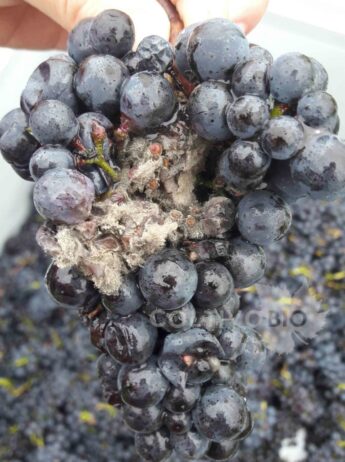
How Botrytis appears on grapevine
Also known as gray mold, Botrytis manifests on infected clusters through the formation of gray-colored mold (see Figure 1). The affected tissues lose turgor, and infected berries are irreversibly damaged. Table grapes affected by Botrytis are unmarketable, while wine grapes undergo biochemical changes that alter wine flavor and result in quality loss.
In addition to clusters, leaves and shoots may also be affected, although such infections are much rarer. On leaves, symptoms appear as chlorotic areas that later become necrotic and, under suitable climatic conditions, develop a grayish mold. On shoots, infection occurs only on green tissues, causing slight drying with limited ability to spread. Similarly, infections on tendrils and petioles are rare and generally not harmful.
This fungus can penetrate plant tissues in two different ways.
The first occurs when tissues are still green and photosynthetically active, such as leaves, shoots, and unripe berries. These tissues have numerous stomatal openings through which the fungus can easily enter and colonize the host. Botrytis can also penetrate through the floral stigma, stimulated by secretions released by the flower. When penetration occurs through flowers or young clusters, infections remain latent due to the low pH of berries at this stage.
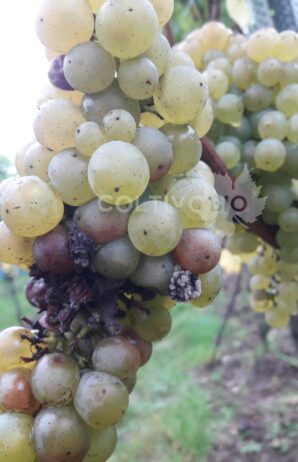
The second penetration route is the most dangerous and damaging. It occurs only on clusters at veraison, when the fungus can invade the host only through biotic injuries (such as damage caused by grape moths, thrips, or powdery mildew) or abiotic injuries (hail or strong wind damage). At this phenological stage, berries no longer have stomatal openings, but the reduced organic acid content and increased sugar levels make infection highly aggressive.
Biological cycle of Botrytis
Botrytis cinerea can survive in the environment in several forms (conidia, sclerotia, and overwintering mycelium in the bark), as well as as a saprophyte on decaying material. At the beginning of autumn, sclerotia begin to form on organs affected by Botrytis. These appear as small black structures a few millimeters long, oblong and hard to the touch, usually produced on canes.
In early spring, under suitable temperature and humidity conditions, grayish mycelium develops from sclerotia, overwintering mycelium on bark, and crop residues. These structures consist of conidiophores and conidia. Conidia are dispersed by wind and favored by water droplets. Once they reach plant tissues, penetration can occur through stomata or wounds.
Ideal conditions for conidial germination include an average temperature of 15 °C and 15 hours of leaf wetness—known as the “rule of two fifteens.” If berries at veraison are wounded by biotic or abiotic factors, the required wetness duration is reduced. These climatic conditions also favor the development of overwintering mycelium on bark and residues.
Throughout the growing season, conidia are continuously produced, with production strongly correlated with rainfall. Generally, two peaks occur: the first between May and June, corresponding to the germination of survival structures, and the second in autumn with the first rains, corresponding to the formation of sclerotia.
In the absence of rain, conidial germination can also occur at relative humidity levels above 90%. Conidia can germinate at temperatures close to 0 °C (though with very low efficiency) and up to 30 °C, with an optimum around 18 °C.
Natural remedies and agronomic control
In organic agriculture, Botrytis management relies primarily on vineyard agronomic practices and secondarily on the use of plant protection products approved for organic farming. These practices are also strongly recommended in conventional vineyards, as chemical fungicides alone are not always sufficient to contain Botrytis cinerea, especially in certain years.
Key agronomic practices include:
- Varietal choice: Prefer grape varieties with loose clusters, which allow better air circulation and reduce moisture retention between berries.
- Rootstocks: Varieties grafted onto deep-rooting rootstocks are generally less susceptible, as they reduce berry splitting, especially in hot seasons.
- Nitrogen management: Excess nitrogen increases vigor and leaf mass, raising canopy humidity and reducing berry cuticle thickness, making berries more susceptible.
- Calcium nutrition: Well-calcium-nourished plants have stronger tissues and greater resistance to pathogen attacks.
- Canopy management: Green pruning and leaf removal improve aeration and expose clusters to UV radiation, promoting phytoalexin production.
- Training systems: Trellis systems such as Guyot favor better aeration compared to pergola systems, where humidity stagnation is higher.
- Crop residue management: In areas prone to Botrytis, residues from the previous season should be promptly removed, burned, or buried.
- Control of other pests and diseases: Botrytis often establishes as a secondary pathogen following damage by grape moths or powdery mildew.
The three key moments for control
Whether in organic or conventional farming, Botrytis should be managed at three critical times:
- End of flowering: Botrytis begins developing on floral residues, remaining latent until grape maturation. Early control reduces disease potential.
- Before cluster closure: When berry size is between peppercorn and pea size. This is the last chance to deliver treatments inside the cluster before berries touch and close it.
- At veraison: In susceptible varieties and adverse climatic conditions, treatments may need to continue until harvest.
Biological control of Botrytis
Direct control of Botrytis in organic agriculture can be achieved using various biological plant protection products and resistance enhancers. Common products include:
- Copper salts: Used primarily against downy mildew, they thicken berry cuticles and act as contact fungicides.
- Sulfur: Has a secondary effect on Botrytis when used against powdery mildew, usually in combination with copper.
- Potassium bicarbonate: Has fungitoxic and fungistatic effects by increasing berry surface pH and dehydrating fungal hyphae.
In recent years, products based on microorganisms and natural molecules have become increasingly important, especially in organic farming. These include:
- Cerevisane: A systemic resistance inducer derived from yeast cell wall extracts (Saccharomyces cerevisiae).
- Bacillus amyloliquefaciens: An antagonistic bacterium effective in limiting infections.
- Bacillus subtilis: Widely used in organic agriculture.
- Aureobasidium pullulans: A fungus that prevents Botrytis through competition and production of the protective polysaccharide pullulan.
- Pythium oligandrum: An oomycete that parasitizes pathogenic fungi through direct mycoparasitism.
- Eugenol, thymol, and geraniol: Natural compounds found in thyme, geranium, clove, and cinnamon; effective but relatively expensive.
Among resistance enhancers with anti-Botrytis activity:
- Kaolin and zeolite: Drying agents that also enhance plant defenses.
- Soybean vegetable oil
- Lecithin: Enhances natural plant defense mechanisms.