

The apple rust mite is a small phytophagous mite belonging to the Eriophyidae family. One of the main species associated with apple is Aculus schlechtendali, although other eriophyid mites may also be present on the crop, such as Phyllocoptes malinus and Eriophyes mali Nalepa (1926), the latter not reported in Italy, which are responsible for different symptoms.
📷 Original photos from the field
The images in this article are original photographs taken personally during monitoring and field observation activities. The symptoms shown therefore refer to real cases observed directly on crops.
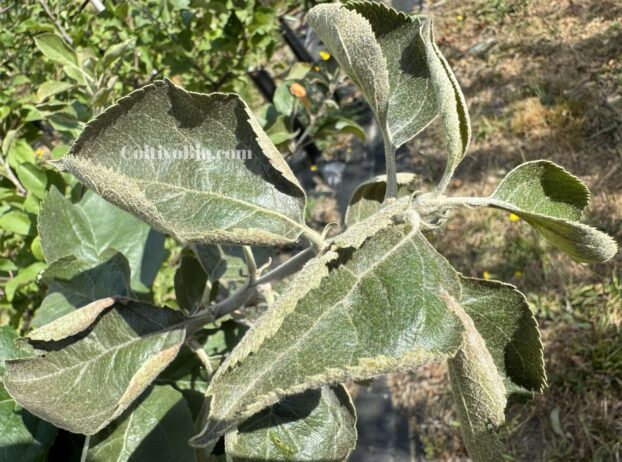
Symptoms and damage on apple
Eriophyid mites are microscopic mites that feed by piercing leaf cells, causing a progressive bronze or rusty discolouration.
With heavy infestations, the leaves become darker and may take on an apparently scorched appearance.
Populations are concentrated mainly on the underside of the leaves, where they should be looked for during monitoring.
Heavy infestations reduce the photosynthetically active leaf surface and can impair vegetative growth, especially in young plants.
Bronzing can be confused with water stress, high temperatures, phytotoxicity or other problems.
Life cycle
The apple rust mite can complete numerous generations during the growing season.
Overwintering occurs mainly through females protected in buds and other sheltered areas on the plant. With the resumption of vegetative growth in spring, overwintering individuals become active again and begin to colonise new tissues.
Females lay eggs on the vegetation and generations can follow one another rapidly during spring and summer, with different developmental stages present at the same time.
High temperatures and hot, dry weather favour population development, which can increase rapidly during the summer months.
As autumn approaches, overwintering forms are progressively produced. These move to protected areas of the plant and allow the population to resume its cycle the following spring.
Monitoring and symptoms
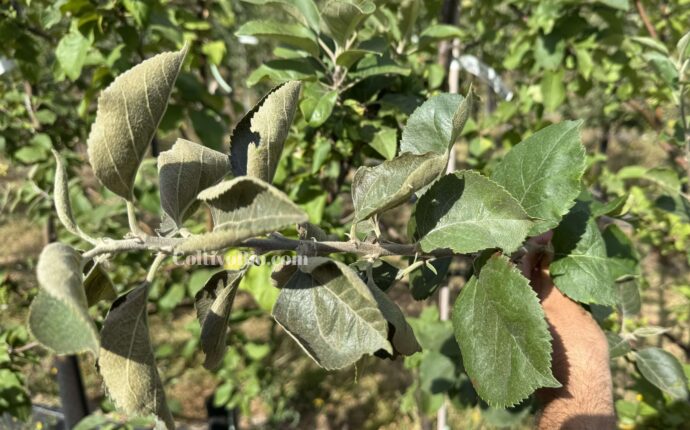
Monitoring of apple rust mite is mainly visual. The first symptoms are a loss of shine and progressive bronzing of the leaves, which tend to become dark green on the upper surface and bronze on the underside. As the infestation progresses, the leaf blade thickens and the margins tend to curl upwards (see photo above).
Symptoms are particularly evident on the younger leaves located at the terminal part of the shoots, which may show browning, marginal necrosis and deformation, while the older basal leaves may remain green and apparently healthy.
In case of doubt, symptomatic leaves can be examined under a binocular stereomicroscope to confirm the presence of the mites. It is also important to preserve predatory mites and beneficial fauna, limiting the use of pyrethroids and natural pyrethrum, which can indirectly favour the development of eriophyid mite populations.
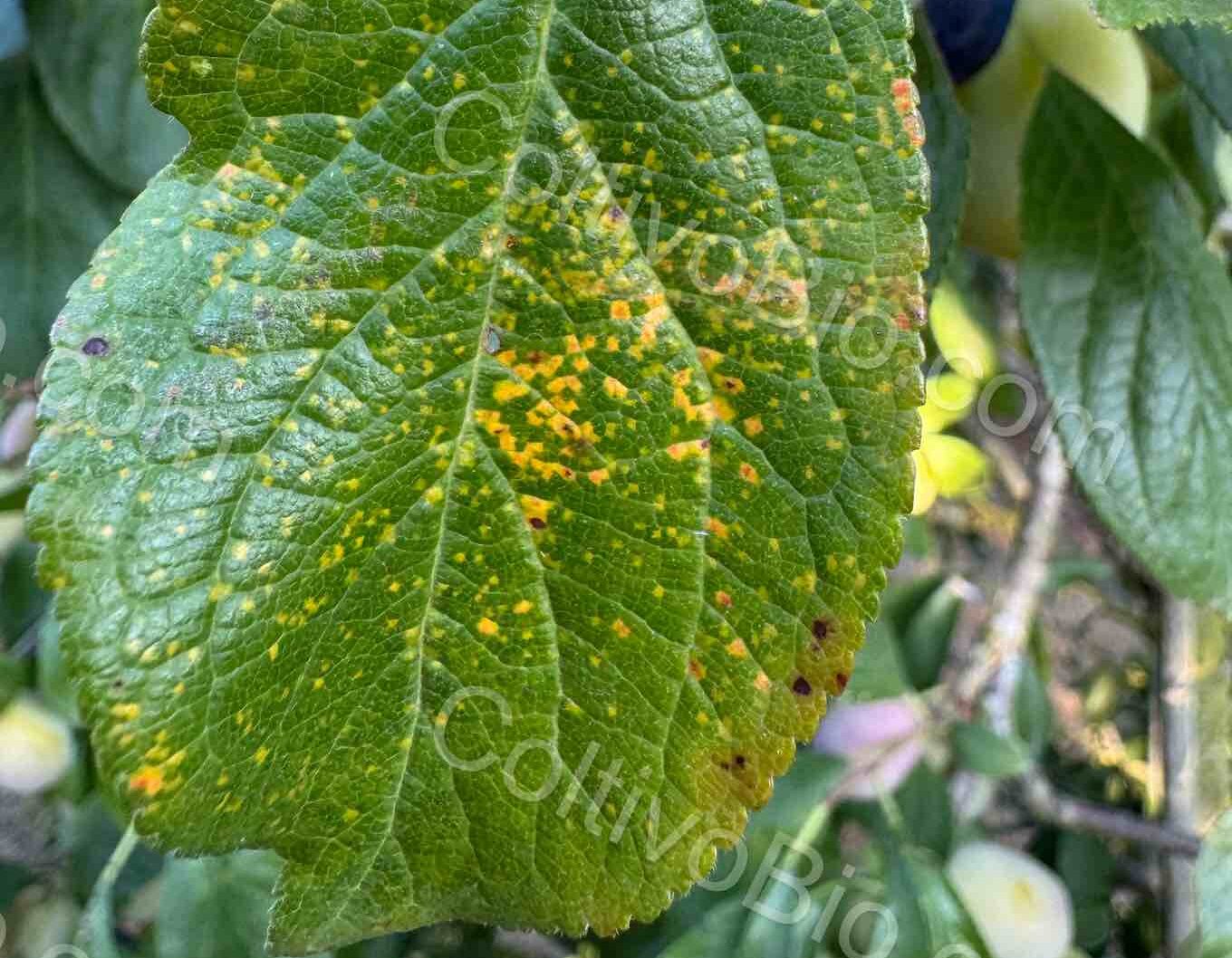
Control strategies
Control of apple rust mite is relatively simple when the problem is identified promptly.
Available control methods include mineral horticultural oil, silicone-based products and sulphur, when authorised for the specific use.
Horticultural oil insectidide (see here) acts mainly through a physical mechanism and can effectively contribute to reducing the population. To achieve good results, it is important to ensure uniform coverage of the vegetation.
Silicone-based products also act mainly through physical mechanisms and can provide good control of individuals present on the leaf surface. It is important to reach the underside of the leaves as well, where populations may be concentrated.
Sulphur (see here), although mainly used as a fungicide, also has interesting acaricidal activity and can contribute to the control of eriophyid mites within standard apple protection programmes.
Another useful product is insecticidal soap, which has an action similar to that of mineral horticultural oil, although slightly less effective, but safer in the presence of high temperatures.
Particular attention should be paid to the use of oils and sulphur during periods characterised by high temperatures and to the interval between their respective applications, in order to avoid possible phytotoxicity.
A further element of the strategy is the conservation of beneficial fauna, particularly predatory mites. Among these, Amblyseius andersoni (easily available online) can contribute to the natural control of eriophyid mite populations, also feeding on these small phytophagous mites.
If you are interested in observing the eriophyid mite under a microscope, click on this link. You will find the dedicated video on the official Coltivo Bio channel: https://youtube.com/shorts/MBJ97vGzzWw
Useful products
- Horticultural mineral oil: https://amzn.to/4zeXzyk
- Sulphur: https://amzn.to/45pKp3V
- Insecticidal soap: https://amzn.to/4qhbFLF