

What Is the Brown Marmorated Stink Bug?
The brown marmorated stink bug (Halyomorpha halys), commonly abbreviated as BMSB in the United States, is an insect belonging to the order Hemiptera and the family Pentatomidae. Native to East Asia, it is a highly destructive, polyphagous pest that feeds on numerous fruit and vegetable crops, including apple, pear, kiwifruit, peach, plum, cherry, apricot, tomato, eggplant, bell pepper, corn, soybean, and sunflower. In the United States, it was first detected near Allentown, Pennsylvania, during the 1990s and has since spread across much of the country, becoming both a serious agricultural pest and a household nuisance because adults frequently enter homes and other buildings in the fall to overwinter. Chemical insecticides are not always completely effective, and their protective action may last only a short time. For this reason, its control requires careful monitoring and an integrated pest management strategy. This article contains affiliate links. We may earn a commission from qualifying purchases.
Life Cycle and Identification of Adults, Nymphs, and Eggs
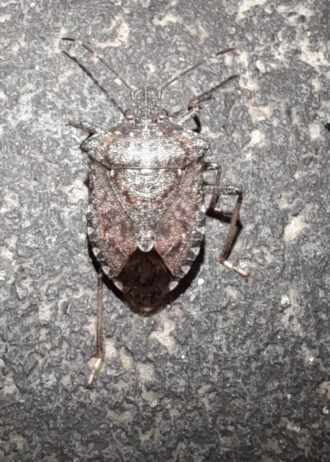
The adult brown marmorated stink bug has the typical shield-shaped body of insects belonging to the family Pentatomidae. Its upper surface is mottled dark brown, while the underside is generally lighter. The antennae are approximately half the length of the body and have two clearly visible pale bands. Another distinguishing feature is the alternating pattern of light ivory and dark markings along the exposed outer edge of the abdomen.
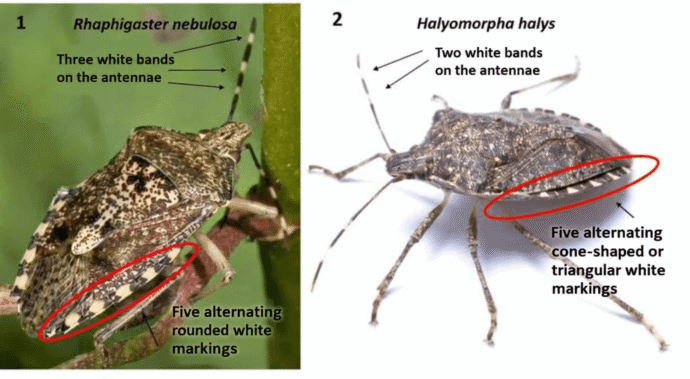
In the United States, the brown marmorated stink bug may be confused with native stink bugs belonging to the genera Brochymena and Euschistus. Species of Brochymena, commonly known as rough stink bugs, generally have a rougher body surface, toothed or serrated margins along the pronotum, and a bark-like appearance. Species belonging to the genus Euschistus, often called brown stink bugs, may have a similar brown coloration but do not show the same combination of distinct pale bands on the antennae and alternating light and dark markings along the edge of the abdomen that characterizes Halyomorpha halys.
In Europe, the brown marmorated stink bug may also be confused with the mottled shieldbug, Rhaphigaster nebulosa, a European species that is not currently known to be established in the United States. One of the main differences can be observed on the underside of the body: Rhaphigaster nebulosa has a conspicuous abdominal spine projecting forward between the legs, while this spine is absent in Halyomorpha halys.
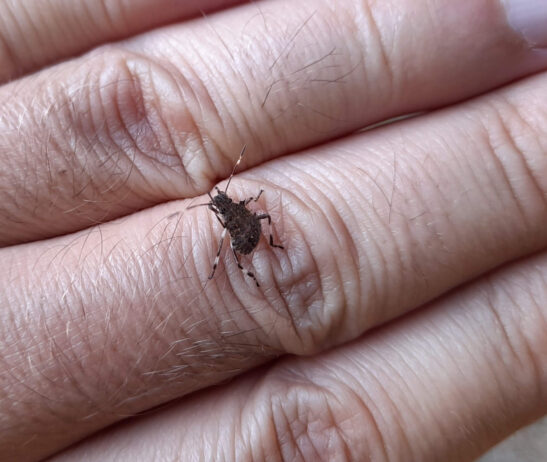
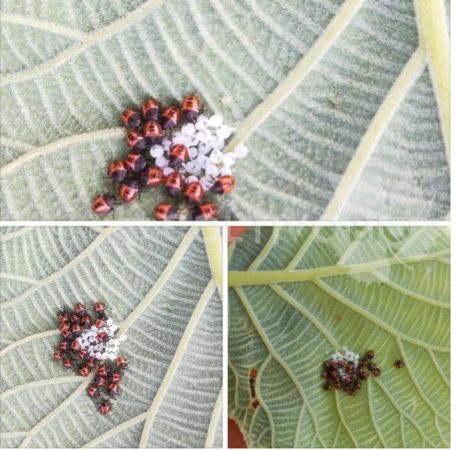
It is more difficult to confuse the brown marmorated stink bug with the southern green stink bug (Nezara viridula), which is predominantly bright green as an adult. The life cycle of Halyomorpha halys includes the egg stage, five nymphal instars, and the adult stage. The eggs are pale or creamy white and are usually deposited in clusters of approximately 20 to 30 on the undersides of leaves. Newly hatched nymphs have a reddish-orange abdomen and remain close to the egg mass for a short period. As they develop through five molts, they gradually acquire the characteristic mottled brown appearance of the adults.
Damage Caused by the Brown Marmorated Stink Bug
Both adults and nymphs damage plants by piercing fruits, leaves, stems, and seeds with their needle-like mouthparts and feeding on plant tissues. Feeding on developing fruits can cause depressions, discoloration, deformation, and hardened or corky areas in the flesh beneath the feeding sites. Damaged fruit may become unmarketable and may also be more vulnerable to secondary infections and decay. On crops such as apples, pears, peaches, cherries, and kiwifruit, infestations can result in significant economic losses. Damage to vegetables may include punctures, discolored tissue, deformation, and reduced product quality. The insect may also feed on developing seeds and pods of crops such as corn, soybean, and sunflower, reducing seed quality and yield. The external symptoms can sometimes be confused with damage caused by other insects, including certain fruit flies. See our technical information about fruit fly control.
Brown Marmorated Stink Bug Control: Insecticides, Traps, and Effective Methods
Controlling the brown marmorated stink bug is particularly difficult. No single control method provides complete protection, and insecticides may only temporarily reduce the population because new adults can quickly move into the treated area from nearby vegetation. Repeated applications can increase production costs, environmental impact, and the risk of pesticide residues. For this reason, treatments should be based on careful monitoring and combined with preventive and physical control methods whenever possible.
Among the currently available chemical control options, contact insecticides containing pyrethroids generally provide the most effective control of the brown marmorated stink bug. When applied promptly, at the correct rate, and with thorough spray coverage, they can be particularly effective against both adults and nymphs. However, their residual activity may be limited.
Natural pyrethrum and spinosad generally provide limited control of adults and may be somewhat more effective against young nymphs. Orange oil products may have little effect on adults but can produce greater mortality among juvenile stages. Azadirachtin also generally provides limited control when used alone. Paraffinic mineral oil may improve the effectiveness of pyrethrum by increasing contact with the insect. Products containing the entomopathogenic fungus Beauveria bassiana can also infect stink bugs, but their effectiveness depends heavily on temperature, humidity, application quality, and environmental conditions.
In the United States, pesticide registrations vary according to the crop and state. Always use a product specifically labeled for the crop and target pest, follow all label directions, observe the required preharvest interval.
Aggregation pheromone traps can be used to monitor the presence and seasonal activity of the brown marmorated stink bug. These traps attract both adults and nymphs, but their effectiveness is generally limited to the surrounding area. They are useful for monitoring, although they do not normally provide complete population control when used alone. One of the most effective ways to protect high-value crops is the use of insect-proof netting. Nets physically prevent stink bugs from reaching the crop, although they must be installed correctly and completely sealed to be effective.
Natural Enemies and Biological Control
Several natural enemies attack the eggs of the brown marmorated stink bug. In Europe, the native parasitoid Anastatus bifasciatus can parasitize its eggs, although natural parasitism rates are often too low to provide adequate crop protection on their own. One of the most important natural enemies is Trissolcus japonicus, commonly known as the samurai wasp. This tiny parasitoid is native to Asia and lays its eggs inside brown marmorated stink bug eggs, preventing the pest nymphs from developing.
Adventive populations of the samurai wasp have been detected in several parts of the United States, where universities and government agencies are studying its distribution and potential role in biological control programs. Controlled releases and monitoring programs have also been conducted in Italy. Biological control may help reduce brown marmorated stink bug populations over time, but it should be considered part of an integrated pest management program rather than a complete stand-alone solution.
Products for the control of brown marmorated stink bug
- Pyrethrin insecticide: https://amzn.to/4xJYcPB
- Pyrethroid insecticide: https://amzn.to/4eoWmMG
- Horticultural oil insecticide: https://amzn.to/4cXtoSZ
- Neem oil insecticide (azadirachtin): https://amzn.to/3T8nM1v
- Fertilome Spinosad: https://amzn.to/4fTrhBv