

Plasmopara viticola is the causal agent of grapevine downy mildew, one of the most destructive diseases in viticulture. It is very difficult to control unless all preventive measures are implemented. This article describes the symptoms, damage, and biological cycle of downy mildew.
This article contains affiliate links. We may earn a commission from qualifying purchases
Disease identification and damage
Grapevine downy mildew is caused by an oomycete (it was considered a fungus for a long time, but is now classified within the Kingdom Chromista) known as Plasmopara viticola. It is regarded as one of the most dangerous diseases affecting grapevines. The pathogen attacks leaves, shoots, flowers, and fruits.
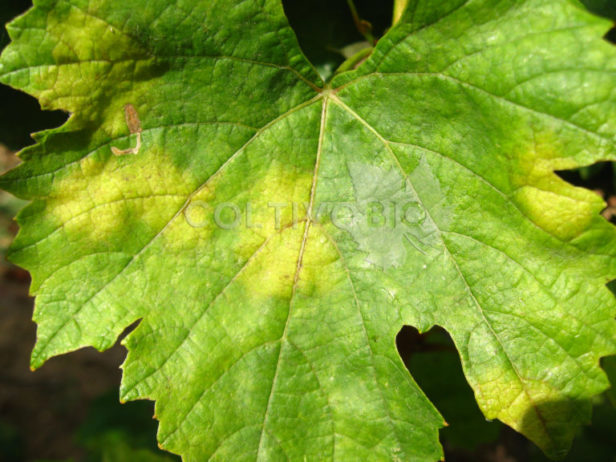
The symptoms of grapevine downy mildew are quite characteristic. On the upper leaf surface, yellowish, translucent, and more or less circular spots can be observed (see photo below). These lesions are commonly referred to as “oil spots.”
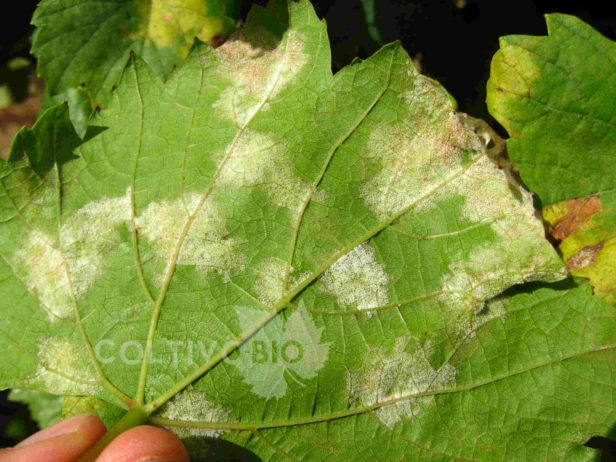
On the lower leaf surface, directly beneath the oil spots, a white mildew develops (see photo below). This growth consists of the pathogen’s asexual reproductive structures. Eventually, the lesions become necrotic. In rare cases, the white mildew may appear without visible oil spots, or vice versa.
In other cases, leaf infections may appear as a mosaic pattern, with numerous small yellow spots scattered across the leaf blade that later become necrotic (see photo below). This symptom is typical of late-season infections occurring in older leaves and is commonly referred to as mosaic downy mildew.

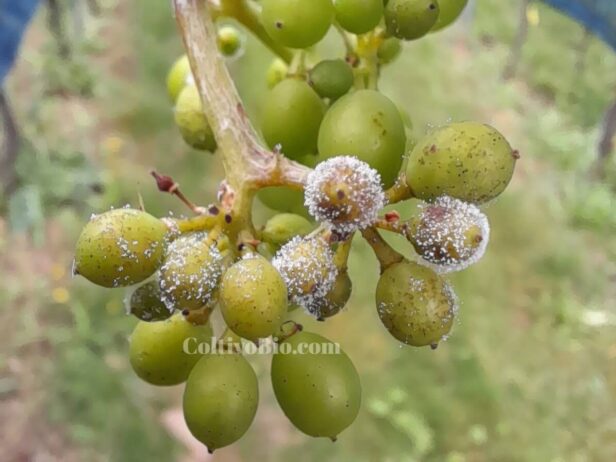
Affected inflorescences become covered with white mildew, which may eventually lead to the necrosis of the entire flower cluster (see photo below). In other cases, only the tip of the inflorescence is affected, becoming hooked and brown before being covered by white mildew.
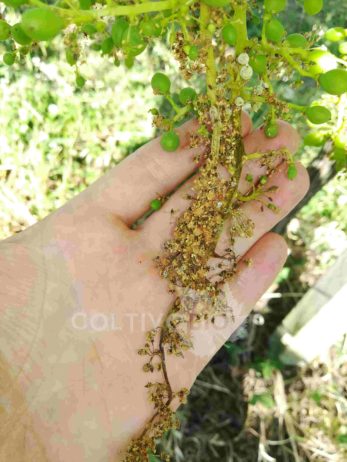
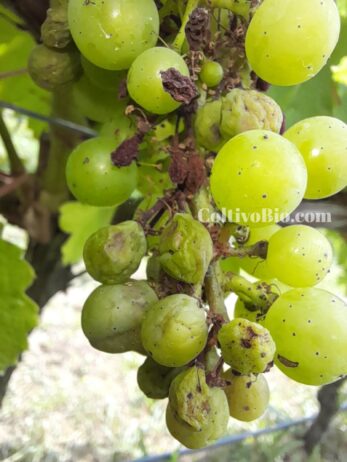
After fruit set, the pathogen begins attacking young grape clusters. In this case, the disease is referred to as brown rot phase or latent downy mildew (see photo below). Symptoms include browning, dehydration, and partial or complete drying of the cluster, resulting in the necrosis of individual berries. At this stage, the typical white sporulation is often absent because the stomata on the berry surface become non-functional as the berries develop. As a result, Plasmopara viticola continues to grow and spread internally within the cluster tissues without producing the characteristic white mildew visible on leaves and young berries. This form of the disease is much more damaging than leaf infections because it directly affects the developing fruit and can significantly reduce yield and fruit quality.
Biological cycle of grapevine downy mildew
The pathogen overwinters as a sexual spore (oospore) within infected crop residues, particularly fallen leaves.
Oospore germination occurs in spring when specific environmental conditions are met. These conditions are commonly known as the Rule of Three Tens:
- Temperature of at least 10°C (50°F)
- At least 10 mm of rainfall within 48 hours
- Shoots at least 10 cm long
The biological cycle begins with oospore germination and the production of zoosporangia (sac-like structures) containing zoospores. Zoospores are motile, flagellated asexual spores capable of swimming in water.
Transported by rain and wind, zoospores reach grapevine leaves and move through water films toward the stomata using their flagella. Once there, they germinate and initiate the primary infection.
The germinating zoospores produce mycelium that colonizes the intercellular spaces of plant tissues. Specialized feeding structures known as haustoria are formed, allowing the pathogen to extract nutrients from host cells.
As the pathogen develops, sporangiophores emerge on the lower leaf surface, forming the characteristic white mildew. These structures produce zoospores that give rise to secondary infections. This process continues throughout the growing season, generating numerous infection cycles.
In autumn, the pathogen differentiates male (antheridium) and female (oogonium) sexual organs. Their fusion results in the formation of overwintering oospores, which survive until the following season and restart the disease cycle.
Organic control of grapevine downy mildew
Agronomic control measures alone are not sufficient to manage grapevine downy mildew, but given the severity of the disease, they play an important role in reducing damage. Organic disease management combines cultural practices with approved plant protection products.
The most effective agronomic practices include:
- Removal of abandoned vineyards to reduce pathogen inoculum in the growing area.
- Proper pruning and suitable training systems to improve air circulation and reduce humidity within the canopy.
- Balanced nitrogen fertilization to avoid excessive vegetative growth and facilitate canopy management.
- Careful site selection, avoiding poorly drained areas prone to waterlogging.
- Whenever possible, removal of infected crop residues to reduce overwintering inoculum.
For organic treatments, preventive copper applications remain the cornerstone of disease management. Copper sprays should begin when conditions favorable to infection occur (Rule of Three Tens) and continue at regular intervals of approximately 7–10 days.
At present, copper-based products remain the most effective tools available in organic viticulture for downy mildew control. Their efficacy can be enhanced by integrating other products such as:
- Copper peptides (with attention to possible phytotoxicity)
- Sodium or potassium silicate
- Chitosan, which stimulates the plant’s natural defense mechanisms
Scientific literature has also reported the effectiveness of the antagonistic bacterium Bacillus subtilis, for which commercial formulations are available in several countries.
Finally, it should be remembered that foliar products based on brown seaweed contain laminarin, a molecule capable of inducing resistance against plant diseases.
In conventional agriculture, several active ingredients are available, each with different levels of curative, eradicant, and protective activity. Among the most important active ingredients used against grapevine downy mildew are:
- Metalaxyl-M (Mefenoxam)
- Oxathiapiprolin
- Dimethomorph
- Mandipropamid
- Mancozeb
- Cymoxanil
The choice of active ingredient depends on disease pressure, the stage of crop development, resistance management strategies, and local regulations.
Most common fungicides available online
- Copper: https://amzn.to/4gpw9ij
- Bacillus subtilis: https://amzn.to/4vhK6DH
- Chitosan: https://amzn.to/43FYAB3