

Rose downy mildew is a disease caused by the fungus Peronospora sparsa. Under favorable climatic conditions, this disease can cause severe damage to rose cultivation and may also affect blackberry and raspberry. In this technical guide we will examine the symptoms, biological cycle, and control methods for rose downy mildew.
What is rose downy mildew
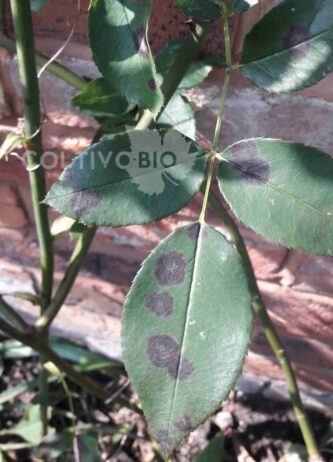
Rose downy mildew is a plant disease caused by the fungus Peronospora sparsa, which attacks cultivated roses and several plant species belonging to the genus Rubus, such as blackberry and raspberry. It is one of the most difficult rose diseases to diagnose because it is often confused with another disease called rose black spot (see technical sheet), caused by a different fungus, Diplocarpon rosae.
For an experienced plant pathologist, like the author, identification is not difficult; however, less experienced observers often encounter significant difficulties. The confusion is so common that many online articles about rose downy mildew display incorrect images, showing black spot instead. To avoid confusion, the images presented here are taken from a scientific publication published in 2018 in the journal Plant Disease by university researchers (the link to the publication is provided at the end of the article).
The difficulty in identifying rose downy mildew lies in the fact that symptoms develop differently depending on the rose species and varieties grown. This results in a wide range of symptoms. In most cases, damage appears on leaves, although it may also occur on stems and flower buds.
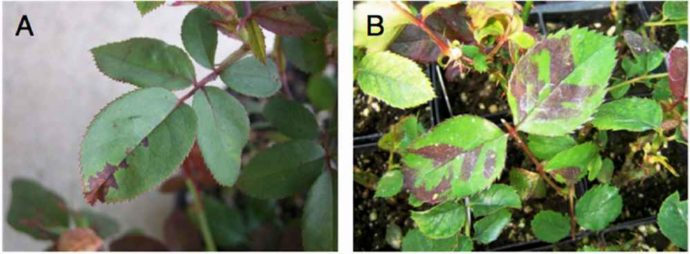
Rose downy mildew is characterized by the formation of necrotic spots on leaves, with colors ranging from purple-red to brown or black. The spots may sometimes be surrounded by a halo of discoloration. Occasionally, especially at the beginning of the disease, the entire leaf or only part of it becomes paler in color. Early symptoms may therefore be mistaken for nutrient deficiencies.
The key element for correctly identifying rose downy mildew and distinguishing it from rose black spot is the shape of the necrotic lesions. In Peronospora sparsa, the spots are always angular and squared, and most often confined between the main leaf veins (see photos A and B below). In black spot, however, lesions are circular with irregular margins and tend to overlap as the disease progresses. Unlike downy mildew, black spot lesions are never limited by leaf veins.
Rose downy mildew can also appear on stems, causing irregular necrotic lesions. On younger stems, it may lead to rapid dieback. On buds and petals, symptoms may appear as tissue drying (see images below).
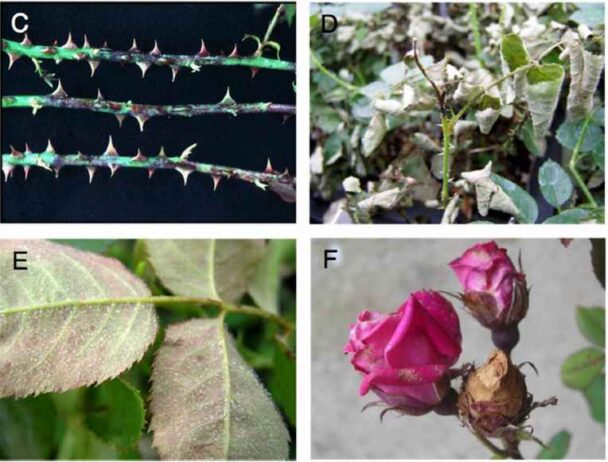
Under conditions of high humidity (above 85%), a grayish mycelial growth may be visible on the underside of leaves, indicating sporulation and confirming the presence of the pathogen. In truth, sporulation of rose downy mildew is relatively rare compared with other downy mildews. In severe infections, leaves affected by Peronospora sparsa fall prematurely, leaving stems and buds deformed and resulting in poor flowering.
Biological cycle of rose downy mildew
In its biological cycle, Peronospora sparsa overwinters as oospores (survival structures) in plant crevices or crop residues. High environmental humidity is essential for this fungus, which explains why the most severe infections are often observed in protected cultivation (greenhouses).
Under ideal conditions, oospores germinate and release zoospores into the environment, initiating new infections. Zoospore germination begins above 18 °C. These spores generate multiple infection cycles, as they are produced not only from oospores but also from sporangiophores formed on the underside of infected leaves (visible as grayish mold).
Control and treatment of rose downy mildew
The best strategy against rose downy mildew is agronomic prevention. Through proper cultivation practices, the disease can be partially contained. Recommended practices include:
- Destroying infected pruning residues
- Avoiding overly dense plant training systems
- Replacing overhead irrigation with localized irrigation and/or sub-irrigation
- Especially in greenhouses, preventing excessive humidity by ensuring adequate air circulation
Treatment of rose downy mildew mainly relies on the use of copper salts, applied at the first appearance of symptoms and followed by additional treatments according to the instructions on the commercial product label.
The cited scientific article (in English):
https://apsjournals.apsnet.org/doi/full/10.1094/PDIS-12-17-1968-FE