

Rose black spot is one of the most common diseases affecting roses. In this technical guide we will discuss how to prevent it and which natural products can be used as effective remedies.
Symptoms and damage of the disease
Rose black spot is a disease caused by the fungus Diplocarpon rosae (sexual stage); the asexual stage of this fungus is also known as Marssonina rosae. This fungus has the rose as its only host and is distributed worldwide. Rose black spot is one of the most common rose diseases and is easy to recognize, although inexperienced observers may confuse it with rose downy mildew (see here). Do not worry, in this technical sheet you will learn how to distinguish between the two diseases.
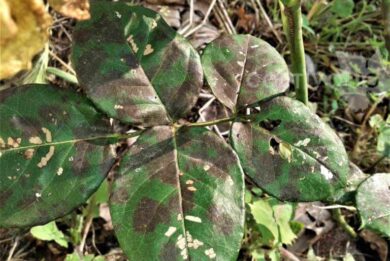
Rose black spot appears characteristically on leaves with the formation of rounded spots with irregular margins. These spots are coal black or sometimes dark gray (see Figure 1). When observed even with the naked eye, the spots may often show a network of veins radiating from the center outward. At the beginning of the disease, the spots are only a few millimeters in diameter but rapidly enlarge until they overlap and invade large portions of the leaf surface. In advanced infections, the spots can exceed one centimeter in diameter. As symptoms progress, leaves begin to lose their color, especially in areas where spots are concentrated (see Figure 2).
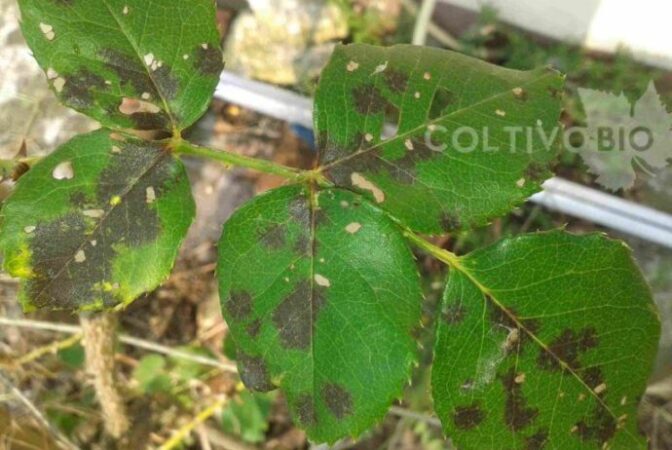
Eventually, when the leaf surface is heavily infected, leaves turn yellow and undergo premature leaf drop (defoliation). The disease may also appear on young stems, where lesions form as irregular necrotic spots. To avoid confusing rose black spot with rose downy mildew, it is important to observe the shape of the lesions. In downy mildew, spots are angular and squared, and they do not show radial branching inside (see Figure 3). Moreover, downy mildew spots are generally confined between the main leaf veins.
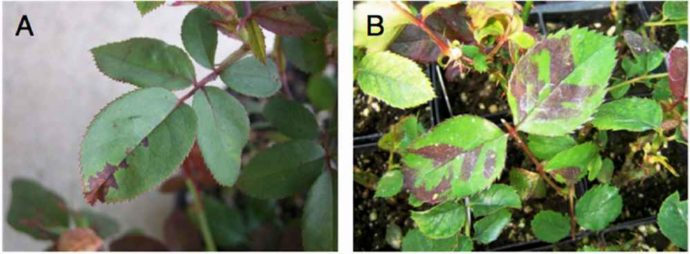
The most susceptible rose varieties may become completely defoliated by black spot. In any case, the disease weakens the plant and reduces flowering.
Life cycle of rose black spot
Rose black spot overwinters in two ways: inside fallen leaves or within lesions on stems. In spring, rising temperatures reactivate the fungus, which begins producing conidia or ascospores. These spores are spread by wind or rain, reach leaf surfaces, germinate, and invade rose leaf cells.
As the fungus colonizes rose tissues and forms the characteristic spots, it produces acervuli (microscopic fungal structures made of hyphae) that generate asexual spores. Once released by wind or rain, these spores cause secondary infections. This process continues as long as environmental conditions remain favorable, especially under mild temperatures and humid weather.
On fallen leaves, the fungus develops structures called pycnidia, which contain asexual spores. The pycnidia overwinter in leaf debris and release spores at the beginning of the following spring, initiating a new infection cycle.
As mentioned earlier, the sexual stage, scientifically known as Marssonina rosae, may also occur. This is a rare event and involves the formation of microscopic reproductive structures called apothecia, which contain fertile cells known as asci. Inside the asci are ascospores, the sexual dissemination organs of the fungus. Once these reach rose leaves, they start a new disease cycle.
How to treat rose black spot
In this section we will examine natural remedies available to prevent and control rose black spot. Prevention is the main strategy to avoid severe damage. Recommended agronomic prevention measures include:
- Regularly remove infected plant parts and burn or dispose of them away from the garden.
- Collect fallen leaves to reduce pathogen inoculum; burn or remove them from the area.
- Avoid overhead irrigation, as it promotes infection. Avoid wetting the foliage.
- Prefer localized irrigation systems; when not possible, avoid splashing soil onto basal leaves, since soil may contain fungal spores.
- Plant roses in open, sunny locations with good air circulation; avoid shaded or enclosed areas.
- Provide balanced fertilization, avoiding excessive nitrogen, which can favor pathogen development.
- Choose rose varieties with genetic tolerance to black spot whenever possible.
The main products used against rose black spot are copper salts. Copper-based plant protection products are easy to apply and provide good preventive protection. Treatments should be applied regularly every 7–10 days.
Another natural product with a secondary effect in limiting black spot development is sulfur. Sulfur treatments also protect roses from another disease, powdery mildew. However, sulfur alone is not sufficient to control black spot and should always be combined with copper treatments.
Finally, the antagonistic bacterium Bacillus subtilis can be used as a preventive measure. This bacterium is naturally present in soils and, when sprayed on plants, acts as a natural competitor against Diplocarpon rosae. Some products based on this bacterium are registered for use on ornamental plants, registered formulations are available in other countries.