

The large rose sawfly is an insect that damages roses, both in its larval and adult stages. In this technical guide, we will look at how to eliminate sawfly infestations and which insecticides can be used as remedies. At the end of the article you will find a list of commercial organic insecticides for controlling the large rose sawfly.
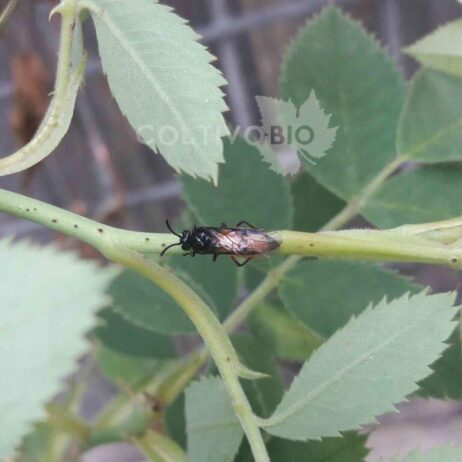
Adult of lerge Rose Sawfly
Identification and damage
The sawfly is an insect belonging to the order Hymenoptera. Under the common name “large rose sawfly,” two distinct species are identified: Arge rosae and Arge pagana. Both cause the same type of damage, so they will be discussed together.
The insect appears toward the end of spring, and adults can be seen moving around rose plants while laying eggs. Adult sawflies are easy to recognize, even for non-experts. The adult vaguely resembles a black wasp (see Figure 1), with a yellow-orange abdomen and transparent wings. Specifically, Arge rosae has not only a yellow-orange abdomen but also a thorax and legs of the same color. Arge pagana is entirely black except for the abdomen (see Figure 2).

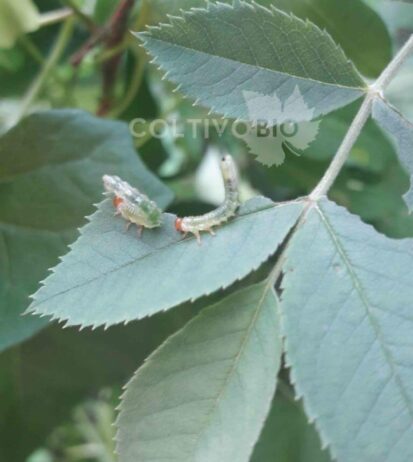
The most important aspect of this insect is the damage caused by both the larvae and the egg-laying activity of the adult. The larvae are heavy leaf feeders and have a gregarious habit, meaning many individuals may be present on the same leaves. Adults create wounds with their ovipositor (called a “saw” in this type of insect), cutting into young stems and twigs and laying eggs inside.
These egg-laying injuries deform the affected tissues and, in severe cases, can dry them out completely, killing young branches and reducing flowering. The larvae are often confused by non-experts with rose sawflies (another species that damages roses). Identification is simple: large rose sawfly larvae feed starting from the edges of the leaves and move toward the center, often leaving only the central vein intact (see Figure 3). Rose sawflies, on the other hand, usually stay on the underside of leaves and create holes, giving a perforated appearance.
Biological cycle of the large rose sawfly
At the beginning of spring, larvae that have pupated in the soil or plant debris emerge as adults, producing the first generation. In some cases, the sawfly overwinters as a mature larva and pupates when temperatures rise.
Adults lay eggs on young shoots, causing the damage described above. The larvae pupate in summer, producing a second generation. Unlike Arge rosae, Arge pagana completes a third cycle. In short, Arge rosae has two generations, while Arge pagana has three.
You may also be interested in our technical guide on: “how to eliminate powdery mildew on roses.”
How to eliminate large rose sawflies using natural remedies
Prevention is certainly the most effective weapon against this insect. It is important to carry out visual inspections at least twice a week, checking roses for adult insects and signs of egg-laying damage. The presence of adults among the leaves indicates a future attack.
If branches showing fresh egg-laying marks are found, they should be removed through pruning to prevent egg hatching. When larvae are present on leaves, they can be removed manually if numbers are low; alternatively, a pyrethrum-based insecticide can be sprayed. White oil (horticultural mineral oil) also has some effectiveness against sawfly larvae, but only on younger ones. Ideally, where possible, a mixture of pyrethrum and horticultural oil can be used to enhance the effectiveness of pyrethrum.
Formulations based on spinosad are generally effective against sawfly species. This means that using this active ingredient on roses to control thrips or leaf miners may have a side effect of controlling sawflies as well.
Insecticides and natural remedies to eliminate sawflies
- Concentrated pyrethrum
- Mineral oil