

The vegetable or cotton leafworm is a common insect pest that attacks many vegetable crops, causing serious damage to product quality. In this technical sheet we will examine which natural remedies can be used to control Spodoptera littoralis in organic agriculture.
Description and damage of the vegetable leafworm
Spodoptera littoralis (Boisduval) is commonly known as the Egyptian cotton leafworm or vegetable armyworm. The larva of this lepidopteran can attack several plant species, including tomato, pepper, lettuce, potato, strawberry, maize, cotton, and cruciferous crops (cabbage, cauliflower, broccoli).
The adult is a nocturnal moth with a wingspan of about 3–4 cm, with a velvety appearance due to dense hair coverage. The dorsal side is brownish and marked with patterns and spots in white, hazel, and black. Adults do not cause damage; the damage is caused by the larvae.
Larvae show variable coloration depending on the host plant they feed on, ranging from grey to green and yellowish. However, all larvae are characterized by dark longitudinal stripes and triangular-shaped black spots on the sides (see Figure 1).
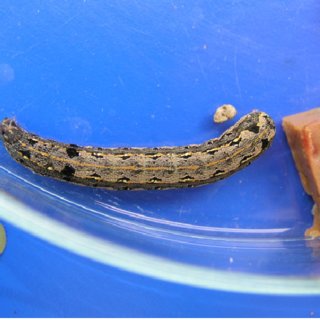
Eggs are laid in clusters (egg masses) that may contain up to 100 eggs, characteristically covered with hairs released by the ovipositing female. Newly hatched larvae initially show gregarious behavior but tend to become solitary as they grow.
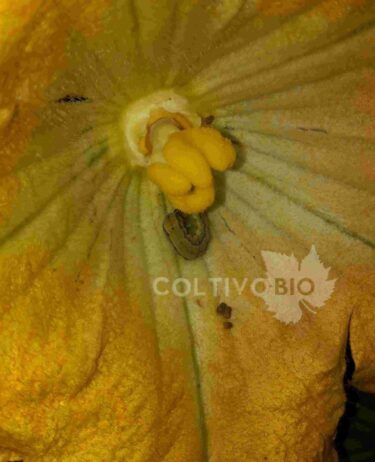
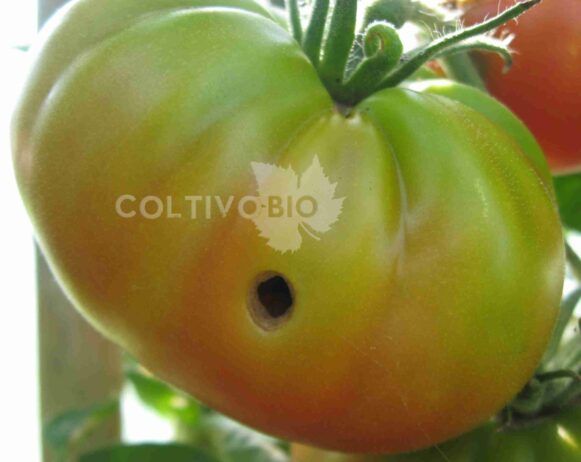
Larvae feed on leaf tissue and may also damage flowers (see Figure 2). However, the most economically significant damage occurs on tomato, pepper, and eggplant fruits. Larvae bore tunnels inside the fruits (see Figure 3), which may lead to rotting caused by secondary pathogens, or they may escape quality controls and reach consumers hidden inside the fruit.
Damage is particularly severe on lettuce, savoy cabbage, and cauliflower, where even a single mature larva penetrating the inner leaves can render the entire plant unmarketable.
Less experienced growers may confuse this damage with that caused by Tuta absoluta, from which it differs due to the larger size of the larvae and the exit holes on tomatoes. These holes are larger than 2 mm in diameter, with clean and regular edges (see Figure 3). Damage caused by Tuta absoluta almost always leads to rotting or softening of the fruit flesh with liquid leakage, whereas Spodoptera causes dry feeding damage with hollowing of the central pulp.
Biological cycle of the vegetable leafworm
Larvae of Spodoptera littoralis pupate in the soil at shallow depth, where they can overwinter. Adult emergence begins in March–April, followed shortly by egg laying. The number of generations per year depends on temperature and is higher in protected environments such as greenhouses. Under ideal conditions, up to nine generations may occur by late summer in southern Italy.
Control and natural remedies against Spodoptera littoralis
In organic pest management, it is essential to monitor adult flights using sex pheromone traps. Once the onset of adult emergence is detected, careful field scouting should be carried out to identify early infestations or egg masses.
When the presence of larvae or eggs is confirmed, treatments should be applied. The most effective products are those based on Bacillus thuringiensis subsp. kurstaki, which are effective against early larval stages. In the presence of older larvae, natural insecticides such as pyrethrum extract or azadirachtin can be used. Products based on spinosad are also effective against this lepidopteran species.
Finally, it is worth mentioning the possibility of using another natural biotechnological remedy: entomopathogenic viruses. In Italy, the use of Spodoptera littoralis nucleopolyhedrovirus (SpliNPV) is registered. This virus is harmless to warm-blooded animals but lethal to the vegetable armyworm.
Entomopathogenic viruses act slowly (taking 2–4 days to kill their targets); therefore, they must be applied promptly to target newly hatched larvae. Treatments must be repeated over time due to staggered egg laying. If field monitoring and pheromone traps show negative results for an extended period, treatments may be suspended, but monitoring should continue, as infestations may resume with greater intensity toward the end of summer.