

Identification
The cotton bollworm, scientific name Helicoverpa armigera (synonym Heliothis armigera), is a lepidopteran belonging to the family Noctuidae.
It is a highly polyphagous insect, widespread throughout Italy and among the most dangerous pests of tomato cultivation. This species feeds on a wide range of plants, including maize, vegetables, and various ornamental crops.
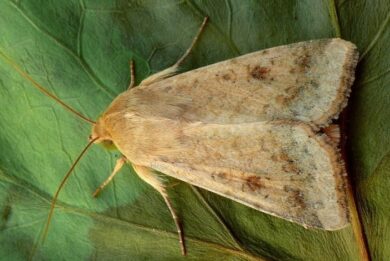
Adults are light hazel in color, with a spearhead-shaped resting posture and a body covered with fine hairs. The terminal portion of the wings is lighter, with a darker marginal band (see photo below). Adults can reach up to 40 mm in wingspan.
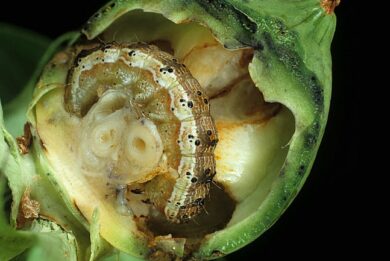
Larvae show great color variability, ranging from pale green to dark brown. A common characteristic is a lighter longitudinal band located just above the legs, extending along the entire body, and the presence of black dots, with at least one per segment (see photo below). This variability in coloration makes it difficult to distinguish the larva from other similar species.
Biological cycle
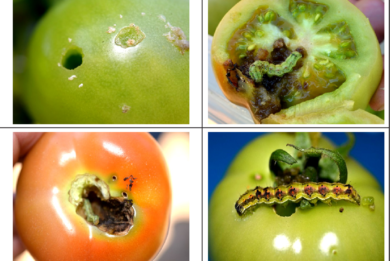
Newly hatched larvae feed on plant tissues such as leaves and stems. Later, they tend to bore into tomato fruits, where they seek shelter and increase in size (see photo below). Their ability to penetrate fruits is generally greater than that of Spodoptera littoralis, with which they may be confused.
Because of its tendency to attack fruits and its migratory capacity in certain years, the cotton bollworm can cause particularly severe infestations.
It can complete 2 to 4 generations per year, depending on temperature. The first egg-laying occurs simultaneously with tomato flowering. The time between adult emergence and the presence of the first larvae on plants is very short—about one week.
Less experienced growers may confuse the damage with that caused by Tuta absoluta. However, cotton bollworm damage differs in the larger size of the larvae and in the exit holes on tomatoes, which are usually larger than 3 mm in diameter, with clean and regular edges.
Damage caused by Tuta absoluta almost always results in rotting or softening of the pulp with liquid leakage. Helicoverpa (like Spodoptera) instead causes dry feeding damage with hollowing of the central pulp of the fruit. Suspected fruits can be cut open with a knife to check for larvae inside.
Control and natural remedies
Both in organic and conventional farming, it is essential to monitor adult flight using sex pheromone traps. Cone-type traps are preferred, but Delta traps with sticky inserts are also suitable. Once the beginning of adult emergence is detected, careful field monitoring should be carried out to identify early infestations or egg-laying sites.
When the presence of larvae or eggs is confirmed, treatments should be applied. The most effective products are based on Bacillus thuringiensis subsp. kurstaki, which is effective against early larval stages. In the presence of older larvae, natural insecticides based on pyrethrum extract or azadirachtin can be used. The most effective active ingredient against this lepidopteran species is spinosad.
White horticultural oil insecticide (mineral or vegetable) may have a moderate effect on eggs and early larval stages.
Another biotechnological natural remedy is the use of entomopathogenic viruses. In Italy, the use of Helicoverpa armigera nucleopolyhedrovirus (HaNPV) is registered. This virus is harmless to warm-blooded animals but lethal to the cotton bollworm.
Entomopathogenic viruses act slowly (taking 2–4 days to kill their targets). Therefore, they must be applied promptly to target newly hatched larvae. Treatments should be repeated every 5–7 days, alternating active ingredients, since egg-laying generally occurs over an extended period. If field monitoring and trap data remain negative for a prolonged period, treatments may be suspended, but monitoring must continue, as infestations may intensify toward the end of summer.
Treatments against this pest are also effective against Tuta absoluta and Spodoptera littoralis.
Finally, the active ingredients mentioned perform best when the spray solution has a pH between 6 and 6.5, so it is good practice to acidify the insecticide solution.