

The southern green stink bug, scientifically known as Nezara viridula, is a plant-feeding insect belonging to the family Pentatomidae. Adults and nymphs attack many crops by piercing plant tissues and causing fruit deformation, discoloration, and internal damage. This article contains affiliate links. We may earn a commission from qualifying purchases.
What is the southern green stink bug?
In the United States, this species is commonly known as the southern green stink bug and is an important agricultural pest, particularly in warmer regions and the southeastern states. It can damage soybeans, cotton, vegetables, fruit, and nut crops.
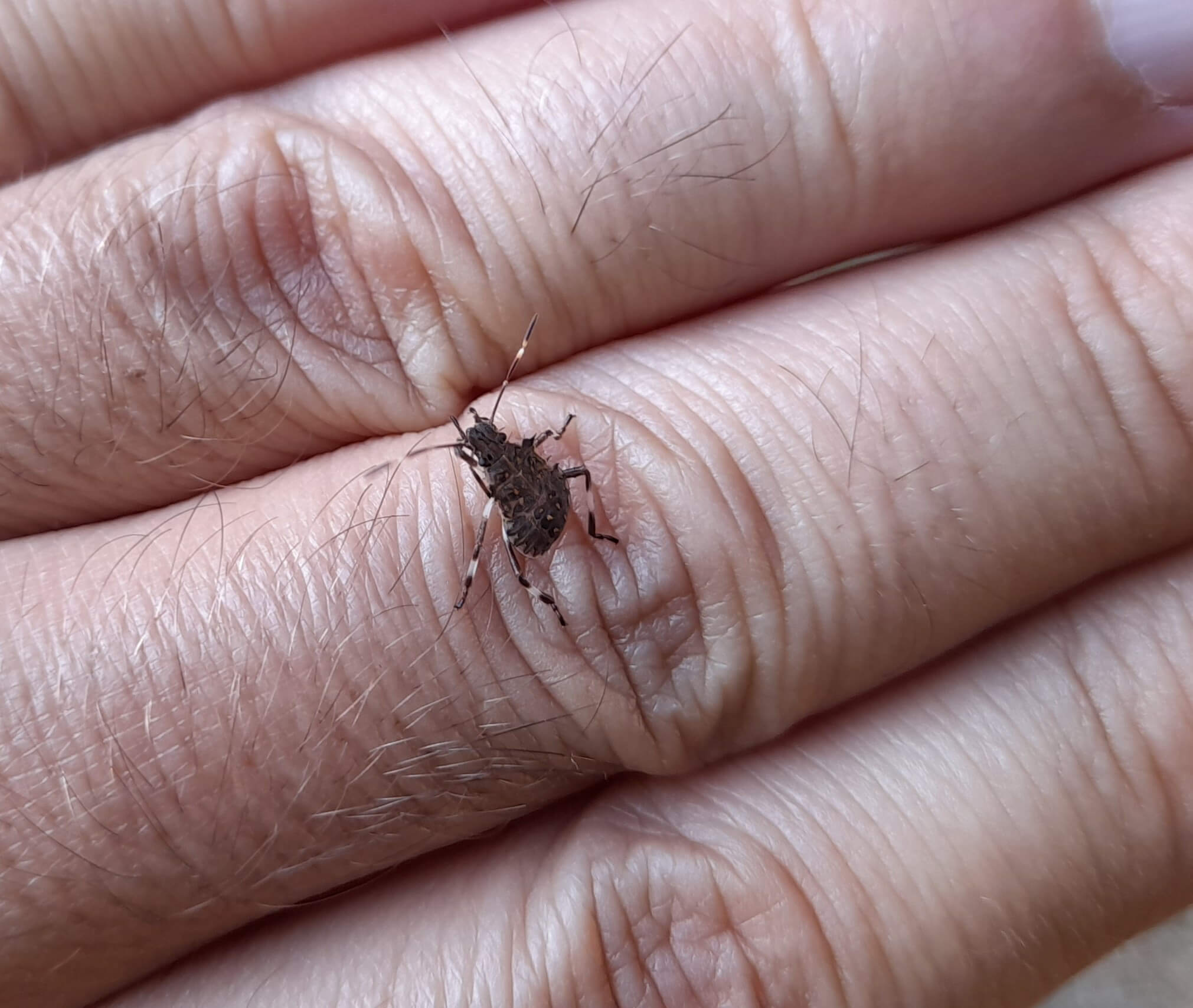
Its damage may occur alongside that caused by other plant-feeding stink bugs, including the now widespread brown marmorated stink bug (Halyomorpha halys). The two species may be present on the same crop and can sometimes be confused, particularly during their juvenile stages. Adult southern green stink bugs are predominantly uniform green, while brown marmorated stink bugs have a mottled brown coloration, pale bands on the antennae, and alternating light and dark markings along the edge of the abdomen.
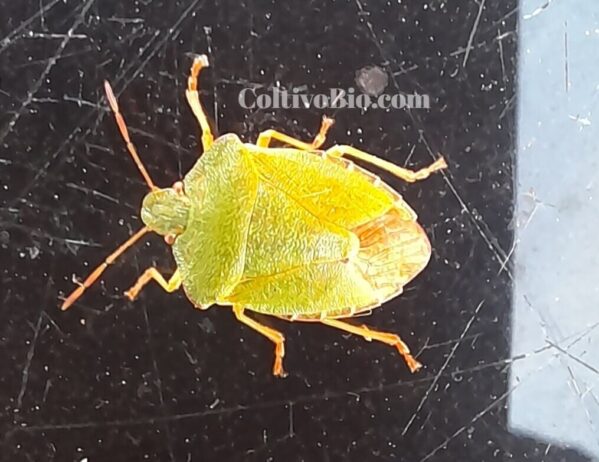
Southern green stink bug life cycle
The southern green stink bug generally overwinters as an adult, finding shelter among dry vegetation, in hedges, beneath tree bark, or inside buildings and other structures. As temperatures rise, adults leave their overwintering sites, begin feeding, and later mate.
Females lay orderly clusters of cylindrical, barrel-shaped eggs on the undersides of leaves. The eggs are initially white or yellowish and gradually change color as the embryos develop.
After hatching, the first-instar nymphs are initially reddish or orange. They remain grouped near the egg mass and do not yet cause significant damage at this stage.
Juvenile development consists of five nymphal instars. Beginning with the second instar, the nymphs start feeding on plant tissues. They are predominantly black, with white, red, orange, or green markings. With each successive molt, their coloration becomes increasingly green and the insects begin to disperse across the vegetation.
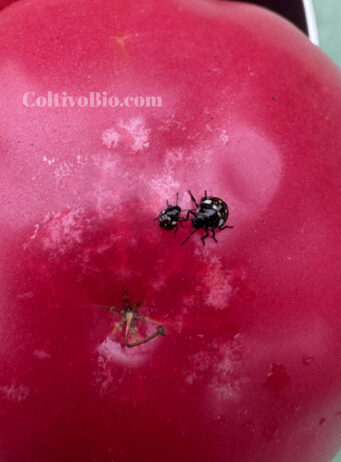
Development time and the number of generations produced each year depend mainly on temperature and food availability. Several generations may develop annually in regions with long, warm growing seasons, including many southern areas of the United States.
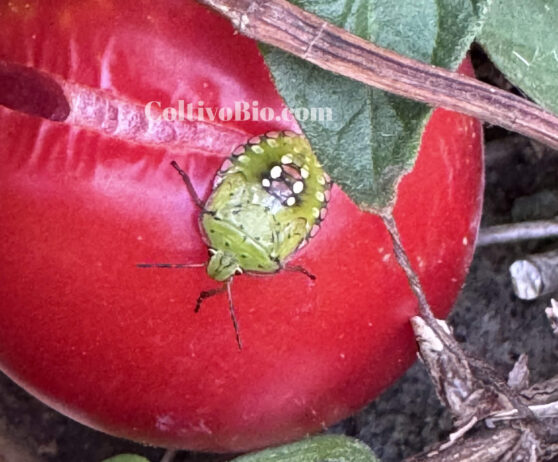
Host plants and damage
Nezara viridula is an extremely polyphagous species. The crops most frequently attacked include tomatoes, peppers, eggplants, beans, soybeans, corn, sunflowers, cotton, hazelnuts, pecans, and numerous fruit and ornamental plants.
Adults and nymphs have piercing-sucking mouthparts that they use to penetrate leaves, shoots, flowers, fruits, pods, and seeds. While feeding, they inject saliva containing substances and enzymes that damage and alter plant cells.
On fruit, feeding punctures may cause yellowish or whitish spots, surface depressions, deformation, and hardened or corky areas in the flesh. When feeding occurs during the early stages of fruit development, the affected fruit may become misshapen, stop growing, or drop prematurely.
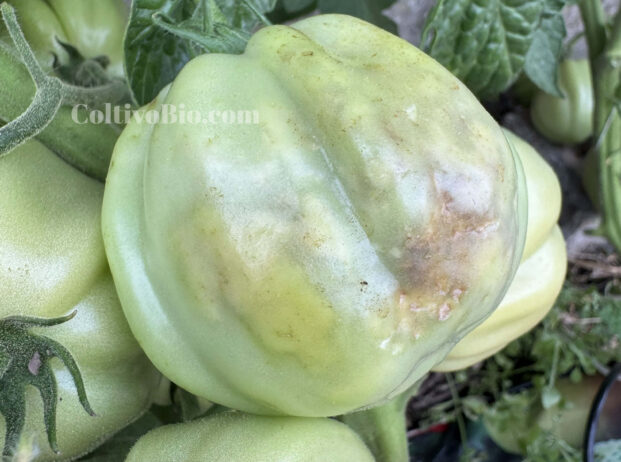
On tomatoes, discolored areas frequently develop beneath the skin, together with whitish, hardened tissue in the flesh. On beans, soybeans, and other legumes, feeding mainly affects pods and developing seeds, which may become empty, deformed, or underweight. Feeding punctures may also facilitate the entry of microorganisms responsible for decay and other secondary disorders.
Monitoring and prevention
Regularly inspect the undersides of leaves to detect egg masses as early as possible. In home gardens and on individual plants, egg masses can be removed manually before they hatch. Groups of young nymphs can also be eliminated relatively easily while they remain concentrated near the eggs.
Managing weeds and volunteer plants can reduce alternative food sources and breeding sites. Insect-proof netting is one of the most effective preventive measures, provided that it is installed before adults enter the crop and is kept completely intact and properly sealed.
Biological control and insecticides
The southern green stink bug is attacked by several natural enemies. One of the most important is Trissolcus basalis, a small parasitoid wasp that lays its eggs inside those of Nezara viridula, preventing the stink bug nymphs from hatching. This parasitoid is also known in the United States and has been widely studied as a biological control agent for the southern green stink bug.
Insecticides are generally more effective against juvenile stages, while adults are more difficult to control. Natural pyrethrum acts primarily through contact and provides rapid knockdown activity, while azadirachtin mainly has repellent and antifeedant activity, reducing insect feeding. Contact insecticides, particularly synthetic pyrethroids, are generally more effective and provide greater residual activity than natural pyrethrum. When applied promptly and with thorough spray coverage, they can provide effective control, especially against young nymphs.
Entomopathogenic fungi may also be used, but their effectiveness requires temperatures within the optimum range for the microorganism and high relative humidity for several hours. These conditions are more easily maintained in protected growing environments. During hot and dry summers, low humidity, intense sunlight, and excessive temperatures can significantly reduce their effectiveness.
Because these products act mainly through contact, the spray must directly reach the stink bugs and provide thorough, uniform coverage of the vegetation.
The best time to intervene is immediately after the eggs hatch, when the nymphs are still young, grouped together, and relatively inactive. Adults are more difficult to control and may quickly recolonize the crop from surrounding vegetation.
In the United States, pesticide registrations vary by state and crop. Only use products registered by the Environmental Protection Agency and permitted in your state, and make sure the crop and target pest are listed on the label. Always follow the application rate, preharvest interval, maximum number of applications, and all other label directions.
Protecting crops with insect-proof netting
In commercial production, one of the most effective preventive strategies is the installation of insect-proof netting on greenhouses and high tunnels. When correctly installed and maintained, netting prevents southern green stink bugs from entering and can also exclude other damaging insects, including tomato leafminer (Tuta absoluta) in regions where this pest is present.
Doors, openings, and ventilation systems must also be protected. The mesh size should exclude the target pests without excessively restricting airflow and increasing temperature or humidity inside the structure.
In home gardens, completely covering the crop can be more difficult and expensive. On tomato plants, individual fruit clusters can instead be enclosed inside breathable mesh bags secured carefully around the stem.
The mesh must be fine enough to exclude stink bugs and should not rest directly against the fruit, preventing the insect from reaching it with its piercing-sucking mouthparts. The bags must also provide adequate air circulation to prevent excessive humidity and condensation.
Insecticides and products available online
- Pyrethrin insecticide: https://amzn.to/4xJYcPB
- Pyrethroid insecticide: https://amzn.to/4eoWmMG
- Neem oil insecticide (azadirachtin): https://amzn.to/3T8nM1v